

 %
%
 %
%
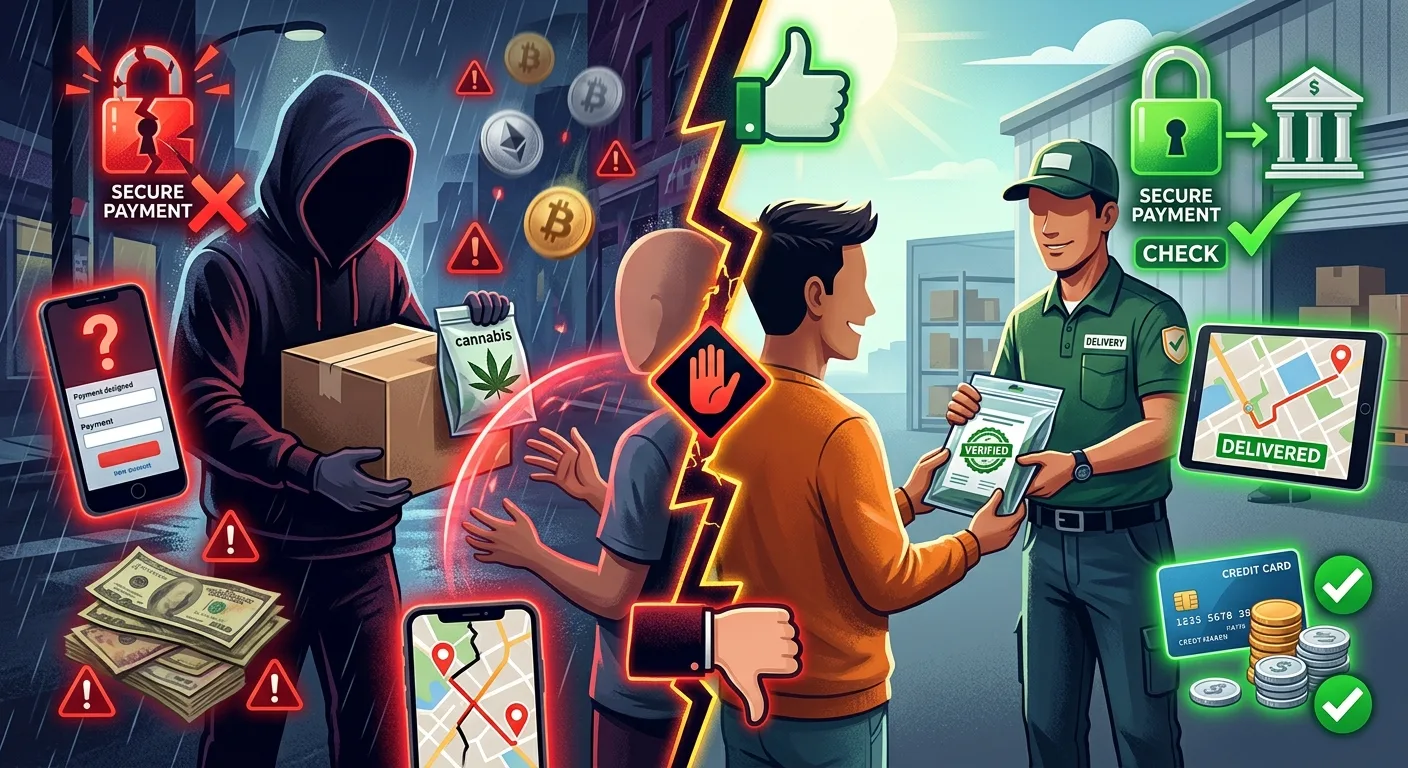
Canadian cannabis moves largely through mail-order services, and that model has a structural weakness: you pay before you receive anything, usually by a method that's difficult to reverse, to a business you may have found ten minutes ago.
Most of these services are real. Some are not, and the fake ones are designed to look exactly like the real ones, because the template is cheap and the photographs are stolen from legitimate stores.
The reassuring part is that scam operations have consistent tells. They have to, because the business model requires getting money from strangers quickly and then disappearing, and that constraint shows up in how the site is built, what payment methods it accepts, and how it behaves after you've paid. Almost all of it is visible before you send anything.
The Payment Tells
This is the fastest filter and it catches most of them.
What Legitimate Canadian Services Accept
Interac e-Transfer, sent from your own online banking to an email address. Cash on delivery, where local delivery exists. That's essentially the list, and the reason is covered in our payment guide: the card networks won't service the sector, so the industry runs on bank transfers.
What Should Stop You
Cryptocurrency only. Some legitimate businesses accept crypto as an option. A site that accepts nothing else has chosen the one payment method that's completely irreversible and untraceable. That's a deliberate choice and it isn't made for your benefit.
Gift cards. No legitimate business asks for payment in retail gift cards. None. If a site or a "support agent" asks you to buy gift cards and send the codes, the transaction is a scam with no exceptions.
Wire transfer or money transfer services. Western Union and similar for an online retail purchase is not normal.
A personal name on the e-Transfer that changes between orders. Legitimate operations use a consistent payment address. An address that's different every time, or that's clearly a random individual, suggests money being routed through mule accounts.
Requests to send as "friends and family" on any platform that offers buyer protection. That's explicitly asking you to waive your recourse.
The Second-Fee Trick
The most common scam in this market, and it's worth recognising by name.
You order. You pay. Then a message arrives saying the package has been held, and there's an additional charge to release it: customs, insurance, a border fee, a handling charge, a "verification deposit." Pay that and another appears. Sometimes several.
Legitimate domestic shipping within Canada does not generate surprise fees after payment. There are no customs charges on a domestic parcel. There is no insurance payment required to release a package.
Once you see this, the money already sent is gone, and the only decision left is whether to send more. Don't.
The Site Tells
Pricing That Doesn't Make Sense
Cannabis has real production and shipping costs. A site advertising premium flower at a fraction of what everyone else charges isn't more efficient; it's either not sending anything, or sending something that isn't what was pictured.
Our price guide covers realistic ranges. If a listing sits far below the bottom of the market across the whole menu, treat it as the warning it is.
Stolen Photography
Scam sites rarely photograph anything. Reverse image search a product photo. Drop the image into Google Lens or a reverse image tool and see where else it appears. Finding the same picture on twenty unrelated cannabis sites tells you plenty.
Watch also for photographs that don't match the described product: American packaging on a Canadian listing, clearly different strains under different names, or professional studio shots that don't match the rest of the site's quality.
No Real Contact Information
Look for a phone number, a business email, and a physical point of contact. A contact form alone, with nothing else anywhere on the site, is a deliberate choice.
Test it before ordering. Send a question and see whether a human answers, how fast, and whether the answer is specific. That exchange costs nothing and tells you a great deal.
A Brand New Domain
Check how long the site has existed. Domain registration lookups show creation dates, and the Internet Archive shows whether the site existed a year ago.
A cannabis site registered three weeks ago with a full menu, hundreds of reviews and a loyalty programme is claiming a history it doesn't have.
Reviews That Arrive in a Burst
Dozens of five-star reviews posted within a few days, written in similar voice, with no specifics and no middling ratings. Real review profiles accumulate gradually, vary in quality, and include complaints.
Check for discussion of the site somewhere the operator doesn't control. Community forums and regional subreddits are generally more informative than on-site testimonials.
Pressure Mechanics
Countdown timers, "3 people are viewing this," stock warnings that never resolve, and discounts that expire in minutes. Legitimate retailers use some of this too, which is why it isn't conclusive on its own. Heavy use of all of it, combined with anything else on this list, is.
Missing Basics
No age verification. Every legitimate Canadian cannabis site gates for 19+.
No shipping or refund policy. Or a policy that's a single vague paragraph.
No terms of service, or copy-pasted terms referencing a different company or a different country.
Broken pages throughout. Links that go nowhere, placeholder text, categories with no products.
Requests for Documents Up Front
Legitimate services verify age at delivery, or through a standard check. A site asking you to upload a photo of your driver's licence or passport before you've ordered anything is collecting identity documents, and you should consider why.
Quick Reference
| Signal | Severity | What it means |
|---|---|---|
| Gift cards accepted | Stop | Always a scam, no exceptions |
| Crypto only, nothing else | Stop | Chosen for irreversibility |
| Fee demanded after payment | Stop | Advance-fee scam in progress |
| ID documents requested up front | Stop | Identity collection |
| Prices far below market everywhere | High | Not sending what's pictured |
| Photos found across many sites | High | Nothing is theirs |
| Domain under a few months old | High | No history to match the claims |
| No contact details at all | High | Nobody to reach afterwards |
| Review burst, all five star | Moderate | Fabricated social proof |
| No age gate | Moderate | Not operating like a real seller |
| Heavy countdown pressure | Low alone | Weighs more alongside others |
What a Real Service Looks Like
For balance, the positive signals:
A consistent e-Transfer address that doesn't change order to order, usually with auto deposit enabled.
Tracking on mail orders, provided without having to chase it.
A contact channel that answers, with specific rather than scripted replies.
Inventory that behaves like inventory — things sell out, restock, and change seasonally.
Product photography that matches what arrives, and descriptions specific enough to be falsifiable.
Batch or testing information where available. Our guide on how to read a lab report covers what to look for.
No urgency about payment. A business that wants a long-term customer isn't rushing you through checkout.
Protecting Yourself on a First Order
Place a small first order. The cost of testing a new service with a minimum order is far lower than the cost of discovering a problem with a bulk one.
Keep everything. Order confirmation, payment confirmation, screenshots of the listing and all correspondence.
Use your bank's own e-Transfer interface, never a payment link sent to you.
Verify the address against your current confirmation rather than a saved contact from a previous order.
Never send a second payment to release a package. That request is the scam, not a complication in it.
If It's Already Happened
Contact your bank immediately. Completed e-Transfers are difficult to reverse, particularly with autodeposit, but speed matters and it's the first call to make.
Report it. The Canadian Anti-Fraud Centre collects reports, and reporting contributes to pattern detection even when individual recovery isn't possible.
Don't pay anything further. Not to release a package, not to "verify" your account, not to a recovery service that contacts you afterwards offering to get your money back for a fee. That last one is a second scam that specifically targets people who fell for the first.
Document it publicly where the community will see it. Regional forums are how these operations get identified.
Our ordering process and contact page are both reachable from any page here, and weed delivery Ottawa covers delivery zones and how local orders work.
Frequently Asked Questions
Check the payment methods first. Interac e-Transfer and cash on delivery are normal; gift cards are always a scam and crypto-only is a deliberate choice of irreversibility. Then check domain age, reverse image search a product photo, look for real contact details, and send a question to see whether a human replies.
Because Visa and Mastercard are US-based and cannabis remains federally prohibited there, so the card networks apply restrictive policies to cannabis merchants worldwide regardless of local law. Canadian processors follow those rules, which leaves bank-to-bank transfers and cash as the practical options.
No. There are no customs charges on a domestic parcel shipped within Canada, and no legitimate service requires an additional payment to release an order after you've paid. This is an advance-fee scam, and paying will generate further demands rather than a delivery.
The mechanism is the same one Canadians use for rent and payroll, and the merchant never sees your banking credentials. The real risk is who you're sending to, since completed transfers are difficult to reverse. Verify the seller before the first order and use the address from your current confirmation.
Contact your bank immediately, since speed matters even though e-Transfers are hard to reverse. Report it to the Canadian Anti-Fraud Centre. Don't send anything further, including to anyone who later offers to recover your funds for a fee, which is a follow-on scam targeting people who were already defrauded.
Not always. Genuine value exists in bulk weights, compressed formats and budget tiers, where the per-gram economics are real. The warning sign is premium product at a fraction of market price across an entire menu, since that pattern reflects a site that isn't planning to ship anything.
The Short Version
Check the payment page before anything else. Gift cards are always a scam. Crypto as the only option is a choice made for irreversibility. A fee demanded after you've already paid is an advance-fee scam in progress, and paying it only generates the next demand.
Then spend two minutes on the rest: reverse image search a product photo, check how old the domain is, and send a question to see whether a person answers.
And make your first order a small one. The cost of testing a new service is always lower than the cost of finding out the hard way.