 %
%
 %
%
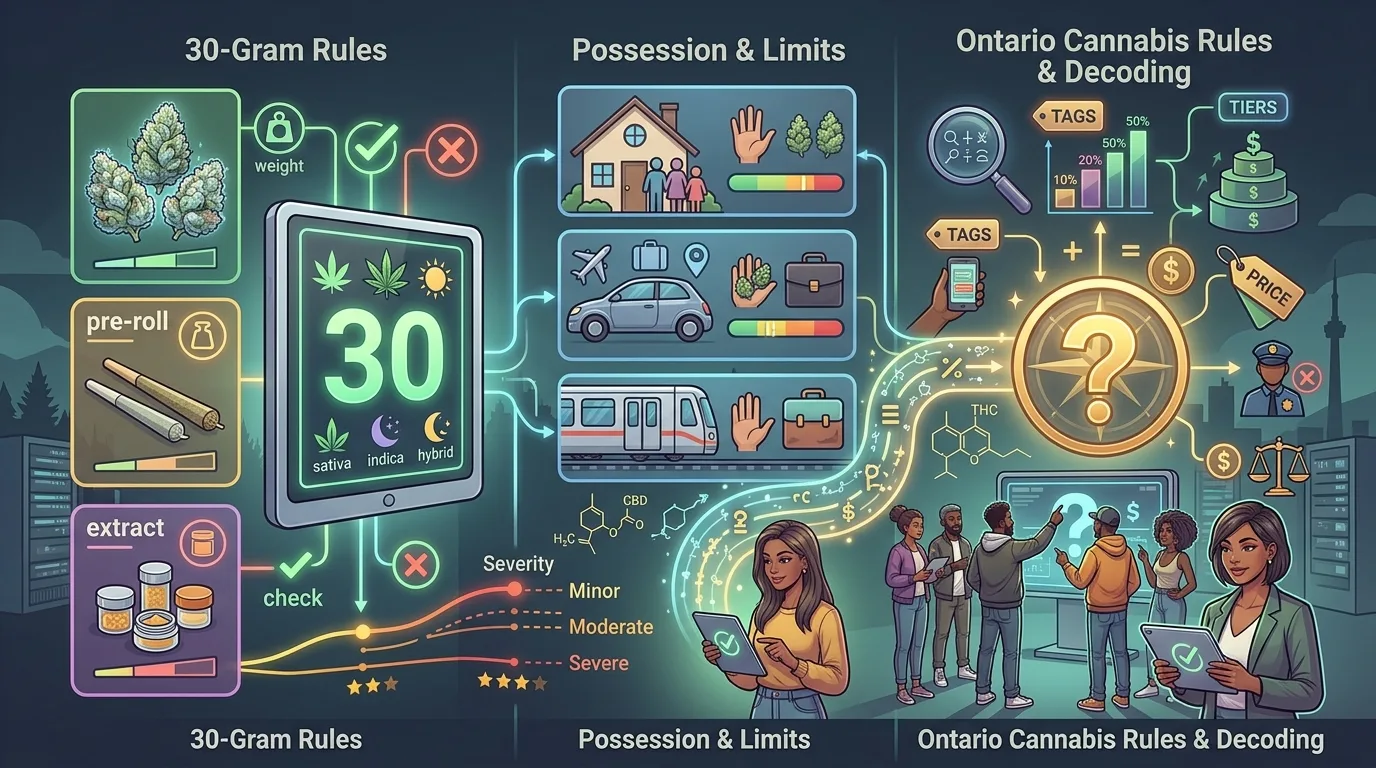
Most people know the number. Thirty grams of dried cannabis in public, anywhere in Canada. It's one of the few cannabis rules that genuinely entered common knowledge.
What almost nobody knows is that the limit isn't measured in grams of product. It's measured in grams of dried cannabis equivalent, and there's a federal conversion table that translates every other format into that unit. Under it, concentrates count at four times their actual weight.
That single detail catches people out. Three 3-gram vapes weigh nine grams and look like nothing, and they put you over the public limit on their own. Meanwhile nearly half a kilogram of edibles sits comfortably under it. The intuitive assumption, that heavier means closer to the limit, is close to backwards.
Here's how the table actually works, what the realistic thresholds are for each format, and where the rules differ between being out in public and being at home.
The Rule Itself
Adults 19 and over in Ontario may possess a maximum of 30 grams of dried cannabis, or the equivalent in other formats, in public at any time.
Two words carry the weight. "Public" means outside a private residence, which includes a vehicle. "Equivalent" means other formats get converted before they're counted.
The Equivalency Table
This is set federally and applies across Canada. One gram of dried cannabis is treated as equal to:
| Format | Equal to 1g dried |
|---|---|
| Fresh cannabis | 5 g |
| Edible product | 15 g |
| Liquid product | 70 g |
| Concentrates, solid or liquid | 0.25 g |
| Cannabis plant seeds | 1 seed |
The concentrate line is the one that matters. A quarter gram of concentrate is treated as a full gram of flower, which means concentrates count at four times their weight.
What 30 Grams Actually Looks Like
Flipping the table gives you the practical ceiling for each format if you were carrying only that format:
| Format | Public limit |
|---|---|
| Dried flower | 30 g (about one ounce) |
| Fresh cannabis | 150 g |
| Edible product | 450 g |
| Liquid product | 2,100 g |
| Concentrates | 7.5 g |
| Seeds | 30 seeds |
Seven and a half grams of concentrate. That's the number worth remembering, and it's low enough to reach without trying.
Where People Go Over Without Realising
Vape cartridges and disposables. Cart oil is a concentrate. Three 3-gram disposables is nine grams of concentrate, which converts to 36 grams of dried equivalent and is over the limit by itself. Even a handful of 1-gram carts adds up faster than it feels like it should.
Hash and extracts. A couple of slabs of hash plus a gram or two of rosin reaches 7.5 grams quickly. Our guides on hash grades and live resin and rosin cover the formats; the possession maths treats all of them the same way.
Mixed carrying. The conversions combine. Fourteen grams of flower plus four grams of concentrate is 14 + 16 = 30 grams of equivalent, which is exactly at the limit with nothing else allowed.
The ounce plus "just a cart." An ounce of flower is already 28 grams of your 30. A single 1-gram cart on top adds 4 more. That puts you at 32.
Where You Have Far More Room Than You'd Think
Edibles. 450 grams of edible product is a lot of gummies. The figure counts the weight of the whole product, not the THC content, so a heavy, low-potency package is far more generous than it sounds. Note that the equivalency table and the dose on the label are unrelated questions, and our guide to reading THC labels covers the dosing side.
Beverages. 2,100 grams of liquid is more than two litres. Not a practical constraint for anyone.
At Home Is Different
Ontario places no equivalent limit on how much cannabis an adult may possess inside a private residence. The 30-gram rule governs public possession.
So buying an ounce or more and keeping it at home is not a possession problem. Taking a large quantity out with you is a different question.
This is worth knowing for anyone buying at bulk tiers, where the per-gram economics are much better. Our guide on working out price per gram covers the ladder, and the practical implication is simple: buy to your storage, carry to the rule.
Growing at Home
Ontario permits adults 19 and over to grow up to four cannabis plants per residence — not per person — subject to conditions:
-
It must be for personal use only
-
The starting material must have been bought from the Ontario Cannabis Store or an authorised retailer
-
It must not be prohibited by your lease agreement or condominium rules
-
Building and fire codes and the Residential Tenancies Act still apply
That last point matters more than people expect. Four plants is the provincial allowance, but a landlord's lease term or a condo declaration can prohibit growing entirely, and those are separate from the provincial rule.
Public health guidance also advises keeping plants and products locked away from children and pets, which our guide on cannabis and pets covers for good reason.
Rules differ by province. Quebec and Manitoba prohibit home cultivation entirely, so this is Ontario-specific.
In a Vehicle
A vehicle counts as a public place for possession purposes, so the 30-gram equivalent limit applies.
Beyond that, consuming cannabis in a vehicle is prohibited, including as a passenger and including when parked. Impaired driving law applies to cannabis the same as to alcohol.
The practical advice for transporting: keep it sealed, keep it out of reach of the driver, and don't carry more than you need to.
Quick Reference
| If you're carrying | You're at the limit when |
|---|---|
| Only flower | 30 g, about one ounce |
| Only concentrates or carts | 7.5 g of actual product |
| Only edibles | 450 g of product weight |
| Only beverages | 2,100 g |
| Flower + concentrate | (flower g) + (concentrate g × 4) = 30 |
The last line is the one to internalise. Multiply concentrate weight by four, then add it to your flower weight. If that total is under 30, you're inside the limit.
A Note on What This Article Is
This is general information about how the possession rules are structured, not legal advice. Rules differ between provinces and can change. For anything with real consequences attached, check the current Ontario and federal guidance or speak to someone qualified.
What it is useful for is the thing most people get wrong: assuming the limit is about weight on a scale rather than about format-adjusted equivalent. It isn't, and concentrates are where that distinction bites.
You'll find the formats across flower, hash, concentrates, vapes and edibles, and weed delivery Ottawa covers how ordering works.
Frequently Asked Questions
A maximum of 30 grams of dried cannabis or the equivalent in other formats. 'Public' includes anywhere outside a private residence, including a vehicle. Other formats are converted using a federal equivalency table before being counted, which means weight alone doesn't tell you whether you're inside the limit.
At four times their weight. The federal equivalency table treats 0.25 grams of concentrate as equal to 1 gram of dried cannabis, so the practical public ceiling is 7.5 grams of actual concentrate. Vape cartridge oil counts as a concentrate, which catches a lot of people out.
Yes, as concentrates, at four times their weight. Three 3-gram disposables total 9 grams of product, which converts to 36 grams of dried equivalent and exceeds the 30-gram public limit on its own. A single 1-gram cart counts as 4 grams of equivalent.
Up to 450 grams of edible product, since 15 grams of edible counts as 1 gram of dried cannabis. That's a generous allowance because it measures the weight of the whole product rather than its THC content. The possession limit and the question of safe dosing are entirely separate.
Ontario does not apply the 30-gram cap to possession inside a private residence. The limit governs public possession. If you grow at home, the separate restriction is four plants per residence, not per person, subject to the conditions set out in provincial rules.
Adults 19 and over may grow up to four plants per residence, not per person, for personal use, from starting material purchased from the Ontario Cannabis Store or an authorised retailer, provided it isn't prohibited by a lease or condo rules. Building and fire codes apply. Quebec and Manitoba prohibit home growing entirely.
The Short Version
Thirty grams is the number, but it's thirty grams of dried equivalent, not thirty grams on a scale.
Multiply concentrate weight by four before you count it. That makes 7.5 grams the real ceiling on carts, hash and extracts, which is less than three 3-gram disposables. Edibles go the other way, with 450 grams of product allowed.
At home there's no cap, and up to four plants per residence is permitted under Ontario rules with conditions attached. Buy to your storage, carry to the rule, and remember that the format matters more than the weight.