
 %
%
 %
%
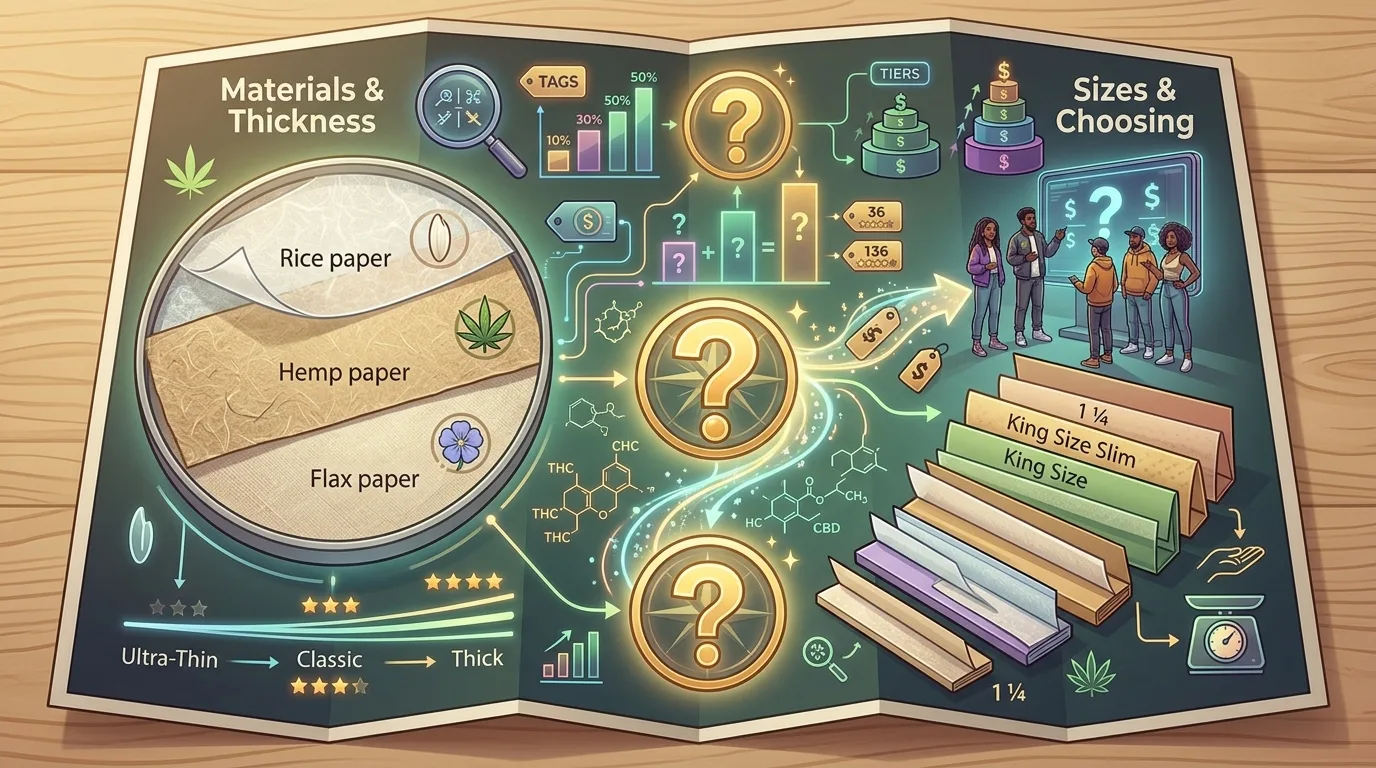
Papers are the cheapest component of a joint and the one that most changes how it smokes. A dollar fifty of paper sits between you and several dollars of flower, and if it burns at the wrong rate, adds its own taste, or runs down one side, it degrades all of it.
Most people pick a brand once in their teens and never revisit the decision. That's understandable, because almost nothing written about papers goes further than brand loyalty and thickness claims. What actually matters is narrower than the marketing suggests and easier to reason about: the material determines burn rate and taste, the size determines how much you're committing to, and the gum determines whether the thing stays shut.
Here's what each choice actually does.
The Four Materials
Wood Pulp
The traditional paper, and still the most common. Processed wood fibre, usually a little thicker than the alternatives, often bleached white though unbleached versions are widely available.
Burns: fastest of the four, and faster than the flower inside it. That mismatch is part of why thicker papers deform the cherry.
Tastes: the most noticeable of the four. A faint papery note that some people genuinely like and others find intrusive.
Rolls: easiest. Thicker paper is more forgiving of imprecise technique, holds its shape, and tolerates being unrolled and redone.
Best for: beginners, cold hands, anyone who rolls infrequently and wants it to just work.
Rice
Processed rice fibre, pressed very thin. The classic choice for people who care about flavour.
Burns: slowest of the four, and closest to the rate the flower burns at. That matching is why rice papers run and canoe noticeably less.
Tastes: very close to neutral. You taste the flower.
Rolls: hardest. Thin paper is slippery, tears more easily, and punishes a sloppy tuck. Rice papers also tend to go out if you leave them sitting, which is the price of a slow burn.
Best for: flavour-focused smokers, anyone rolling frequently enough to have good technique.
Hemp
The middle option, and the one most people end up on.
Burns: between rice and wood pulp. Slower than wood pulp, a little faster than rice.
Tastes: slight earthy or grassy note. Less neutral than rice, far less than wood pulp.
Rolls: noticeably easier than rice. Hemp papers have a slightly textured, grippy surface that holds flower in place while you shape the roll.
Best for: most people, most of the time. Good burn, acceptable taste, forgiving enough to roll quickly.
Flax and Blends
Less common. Flax papers are very thin and burn slowly, similar to rice but usually with slightly better handling. Blended papers mix fibres to balance burn and grip.
Best for: people who want rice-paper burn with a bit more forgiveness.
Clear Cellulose
Transparent papers made from plant cellulose. Mostly a novelty.
Burns: unevenly, and they can produce an unpleasant taste as they go. They also tend to melt and curl rather than ash cleanly.
Best for: photographs. Not for smoking.
Side by Side
| Wood pulp | Hemp | Rice | Flax | |
|---|---|---|---|---|
| Burn speed | Fastest | Medium | Slowest | Slow |
| Taste contribution | Most | Slight | Minimal | Minimal |
| Ease of rolling | Easiest | Easy | Hardest | Moderate |
| Tendency to run | Highest | Low | Lowest | Low |
| Stays lit | Very well | Well | Needs attention | Needs attention |
| Ash colour | Darker, greyer | Grey | Pale grey to white | Pale |
Ash colour is a rough indicator rather than a verdict, and the flower's cure matters more than the paper does. Our guide on how to tell if flower was cured properly covers what ash actually tells you.
Thickness, and Why It Matters More Than Material
Within any material, papers come in different weights, usually expressed in grams per square metre. Lower numbers are thinner.
The principle: you want the paper to burn at roughly the same rate as the flower. When paper burns faster than its contents, the burning edge races ahead and the cherry deforms, which is one of the main causes of canoeing.
Thinner papers also contribute less of their own combustion products, which means less harshness. If you cough more on joints than on a pipe, the paper is one of the suspects, as our guide on why cannabis makes you cough covers.
The trade-off is purely one of difficulty. Thin papers smoke better and roll worse. There's no version where you get both.
Bleached vs Unbleached
Bleached papers are white. Unbleached are tan or brown.
Unbleached is the better default. Fewer processing steps, no chlorine-based whitening, and a marginally more neutral taste. The difference is small, and anyone claiming it's dramatic is overselling.
Worth noting that "natural" and "organic" on paper packaging aren't regulated terms in any meaningful way. Unbleached is a description of a process; the rest is marketing.
The Gum Line
The adhesive strip is the component nobody thinks about until it fails.
Most quality papers use gum arabic, also called acacia gum, a plant-derived adhesive that's been used in paper products for a very long time. It needs only light moisture to seal.
Two practical points:
Don't soak it. Over-wetting the gum line weakens the seal and can cause the paper to tear or unstick as it dries. A light pass is enough.
The seam burns differently. The glued edge is a double thickness of paper running down one side of the joint. On cheaper papers that seam burns at a noticeably different rate from the rest, which produces a run. Rolling so the seam sits on the underside helps, since heat rises and a seam on top gets more exposure.
Old papers dry out and the gum stops working well. If a pack has been in a drawer for two years, that's usually why it won't seal.
Sizes
Papers are sold in standard sizes, and the names are not intuitive.
| Size | Rough length | Holds | Common use |
|---|---|---|---|
| Single wide | 70mm, narrow | 0.25–0.4g | Solo, quick |
| 1¼ | 76–78mm | 0.4–0.6g | The most common size |
| 1½ | 76–78mm, wider | 0.6–0.8g | Solo-plus or two people |
| Double wide | 76–78mm, widest | 0.8g+ | Uncommon |
| King size | 100–110mm | 0.8–1.2g | Groups |
| King slim | 100–110mm, narrow | 0.6–0.9g | Groups, less material |
1¼ is the default for a reason. It fits a standard half-gram comfortably, rolls easily, and doesn't commit you to more than one person usually wants.
King slim is the underrated option for group sessions. The extra length gives the smoke more room to cool before it reaches you, without the extra width committing a full gram and a half.
Size is also a cost decision. Our guide on cost per session covers how much material each format consumes, and a king size burning in an ashtray between passes is the most expensive line in it.
Tips, Crutches and Filters
The small rolled piece of card at the mouth end goes by several names and does three things:
Structure. It gives the joint something to roll around, which makes the whole thing easier to construct and keeps the end from collapsing.
Airflow. It stops flower being pulled into your mouth and keeps the draw open.
Length. It lets you smoke the joint down without burning your fingers, which recovers material you'd otherwise discard.
What it does not do, to any meaningful degree, is filter. A rolled piece of card removes some particulate and essentially nothing else. Anyone describing a paper crutch as a filter is overstating it.
Activated carbon tips are a different product and do reduce some particulate and harshness, at the cost of taking some flavour with it.
Glass tips are reusable, don't burn, and give a cooler draw. They need cleaning like any glass, which our cleaning guide covers.
Cones vs Papers
Pre-rolled cones are papers already formed with a tip in place. You fill and pack rather than roll.
In favour: far easier, consistent shape, no technique required, and consistent packing density means fewer runs.
Against: more expensive per unit, limited material and size options, and they take up more space in storage.
For anyone who finds rolling frustrating, cones remove the main obstacle entirely. The joint itself smokes the same.
Choosing, Practically
If you're new to rolling: hemp, 1¼, with tips. Forgiving enough to learn on, good enough that you won't need to upgrade.
If flavour is the priority: rice, 1¼ or king slim, unbleached. Accept that it takes practice and goes out if you let it sit.
If joints keep running: switch from wood pulp to hemp or rice, and roll the seam underneath. That plus correct flower humidity solves most of it.
If you smoke mostly in groups: king slim, with tips. More cooling, less material committed.
If rolling is the thing you don't enjoy: cones.
Papers, cones, tips and grinders are in our accessories section, and weed delivery Ottawa covers them alongside flower, which is worth bundling rather than making a separate trip for.
Frequently Asked Questions
Rice papers are thinner, burn slowest, and contribute almost no taste, but they're slippery and harder to roll. Hemp papers are slightly thicker with a grippy texture that makes rolling considerably easier, burn a little faster, and add a mild earthy note. Hemp suits most people; rice suits flavour-focused smokers with good technique.
Generally yes, and that's the point. A thinner paper burns closer to the rate of the flower inside it, which keeps the cherry even and reduces running and canoeing. Thicker papers burn faster than their contents, deform the burning edge, and contribute more of their own combustion products.
Marginally, and it's a reasonable default. Unbleached papers skip chlorine-based whitening and taste slightly more neutral. The difference is small rather than dramatic. Note that
1¼ for most purposes. It holds a comfortable half gram, rolls easily and suits solo or shared use. King slim is better for groups, since the extra length cools the smoke without the extra width committing a full gram and a half. Single wide is for small, quick solo joints.
Barely. A rolled card crutch provides structure, keeps the draw open, stops flower reaching your mouth and lets you smoke further down. It removes some particulate and very little else. Activated carbon tips do reduce harshness meaningfully, at the cost of some flavour.
Usually dried-out gum. Gum arabic loses effectiveness over time, so an old pack often won't seal. The other common cause is over-wetting, which weakens the adhesive and can tear the paper as it dries. A light pass across the gum line is all that's needed.
The Short Version
The material sets burn rate and taste. Wood pulp burns fastest and tastes most; rice burns slowest and tastes least; hemp sits between and is easier to roll than either.
Thinner is better for smoking and worse for rolling, with no version where you get both. Unbleached is a sensible default. Roll the seam underneath. And 1¼ covers almost every situation you'll actually encounter.
If your joints keep running, the paper is the second thing to check. The first is whether your flower is too dry.