Two jars, the same grade on the label, the same price, bought two weeks apart. One smokes smoothly with layered flavour and a clean burn. The other scratches the throat, tastes vaguely of hay, and leaves a dark, crumbly residue in the bowl.
Most people blame the strain. Sometimes they blame themselves. But another important variable is cure quality, and it's one of the biggest factors that rarely appears on a cannabis menu.
Curing is the period after drying when cannabis flower is stored in controlled conditions, allowing moisture to redistribute and the flower to develop its final aroma, texture, and smoking characteristics. Rush the process or handle the flower poorly and you can end up with harsh smoke, flat flavour, or inconsistent burning regardless of the original flower quality.
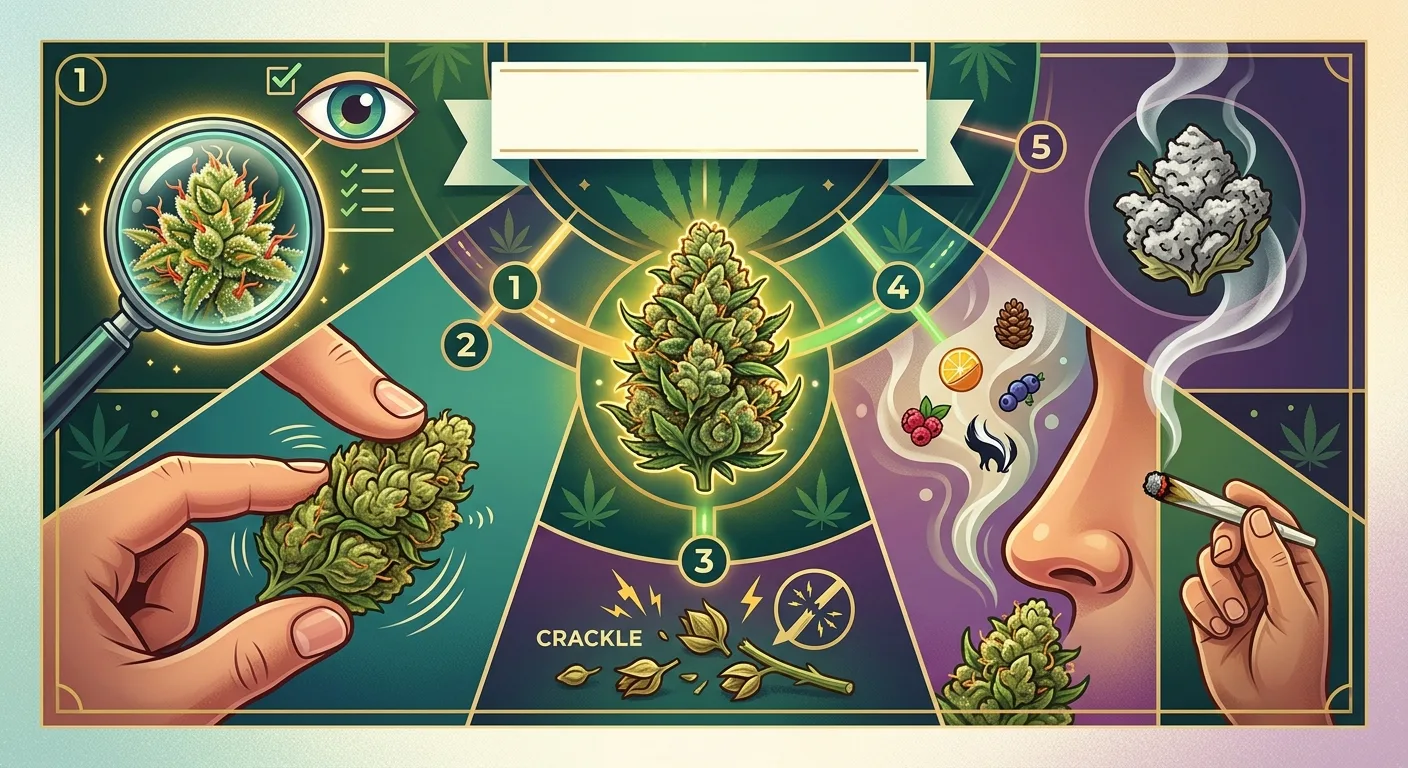
The good news is that you can assess cure quality in under a minute using nothing more than your senses. Here are five checks worth running before you commit to a jar.
Check One: Smell
Smell is one of the most useful tests available, and it's also one people tend to rush.
Open the container and give the flower a moment before smelling it properly. A compressed or freshly opened container may need some time for its aroma to develop.
Properly Cured
A well-cured flower should have a reasonably complex aroma. You may notice multiple notes, such as something sweet or fruity alongside earthy, spicy, herbal, or fuel-like characteristics.
The important part is that the aroma has depth rather than smelling like one flat note.
Under-Cured
Under-cured flower can smell green, grassy, or similar to freshly cut lawn. A strong green or hay-like aroma can indicate that the flower was not dried or cured optimally.
Rushed or Over-Dried
Over-dried flower often smells faint or muted. It may not smell bad, but the aroma can feel thin compared with fresher, better-preserved flower.
Spoiled Flower
Ammonia, musty, or damp-basement smells are warning signs. If flower smells strongly of ammonia or appears mouldy, don't smoke it.
Check Two: The Squeeze
Take a small bud between your thumb and forefinger and apply gentle pressure.
Properly Cured
Properly cured flower should have some give without feeling wet or spongy. It should compress slightly and retain its overall structure.
Too Dry
Very dry flower may crumble easily with little pressure.
Dry flower can burn quickly and harshly and may contribute to uneven burning. Our guide on why joints canoe explains how moisture and other factors can affect an uneven burn.
Too Wet
Flower that feels unusually spongy, damp, or doughy deserves caution. Excess moisture can create conditions where mould becomes a concern, especially when flower is stored improperly.
Check Three: The Stem Snap
The stem test is an old method, but it can still provide useful information about how much moisture remains in the flower.
Take a small stem and bend it gently.
Properly Cured
A relatively dry stem should snap cleanly rather than simply folding over.
Under-Dried
If the stem bends and folds without breaking, the flower may still contain substantial internal moisture.
Over-Dried
If the stem becomes extremely brittle and breaks into multiple fragments with almost no resistance, the flower may be excessively dry.
The stem test should not be treated as a laboratory measurement, but combined with smell and texture, it can help give you a clearer picture of the flower's condition.
Check Four: Stickiness and Trichome Condition
Run a clean finger lightly along the surface of the bud.
Properly Cured
Good flower may feel slightly tacky without feeling wet or greasy. You may notice a small amount of resinous residue on your fingers.
If you have a phone camera with a good zoom or macro capability, you can also inspect the trichomes.
Intact trichome heads are generally preferable to flower where a large amount of resin appears damaged or rubbed away.
Trichome colour can also provide information about harvest timing, although it should not be used as a standalone indicator of overall quality.
Old Flower
Flower that has very little aroma, little surface character, and no noticeable stickiness may have been stored for a long time or exposed to conditions that reduced its freshness.
Cannabinoid potency and terpene preservation are different considerations, so a flower can retain some potency while losing much of its original aroma.
Check Five: Ash Colour
Ash colour is the most debated test on this list.
If you're already consuming the flower, observe the ash and how consistently it burns. Pale grey ash is sometimes associated with a clean, well-burning flower, while dark, clumpy ash can be associated with moisture or other factors affecting combustion.
However, ash colour is not proof of cure quality.
Mineral content, growing conditions, paper, moisture, airflow, and even how the flower is lit can affect the result. Treat ash as one additional data point rather than a final verdict.
The Five Checks at a Glance
| Check | Good Signs | Too Dry | Too Wet or Under-Cured |
|---|---|---|---|
| Smell | Complex, layered aroma | Faint or thin | Grassy, green, ammonia-like |
| Squeeze | Slight give, retains structure | Crumbles easily | Spongy or damp |
| Stem | Breaks cleanly | Extremely brittle | Bends without breaking |
| Surface | Slightly tacky, intact trichomes | Very dry | Damp or unusually soft |
| Burn/Ash | Consistent burn, lighter ash | Burns very quickly | Dark, clumpy, inconsistent burn |
The first four checks can be performed before buying. They also work better together than individually.
If smell, texture, stem condition, and surface character all point in the same direction, you have a much stronger indication of the flower's condition than you would get from any single test.
Why Cure Matters More Than the THC Number
This is one of the most important things to understand when comparing cannabis flower.
A higher THC percentage doesn't automatically tell you how enjoyable, flavourful, or well-preserved a particular batch will be.
Curing affects moisture distribution, aroma preservation, texture, and the way flower burns. These characteristics aren't captured by a single THC percentage on a menu.
Our article on what THC percentage actually measures explains why potency numbers provide only part of the picture.
The cannabis grading guide also explains how quality factors such as appearance, aroma, trichomes, and overall condition can contribute to how flower is assessed.
What to Do With Flower That Fails the Checks
Not every problem means the flower has to be thrown away. It depends on what is wrong with it.
Too Dry
Dry flower can sometimes be reconditioned using an airtight container and a commercially made two-way humidity-control pack.
A 62% pack is commonly used for cannabis storage, but follow the manufacturer's instructions and give the flower time to equilibrate.
Rehydrating flower can improve its texture and burn. It cannot reliably restore terpenes or other compounds that were already lost during poor storage or excessive drying.
If you're storing cannabis through an Ottawa winter, our cold-weather cannabis guide covers how cold, dry indoor air can affect flower, vapes, and edibles.
Too Wet
Be more cautious with flower that feels excessively wet or smells unusual.
Avoid using heat to dry cannabis quickly. If the flower develops visible fuzzy growth or a strong ammonia/musty odour, discard it rather than attempting to salvage it.
Old and Flat
Flower that has lost much of its aroma may still contain cannabinoids, but the experience can be noticeably different.
If you're considering using older flower for an infusion or edible preparation, our decarboxylation guide explains the underlying process.
At Uper Weed, batches are reviewed for overall quality, and cure and freshness are among the factors considered when flower is placed into our flower and AAAA selections.
You can also browse weed delivery in Ottawa for current flower options.
Frequently Asked Questions
What does properly cured cannabis feel like?
Properly cured flower should have some give without feeling wet or spongy. It should retain its structure when gently squeezed, have a noticeable aroma, and may feel slightly tacky. A small stem should generally break rather than simply fold.
Does white ash actually mean good weed?
Not necessarily. Ash colour can provide a rough indication of how consistently flower is burning, but it is not proof of quality or cure. Moisture, mineral content, paper, airflow, and lighting technique can all affect ash colour.
Why does my cannabis smell like fresh-cut grass?
A strong grassy or hay-like aroma can be associated with flower that was not dried or cured optimally. It may also reflect the flower's genetics or storage history, so smell should be considered alongside texture and other signs.
Can I fix weed that's too dry?
You can sometimes improve overly dry flower by storing it in an airtight container with a commercially made two-way humidity-control pack. This can restore some moisture and improve texture, but it cannot reliably restore terpenes that have already been lost.
Avoid using citrus peels, bread, or other household materials because they can introduce unwanted moisture and contamination.
How long should cannabis be cured?
Cure time varies depending on the producer, drying process, flower characteristics, and storage conditions. Cannabis is generally dried first and then cured over an extended period in controlled storage. There isn't one universal cure length that guarantees better flower.
Is harsh smoke always a cure problem?
No. Harsh smoke can have several causes, including excessive dryness, combustion temperature, the way the flower is consumed, and the characteristics of the specific batch. A grassy aroma combined with excessive moisture or poor stem behaviour may point toward a drying or curing issue, while flower that crumbles into dust is more clearly associated with dryness.
The Short Version
Smell it, squeeze it, check a stem, and look at the surface.
Four simple checks can tell you a lot about how fresh and well-conditioned cannabis flower is before you buy it.
Complex aroma, slight give, a reasonably clean stem break, and some natural tackiness are positive signs. Grassy or ammonia-like smells, excessive brittleness, spongy texture, or visible mould are reasons to be cautious.
Cure is one of the quality factors you can't see on a THC percentage. When comparing flower, look beyond the number on the label and pay attention to aroma, texture, freshness, storage, and overall condition.
Browse Uper Weed's flower and AAAA selections and find cannabis with the freshness and quality you're looking for.Shop Cannabis Flower in Ottawa