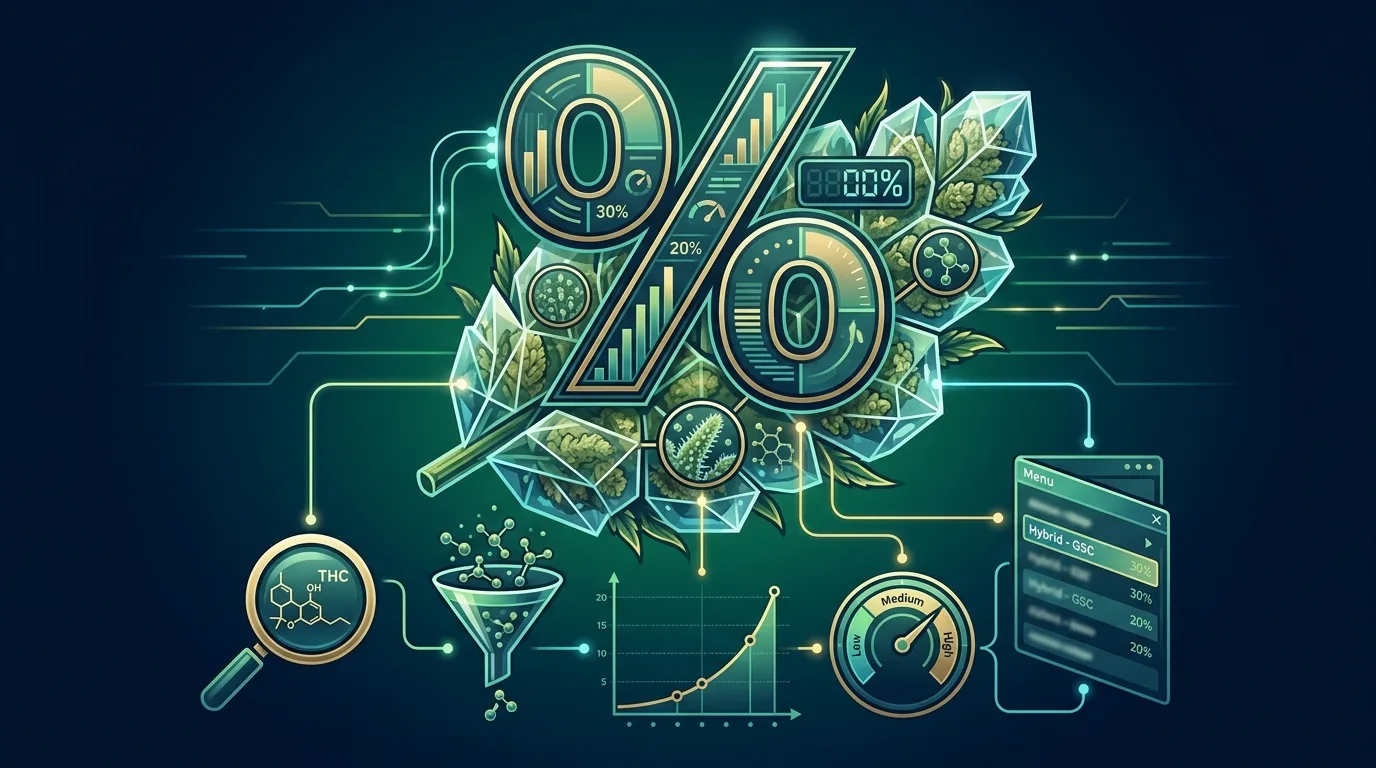
Two jars sit side by side on a menu. One says 19%, the other says 28%. The second one costs more.
Almost everyone picks the second one, and a meaningful share of those people report afterward that it didn't feel nine points stronger, or stronger at all.
They aren't imagining it.
THC percentage is a real measurement of a real thing, but what it measures and what people believe it measures are two different claims.
It tells you the concentration of one compound in one sample of one batch at one moment.
It does not tell you how the flower will feel, how long it will last, what the effect will be like, or whether you'll enjoy it.
The number has become one of the dominant ways cannabis gets priced and sold, which makes it worth understanding properly: how it's calculated, why the figures you see can vary, and what else can help you judge whether a particular flower suits you.
How THC Percentage Is Calculated
Understanding THC percentage starts with the difference between THC and THCA.
THCA and the Conversion
Raw cannabis contains relatively little active THC.
Instead, the plant primarily contains THCA, or tetrahydrocannabinolic acid. THCA is not intoxicating in the same way as THC until heat converts it.
That conversion is called decarboxylation.
It happens when cannabis is heated, such as when flower is smoked or vaporized, and it is also part of preparing cannabis for certain infusions.
Our decarboxylation guide explains the process in more detail.
When a laboratory tests dried cannabis flower, it can measure both THCA and existing THC.
A commonly used calculation for total THC is:
Total THC = (THCA × 0.877) + existing THC
The 0.877 factor accounts for the mass lost when THCA converts to THC during decarboxylation.
This calculation represents a theoretical amount of THC after conversion. Actual consumption does not necessarily result in every molecule being converted or absorbed.
That means a menu figure such as 28% total THC should not be interpreted as saying that 28% of the material will enter your bloodstream.
It is a laboratory measurement of cannabinoid concentration under a standardized calculation.
One Sample Doesn't Represent Every Flower
Another important limitation is sampling.
A laboratory tests a sample rather than every piece of flower in an entire batch.
Cannabinoid concentrations can vary throughout a plant. Large top colas, lower growth and different parts of the same plant may not have identical cannabinoid concentrations.
If a producer submits a sample for testing, the reported result describes the material that was tested.
It does not guarantee that every individual bud in the broader batch contains exactly the same percentage.
This is a sampling issue rather than automatically evidence of inaccurate testing.
Why Cannabis Potency Numbers Can Vary
Several factors can influence the THC number displayed on a cannabis listing.
Potency Is Commercially Important
Consumers frequently sort cannabis menus by THC percentage.
When shoppers use potency as a major purchasing signal, the number can influence what products command higher prices.
That makes accurate testing and representative sampling important.
A percentage should be treated as useful information about a tested sample, not as a guarantee that every bud will produce a proportionally stronger experience.
Laboratory Variation Exists
Different laboratories can sometimes produce different results from similar samples.
Testing methodology, calibration, sample preparation and homogenization can all affect laboratory measurements.
This is one reason a small difference between two reported percentages should not automatically be treated as a meaningful difference in the consumer experience.
Regulated and Unregulated Products Are Different
In Canada's licensed cannabis system, testing and product requirements are governed by federal regulations.
Products outside the regulated retail system do not necessarily have the same testing oversight.
That means a stated THC percentage on an unverified listing may not carry the same evidentiary value as a regulated product's laboratory-backed information.
Data Entry Errors Happen
Sometimes the problem isn't laboratory testing at all.
It's a listing error.
If a product displays an obviously impossible potency figure, the information may have been entered incorrectly.
Percentages above 100% are a clear example of a data-entry problem because a percentage concentration cannot exceed the total mass of the product.
Extremely high flower percentages should also be treated cautiously rather than assumed to represent an ordinary measurement.
The Practical Rule for Reading THC Numbers
Don't treat every percentage point as meaningful.
A flower listed at 22% and another at 24% are not necessarily going to produce noticeably different experiences.
A larger difference, such as 18% versus 30%, represents a more substantial difference in measured cannabinoid concentration.
The percentage is most useful as a general potency range, rather than a precise prediction of how a session will feel.
Why Higher THC Doesn't Automatically Mean a Better Experience
THC matters, but the relationship between THC percentage and subjective experience isn't as simple as the number on the label suggests.
You May Titrate Your Intake
People often adjust how much cannabis they consume based on its perceived strength.
Someone using a higher-potency flower may naturally take fewer or smaller puffs.
Someone using lower-potency flower may consume more material.
As a result, the amount of cannabis consumed can change along with the percentage.
You're experiencing a dose rather than simply experiencing the number printed on the package.
Individual tolerance also plays a major role.
More THC Doesn't Mean Proportionally More Intoxication
The relationship between THC dose and subjective effects is not necessarily linear.
Increasing THC exposure can also increase unwanted effects for some people, including anxiety, dizziness, impaired coordination and an increased heart rate.
For consumers with low tolerance, a higher-potency product may therefore feel substantially different even if the percentage difference looks modest.
For experienced consumers with higher tolerance, the difference between two moderately high-potency products may feel less dramatic.
Other Cannabis Compounds Matter
THC is only one component of cannabis.
Cannabis contains numerous cannabinoids alongside aromatic compounds called terpenes.
Terpenes contribute heavily to aroma and flavour, and research continues to examine how cannabinoids and other compounds interact.
This is sometimes discussed using the term entourage effect, although the exact significance of these interactions in humans remains an area of ongoing research.
The practical takeaway is simpler:
Two flowers with the same THC percentage can still be noticeably different products.
Their aroma, terpene profile, freshness, cultivation, curing and cannabinoid composition can all differ.
What to Look at Besides THC Percentage
| Signal | What it tells you | Why it matters |
|---|---|---|
| Terpene profile | Aroma and flavour characteristics | Helps distinguish different flower profiles |
| Harvest or package date | Approximate freshness | Older flower can lose aromatic compounds over time |
| Grade or quality tier | Overall product assessment | Can provide additional context beyond potency |
| Cultivation method | How the plant was grown | May influence aroma, structure and overall characteristics |
| Aroma | Freshness and cure characteristics | A strong, distinctive aroma can indicate preserved volatile compounds |
| Flower structure | Physical quality | Shows density, trim and overall appearance |
| Strain lineage | Genetic background | Can provide clues about expected characteristics |
For many shoppers, aroma is one of the most useful practical signals available.
A flower with a strong, distinctive smell may tell you more about its freshness and terpene profile than a small difference in THC percentage.
Our cannabis grading guide explains how quality grades can provide additional context when comparing flower.
When THC Percentage Actually Matters
None of this means THC percentage is useless.
There are situations where it is particularly useful.
Making Edibles
Starting potency matters when calculating the approximate cannabinoid content of an infusion or edible preparation.
The more accurate your starting information, the easier it is to estimate the amount of THC in the final product.
Our guide to reading THC labels on edibles covers how those calculations work.
Lower Tolerance
People who are new to cannabis or have a low tolerance may deliberately choose lower-potency products.
In this situation, THC percentage can be a useful filter when comparing products.
Higher Tolerance
Consumers with substantial tolerance may also use potency as one of their selection criteria.
The number can help distinguish lower-potency flower from products at the higher end of the available range.
However, tolerance, consumption amount and individual response still matter.
Comparing Extreme Price Differences
THC percentage can also be useful when comparing products with substantially different potency at similar prices.
For example, a 12% flower and a 26% flower at the same price represent a meaningful difference in measured cannabinoid concentration.
The key is to use THC as one comparison point, rather than treating it as a complete measure of quality.
We list potency alongside other product information across our flower and AAAA weed categories.
For Ottawa customers, weed delivery Ottawa provides convenient access to different flower options so you can compare products based on more than THC percentage alone.
Frequently Asked Questions
THC percentage describes the concentration of THC-related cannabinoids by weight in a tested cannabis sample. Total THC is commonly calculated using the formula (THCA × 0.877) + existing THC. The result describes the tested sample and is not a direct measurement of how much THC an individual consumer will absorb.
No. A 30% THC flower contains approximately twice the measured THC concentration by weight compared with a 15% flower, but the consumer experience does not necessarily scale proportionally. Consumption amount, tolerance, individual response and other cannabis compounds all affect the experience.
Extremely high THC percentages in flower should be treated cautiously because cannabis flower has physical limits on cannabinoid concentration. A very high stated number may also reflect testing or sampling differences. Any percentage above 100% is clearly a data-entry error because a concentration cannot exceed 100%.
Testing methodology, calibration, sample preparation, homogenization and other laboratory procedures can affect measured results. This means two laboratories can sometimes report different results for similar cannabis samples.
Consider aroma, terpene profile, package or harvest information, flower structure, cultivation details and overall product quality. THC percentage is useful for understanding approximate potency, but it does not describe every characteristic that affects the cannabis experience.
No. THC concentration and overall flower quality are separate characteristics. A high-THC flower can still have poor aroma, harsh smoke or degraded freshness, while a lower-THC flower can have strong aroma, good curing and desirable characteristics.
The Short Version
THC percentage measures the concentration of THC-related cannabinoids in a tested cannabis sample.
It is useful, but it isn't a complete measurement of quality or a guarantee of how a particular flower will feel.
The difference between 20% and 22% should not automatically be treated as meaningful, while larger differences can provide useful information about relative potency.
When choosing flower, look beyond the number.
Check the aroma.
Consider freshness.
Look at the terpene profile.
Consider the flower's overall quality and structure.
Use THC percentage as a potency guide rather than a quality score.
The number on the menu tells you something real.
It just doesn't tell you everything that matters.
Explore Uper Weed's flower selection and compare cannabis products by potency, strain, quality and available product details.Looking for Cannabis Flower in Ottawa?