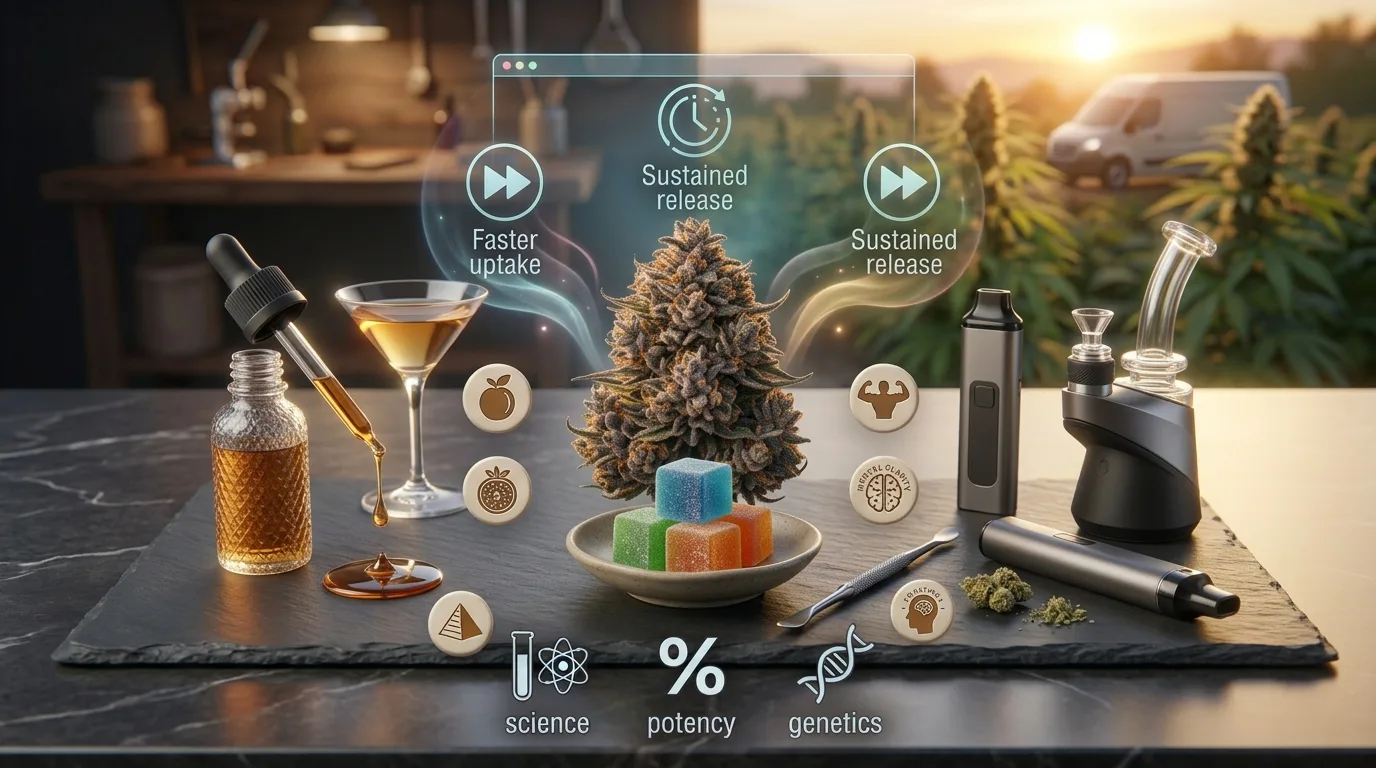
Walking into a cannabis store today feels a lot like stepping into a pharmacy, a beverage aisle, and a dispensary all at once. Gone are the days when smoking a joint was your only option. Now you can sip a cannabis-infused seltzer, pop a THC gummy, or still roll up your favourite flower, and each method delivers a completely different experience. If you've ever wondered why your friend's edible knocked them out for eight hours while your joint wore off in two, or why THC drinks are suddenly everywhere, you're asking exactly the right questions.
The truth is, how you consume cannabis matters just as much as what you consume. The same 10mg of THC will hit faster, last longer, or feel milder depending on whether you drink it, eat it, or smoke it. For consumers in Ottawa and across Canada trying to choose between these three popular formats, understanding onset time, duration, and discretion isn't just helpful, it's essential to having the experience you actually want. Whether you're looking for fast relief, all-day effects, or a consumption method that won't turn heads, this comprehensive guide breaks down exactly how THC drinks, edibles, and smoking stack up against each other.
How Your Body Processes THC: The Science Behind Different Consumption Methods
Before we compare onset times and durations, it helps to understand why these three methods affect you so differently. The answer lies in how THC enters your bloodstream and travels to your brain, and each consumption method takes a fundamentally different route through your body.
Smoking and Inhalation: The Lung Route
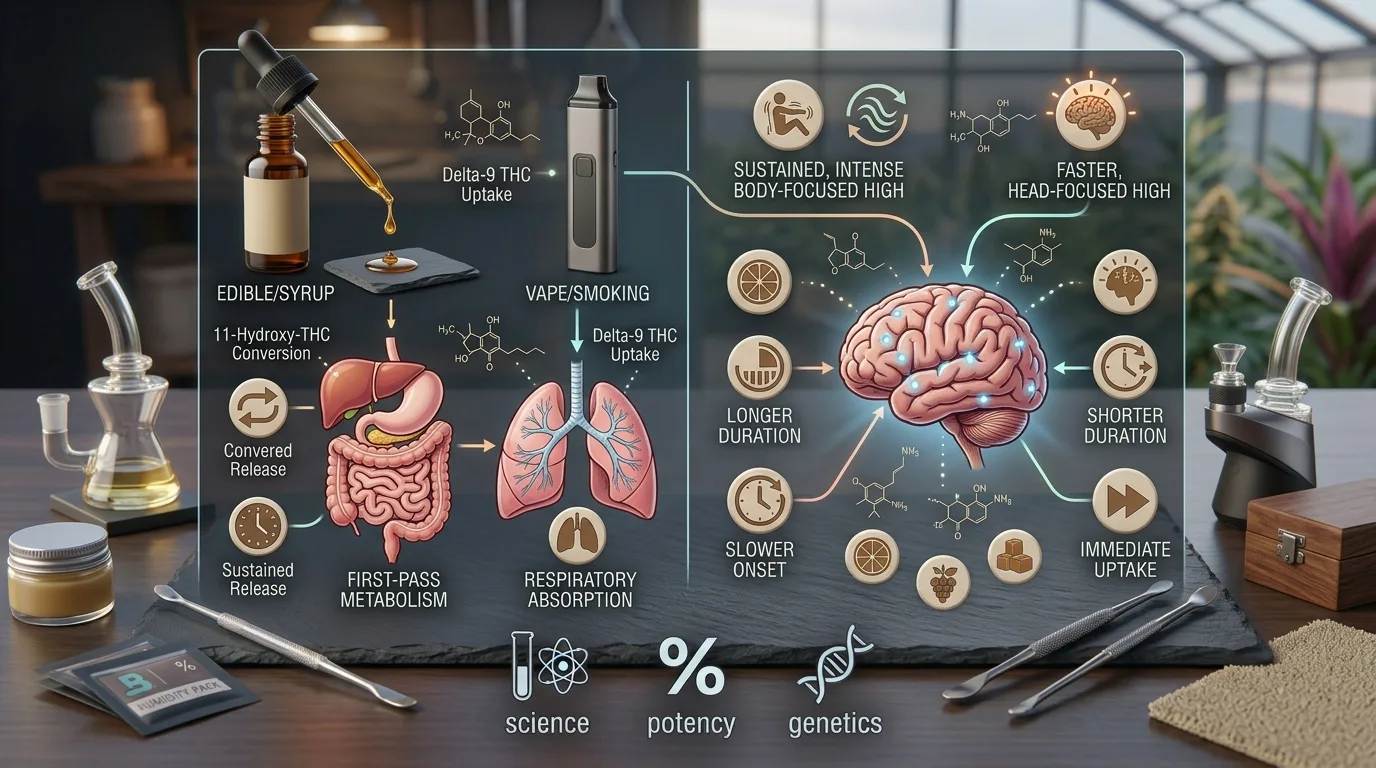
When you smoke or vapourize cannabis, THC enters your lungs as tiny particles suspended in smoke or vapour. Your lungs are designed to be extremely efficient at gas exchange, with millions of tiny air sacs called alveoli that have direct access to your bloodstream. THC molecules pass through the thin walls of these alveoli and into your blood within seconds. From there, they travel straight to your brain without having to pass through your digestive system or liver first. This direct route is why smoking produces effects so quickly, but it's also why those effects fade relatively fast. The THC hasn't been chemically modified, it's just being distributed and then broken down by your body.
Edibles: The Digestive and Liver Route
Edibles take a completely different journey. When you eat a THC gummy or brownie, it travels through your stomach and into your small intestine, where the THC is absorbed through the intestinal walls. But here's where it gets interesting: that absorbed THC doesn't go straight to your brain. Instead, it travels through your portal vein to your liver first, where enzymes convert delta-9 THC (the main psychoactive compound in cannabis) into 11-hydroxy-THC, a more potent metabolite that crosses the blood-brain barrier more easily. This is why edibles often feel stronger and more sedative than smoking the same amount of THC. The liver essentially transforms your cannabis into a more powerful version before it reaches your brain.
THC Beverages: The Hybrid Route
Cannabis drinks occupy an interesting middle ground. Modern THC beverages use nanoemulsion technology to break THC into microscopic droplets that your body can absorb more efficiently. When you drink a cannabis beverage, some THC absorbs through the tissues in your mouth and under your tongue (sublingual absorption), entering your bloodstream directly like smoking. The rest travels to your stomach and follows the edible pathway through your liver. This dual absorption creates an onset time that's faster than traditional edibles but not quite as immediate as smoking, typically kicking in within 15 to 45 minutes. The effects also tend to be more predictable and less intense than traditional edibles because the absorption is more gradual and controlled.
Understanding these three pathways explains why a 10mg THC beverage, a 10mg gummy, and a joint with roughly 10mg of THC all produce such different experiences. The milligrams might be the same, but the metabolic journey is completely different.
Onset Time Compared: How Fast Will You Feel It?
For many cannabis consumers, especially those using cannabis for symptom relief or social situations, how quickly the effects kick in is the deciding factor. Here's how the three methods stack up when it comes to onset time.
Smoking: Near-Instant Relief
Smoking or vaping cannabis delivers the fastest onset time, bar none. Most users report feeling initial effects within 30 seconds to 2 minutes, with peak effects arriving around the 10-minute mark. This rapid onset makes smoking ideal for situations where you need immediate relief from pain, nausea, anxiety, or when you want to gauge your tolerance in real time. You can take a puff, wait a minute, and decide if you need more. This self-titration is one of smoking's biggest advantages, especially for new users who are still learning their ideal dose.
The near-instant feedback also makes smoking popular in social settings where the experience is part of the ritual. Passing a joint at a gathering creates a shared experience with predictable timing that everyone can enjoy together. For medical users dealing with breakthrough pain or sudden anxiety, the speed of inhalation can be genuinely therapeutic.
THC Drinks: The Middle Ground
Modern cannabis beverages typically produce noticeable effects within 15 to 45 minutes, though some users report feeling subtle changes as early as 10 minutes. This places drinks squarely between smoking and traditional edibles in terms of onset speed. The nanoemulsion technology used in most commercial THC drinks creates tiny THC particles that your body absorbs faster than the larger molecules in baked goods or gummies.
This moderate onset time makes drinks appealing for social situations where you want to sip casually without committing to the hours-long journey of an edible, but you also don't want the conspicuousness or lung irritation of smoking. You can enjoy a cannabis-infused beverage at roughly the same pace you'd drink an alcoholic beverage, with effects ramping up gradually rather than hitting all at once. For users looking for guidance on similar consumption methods, our article on cannabis syrup versus gummies explores another liquid-based alternative.
Edibles: The Waiting Game
Traditional cannabis edibles are notorious for their delayed onset. Most users don't feel anything for 30 minutes to 2 hours after consumption, with the average being around 60 to 90 minutes. This delay occurs because the THC must survive your stomach acid, be absorbed through your intestines, travel to your liver for metabolization, and then finally reach your brain as 11-hydroxy-THC. Factors like your metabolism, whether you've eaten recently, your body weight, and even your genetics all influence exactly how long this process takes.
The infamous mistake with edibles is eating more because "it's not working," only to have both doses hit simultaneously an hour later, creating an uncomfortably intense experience. The slow onset requires patience and planning. Edibles work best when you take them knowing you have nowhere to be for several hours and can ride out whatever experience unfolds. For evening relaxation, movie nights, or managing chronic pain overnight, this delayed onset isn't a bug, it's a feature. You just need to respect the timeline.
Which Onset Time Fits Your Lifestyle?
The right onset time depends entirely on your context. Need quick relief from a migraine or anxiety attack? Smoking wins. Want to enjoy a drink during a two-hour dinner party? THC beverages match that timeline perfectly. Planning a long evening at home or need overnight pain relief? Edibles deliver sustained effects that outlast the other methods. There's no objectively "best" onset time, only the onset that matches your specific situation and goals.
Duration of Effects: How Long Will You Be High?
Just as onset times vary dramatically, so does how long each consumption method keeps you elevated. Understanding duration helps you plan your day and avoid the common mistake of consuming more before the first dose has fully run its course.
Smoking: Short and Manageable
The effects from smoking cannabis typically last 1 to 3 hours, with most users feeling back to baseline within 2 to 2.5 hours. The peak intensity occurs within the first 30 minutes, then gradually tapers off. This relatively short duration is both a benefit and a limitation. On the positive side, if you overdo it or don't enjoy the experience, you know relief is coming relatively soon. The short duration also makes smoking practical for users who need symptom relief at specific times without committing to an all-day or all-evening experience.
The downside is that medical users seeking sustained symptom control need to re-dose multiple times throughout the day. Someone managing chronic pain or anxiety with smoked cannabis might need to consume every two to three hours to maintain therapeutic levels, which can be inconvenient and may lead to increased tolerance over time. The short duration also makes smoking less ideal for sleep support, as the effects may wear off in the middle of the night.
THC Drinks: Moderate Duration with Gradual Comedown
Cannabis beverages typically produce effects lasting 2 to 4 hours, with most users reporting a duration closer to 3 hours. This sits between smoking and edibles, offering a more extended experience than inhalation without the marathon commitment of traditional edibles. The comedown from THC drinks tends to be gentler and more gradual than smoking, without the sometimes-abrupt "wearing off" feeling that can accompany the end of a smoked session.
This moderate duration makes drinks ideal for defined social events. If you're attending a three-hour concert, dinner party, or game night, a cannabis beverage consumed at the start can provide effects that last roughly the entire event without extending uncomfortably into the drive home or next day. Users appreciate the predictability, they can plan their consumption with reasonable confidence about when they'll return to baseline. This makes drinks popular among cannabis consumers who are integrating cannabis into social situations where timing matters.
Edibles: The All-Day Experience
Edibles produce the longest-lasting effects by far, typically ranging from 4 to 8 hours, with some users reporting residual effects extending to 12 hours or more, especially with higher doses. The extended duration comes from the way your liver processes THC into 11-hydroxy-THC, which has a longer half-life than delta-9 THC from smoking. The effects build gradually, plateau for several hours, then slowly taper off.
This extended duration is exactly what many users are seeking. For managing chronic pain, anxiety, or insomnia, a single dose that provides relief for 6 to 8 hours beats re-dosing multiple times. Taking an edible an hour before bed can provide pain relief throughout the entire night, helping users stay asleep without waking to re-medicate. The long duration also makes edibles economical, you need fewer doses per day to maintain therapeutic effects. Our guide to properly storing cannabis can help you keep your edibles fresh for maximum potency over time.
However, the long duration becomes a problem if you've taken too much or need to sober up sooner than expected. Unlike smoking where you can simply stop inhaling, once you've swallowed an edible, you're committed to the full experience. This makes proper dosing with edibles absolutely critical. Starting with 2.5mg to 5mg for new users and waiting a full 2 hours before considering more is the standard safety advice for good reason.
Matching Duration to Your Schedule
The best duration depends entirely on your calendar and goals. Have a busy day with multiple commitments? Smoking's short duration lets you fit cannabis into small windows without derailing your schedule. Planning a relaxing evening or long creative session? Edibles provide uninterrupted effects. Want something that matches typical social drinking patterns? THC beverages offer that familiar 2 to 4 hour window that aligns with dinner parties, concerts, or game nights.
Discretion and Social Acceptance: Which Method Draws Less Attention?
In an era where cannabis is legal but social stigma still exists in many contexts, discretion matters. Whether you're concerned about nosy neighbours, professional reputation, or simply prefer privacy, the conspicuousness of each consumption method varies significantly.
Smoking: The Hardest to Hide
Smoking is by far the most conspicuous consumption method. The smell of cannabis smoke is immediately recognizable, travels far, and lingers on clothing, hair, and furniture. Even if you smoke outdoors, neighbours can often detect it. In apartment buildings, smoke can travel through ventilation systems or under doors, leading to complaints or conflicts with landlords. The visual of someone smoking also remains culturally associated with cannabis use in a way that carries stigma in some professional or social circles.
That said, vapourizing flower or concentrates produces less odour than combustion, and the smell dissipates more quickly. For users who value the immediate onset and short duration of inhalation but need more discretion, vapourizers represent a middle ground. Still, you're never going to make inhalation truly invisible. The smell, the device, and the visible vapour all signal cannabis use to anyone nearby.
THC Drinks: Maximum Discretion
Cannabis beverages win the discretion contest hands down. A THC-infused seltzer, tea, or juice looks identical to its non-cannabis counterpart. There's no smell, no smoke, no specialized equipment required, and no visual cues that you're consuming cannabis. You can drink a cannabis beverage in public settings without anyone knowing, assuming you're using a discreet container or the beverage comes in standard packaging.
This discretion makes drinks appealing for consumers who want to integrate cannabis into social situations where smoking would be inappropriate or conspicuous. You can enjoy a THC drink at a picnic, concert, camping trip, or even just walking through a park without drawing attention. For professional cannabis consumers who want to maintain separation between their personal use and public image, drinks offer consumption that's truly invisible to observers.
Edibles: Discreet but Context-Dependent
Edibles fall somewhere between drinks and smoking in terms of discretion. A cannabis gummy looks almost identical to regular candy, and a THC chocolate bar looks like any other chocolate. There's no smell during consumption and no specialized equipment needed. You can consume edibles in most settings without anyone noticing, assuming the packaging is discreet or you've transferred the product to a neutral container.
However, edibles aren't quite as invisible as drinks because eating can draw more attention than drinking, depending on context. Popping a gummy in the middle of a meeting might raise eyebrows, whereas sipping from a water bottle wouldn't. The packaging of many commercial edibles also features cannabis leaf imagery or explicit THC labelling that makes them conspicuous if left out or stored visibly. Still, for most practical purposes, edibles offer discretion comparable to drinks, making both formats popular for consumers prioritizing privacy.
For those exploring different discreet formats, our comparison of THC syrup and gummies examines how various edible formats differ in both consumption method and discretion.
Potency, Dosing, and Control: Which Method Lets You Fine-Tune Your Experience?
Beyond timing and discretion, the ability to control your dose and adjust in real-time dramatically impacts which consumption method works best for different users and situations.
Smoking: Maximum Real-Time Control
Smoking offers the most precise dose control because effects appear almost immediately. You can take a single puff, wait two minutes, assess how you feel, and decide whether to take another. This self-titration is impossible with delayed-onset methods. For new users still learning their tolerance, or experienced users trying a new strain, smoking provides a safety mechanism. You can incrementally increase your dose until you reach the desired effect without overshooting.
The challenge with smoking is that it's harder to know exactly how much THC you're consuming per puff. While you might know your flower is 20% THC, how much of that 20% you actually inhale depends on variables like how deeply you inhale, how long you hold the breath, combustion temperature, and even humidity. This makes smoking somewhat less precise than measured edibles, even though the fast feedback loop allows better practical control. Experienced smokers develop an intuitive sense of dosing through trial and error, but beginners often struggle to predict how much is enough.
THC Drinks and Edibles: Precise Measurement, Delayed Adjustment
Both drinks and edibles offer the advantage of precise, labelled dosing. When a product says it contains 10mg of THC, that's a standardized measurement you can rely on. This makes it much easier to be consistent with your dosing and to know exactly how much you're taking. For medical users tracking their intake for symptom management, or for anyone trying to moderate their consumption, the exact measurements of commercial edibles and drinks are invaluable.
The major downside is the inability to adjust in real-time. Once you've swallowed that 10mg gummy or drunk that beverage, you're committed to experiencing whatever that dose produces. If it turns out to be too much, you can't undo it. If it's too little, you face the dilemma of whether to take more and risk stacking doses at unpredictable times. The standard advice is to wait the full expected onset time (2 hours for edibles, 45 minutes for drinks) before deciding to consume more, but this requires patience many users don't have.
Between drinks and edibles, drinks edge ahead slightly in terms of control because their faster onset means you get feedback sooner and can make more informed decisions about re-dosing if needed. Edibles require the most patience and planning, which is why starting with low doses (2.5mg to 5mg for beginners) is absolutely critical.
Understanding Bioavailability Differences
Another factor affecting real-world potency is bioavailability, the percentage of THC that actually enters your bloodstream and reaches your brain. Smoking has relatively high bioavailability (roughly 10% to 35%, depending on technique), with effects felt from most of what you inhale. Traditional edibles have lower bioavailability (roughly 4% to 12%) because significant THC is lost during digestion and liver processing, although what does make it through is converted to the more potent 11-hydroxy-THC.
Modern THC beverages using nanoemulsion technology can achieve bioavailability rates closer to smoking (some manufacturers claim up to 80% to 90% bioavailability), which is why a 5mg drink might feel stronger than a 10mg traditional gummy for some users. Understanding that "10mg" doesn't mean the same thing across all formats helps explain why your experiences with the same dose can vary so dramatically between methods.
Side Effects, Health Considerations, and Long-Term Impact
Different consumption methods don't just vary in effects and timing, they also have distinct health profiles and potential side effects worth considering when choosing your preferred format.
Respiratory Impact of Smoking
The most obvious health concern with smoking is lung health. Combustion creates tar, carbon monoxide, and other byproducts that irritate lung tissue. While cannabis smoke is less harmful than tobacco smoke in many respects (cannabis doesn't contain nicotine and isn't typically consumed in the same quantities as cigarette smokers), regular smoking still carries respiratory risks including chronic bronchitis, coughing, and reduced lung function. For users with asthma or other respiratory conditions, smoking may not be appropriate.
Vapourizing flower or concentrates reduces but doesn't eliminate these concerns. Vapourizers heat cannabis below combustion temperature, producing fewer harmful byproducts, but they still introduce substances into your lungs. For consumers concerned about respiratory health but who value the fast onset of inhalation, high-quality vapourizers represent a harm-reduction approach. Our guide to THC vapes versus nicotine vapes explains what to look for in vapourizer technology.
Digestive Considerations for Edibles and Drinks
Edibles and drinks bypass the lungs but must pass through your digestive system. For most users, this poses no problems, but people with digestive issues, slow metabolism, or liver conditions may experience unpredictable effects. The variability in edible onset time often relates to digestive health. Someone with a fast metabolism might feel effects in 30 minutes, while someone with slower digestion might wait two hours for the same dose to kick in.
Some users report that edibles cause more intense body effects and sedation compared to smoking, which can be desirable for pain relief and sleep but less ideal for daytime use or situations requiring alertness. The 11-hydroxy-THC produced by liver metabolism crosses the blood-brain barrier more easily and has stronger sedative properties than delta-9 THC from smoking. This isn't a health risk per se, but it's an important experiential difference to understand.
Caloric and Sugar Content
A practical consideration often overlooked with edibles and some drinks is caloric content. Many cannabis edibles are sugar-heavy gummies, chocolates, or baked goods that add empty calories to your diet. If you're consuming edibles daily for medical purposes, those calories add up. Some users also find that the sugar in edibles affects their blood sugar levels or conflicts with dietary goals.
Modern cannabis beverages often address this with low-calorie, sugar-free formulations that make them more suitable for daily use without dietary impact. Checking the nutrition label is important if you're concerned about sugar or calorie intake as part of your cannabis routine.
Tolerance Development
All consumption methods lead to tolerance over time, but they may do so at different rates. Smoking, with its immediate, frequent dosing pattern, can lead to faster tolerance buildup because users can easily consume throughout the day. Edibles, with their longer duration, often require fewer total doses per day, potentially slowing tolerance development. However, if you're consuming high-dose edibles regularly, tolerance still develops. The key is overall THC exposure over time, not the specific method.