If you've ever wondered whether you can throw some cannabis in your suitcase and hit the road across Canada, you're not alone. Since legalization in 2018, thousands of Canadians have found themselves confused about what's actually allowed when travelling with weed between provinces or territories. The short answer? Yes, you can travel with cannabis within Canada, but there are critical rules about how much you can carry, where you can consume it, and what happens when you cross provincial borders. Understanding these regulations isn't just about staying legal , it's about avoiding awkward encounters with law enforcement and hefty fines that could ruin your trip.
Travelling with cannabis in Canada operates under a patchwork of federal and provincial laws that don't always align perfectly. While Health Canada sets the baseline rules, each province adds its own twist on possession limits, public consumption, and retail regulations. Whether you're driving from Ottawa to Montreal, flying from Vancouver to Halifax, or road-tripping across the Prairies, knowing the rules for each jurisdiction makes all the difference between a smooth journey and a legal headache.
Federal Possession Limits: The Baseline Rules for All Canadians
Under the federal Cannabis Act, adults 19 years or older (18 in Alberta and Quebec) can possess up to 30 grams of dried cannabis or its equivalent in public anywhere in Canada. This is your baseline limit, and it applies whether you're in your home province or visiting another. The 30-gram rule creates a common thread across the country, but it's only the starting point for understanding interprovincial travel.
The federal equivalent chart helps you understand what 30 grams of dried flower converts to in other product forms. For example, 30 grams of dried cannabis equals 150 grams of fresh cannabis, 450 grams of edibles, 2,100 grams of liquid products like THC drinks, or 7.5 grams of concentrates. This matters when you're travelling with a mix of products , you need to calculate your total based on these equivalents.
Here's what most travelers miss: the 30-gram limit applies to what you carry in public, not what you store at home. In your private residence, you can typically possess much more (usually up to four plants worth of homegrown cannabis, depending on your province). But the moment you step outside with your stash, whether you're heading to your car or walking to a friend's place, the 30-gram public possession limit kicks in.
Calculating Equivalents for Mixed Product Travel
Let's say you're heading to BC for a week and want to bring both flower and edibles. You pack 15 grams of dried cannabis and 1,200mg worth of THC gummies. Using the federal equivalent formula, those gummies count as roughly 2.66 grams of dried cannabis equivalent (1,200mg ÷ 450 grams per equivalent gram). Your total? About 17.66 grams equivalent, well within the legal limit.
This calculation becomes critical when you're mixing vape cartridges, concentrates, and edibles. A 1-gram vape cartridge counts as approximately 4 grams of dried cannabis equivalent. That 2-gram THC vape cartridge you love? It counts as roughly 8 grams toward your limit. Do the math before you pack, especially if you're bringing variety.
Provincial Possession Limits: Where Things Get Complicated
While the federal government sets the 30-gram baseline for public possession, provinces have the authority to set their own rules , and some have. This creates a confusing landscape where your legal limit can litreally change the moment you cross a provincial border. Understanding these variations is essential for anyone travelling between provinces with cannabis products.
Most provinces stick with the 30-gram federal limit, but Quebec stands out by restricting public possession to just 30 grams for residents and visitors alike. Saskatchewan mirrors the federal limit. Ontario, where UperWeed primarily operates, maintains the 30-gram standard. British Columbia, Alberta, Manitoba, Nova Scotia, New Brunswick, Prince Edward Island, Newfoundland and Labrador, the Northwest Territories, Yukon, and Nunavut all follow the federal baseline.
The real complication emerges with home storage limits. In Quebec, you can store up to 150 grams at home. In Ontario, there's no specified limit for legally obtained cannabis stored in your private residence. Some provinces tie home possession to the number of plants you can grow (typically four), which yields far more than 30 grams but remains legal as long as it stays on your property.
What Happens When You Cross Provincial Borders
Here's the practical reality: when you drive or fly from Ontario to Quebec with 30 grams of cannabis, you're still within legal limits in both provinces. The federal limit covers you. However, if you were somehow carrying more than 30 grams (which would be illegal in public anyway), crossing into Quebec wouldn't suddenly make that legal under their provincial rules.
Law enforcement officers in each province enforce their provincial regulations. If you're stopped by police in New Brunswick, they're applying New Brunswick's public possession rules. If you're carrying 25 grams of dried flower and some edibles that calculate to another 3 grams equivalent, you're fine everywhere. The issue isn't usually interprovincial travel itself , it's understanding that you must comply with the strictest rules that apply anywhere along your journey.
Age Requirements Across Provinces
Another critical variable is minimum age. If you're 18 and travelling from Alberta (where 18 is the legal age) to Ontario (where it's 19), your legal Alberta purchase becomes illegal possession the moment you enter Ontario. The same applies to Quebec, which also requires you to be 19. Always ensure you meet the age requirements for every province you'll pass through or visit.
Flying Within Canada with Cannabis: What Airlines and CATSA Actually Allow
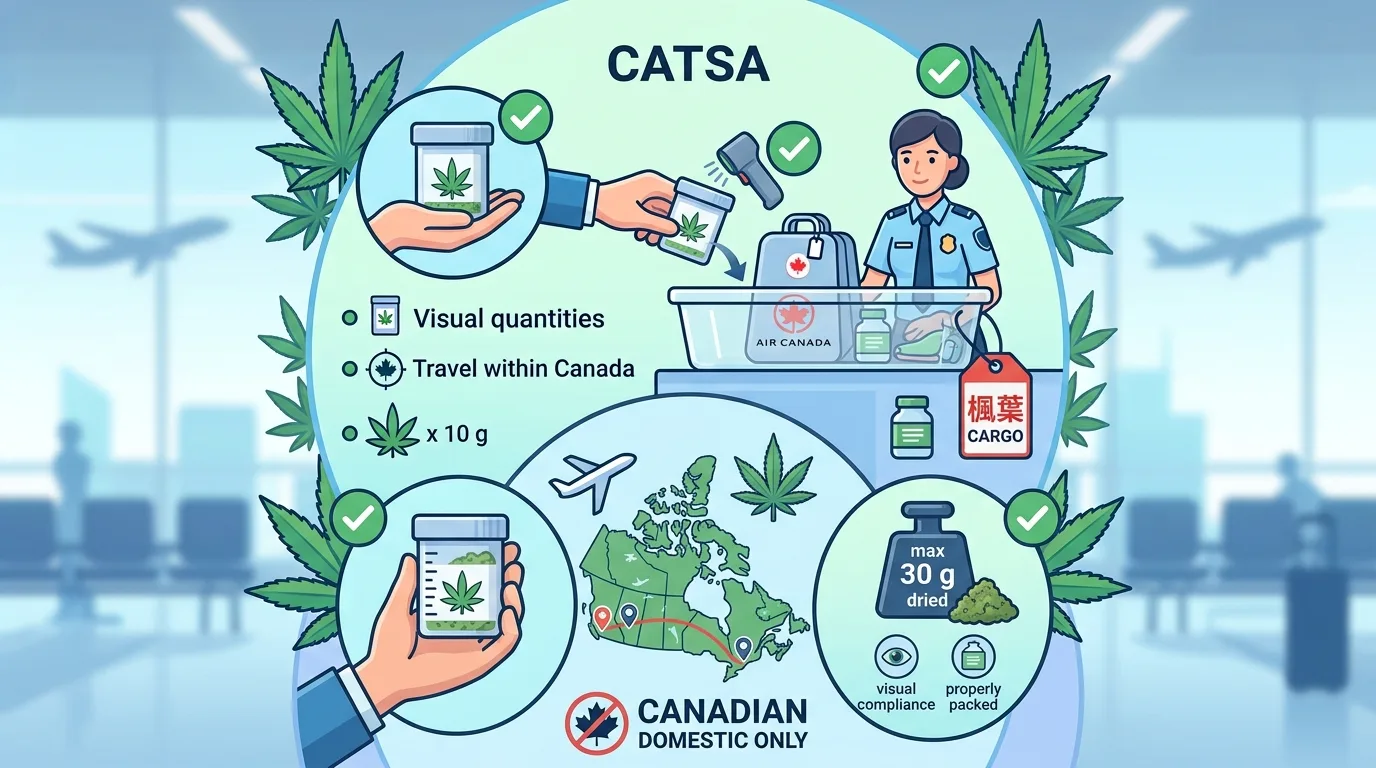
Contrary to popular belief, you absolutely can fly within Canada with cannabis. The Canadian Air Transport Security Authority (CATSA) explicitly permits air travelers to carry up to 30 grams of cannabis in either carry-on or checked baggage on domestic flights. There's no federal prohibition against flying with weed between Canadian airports, and CATSA officers are trained to allow it within legal limits.
That said, individual airlines can set their own policies. Most major Canadian carriers like Air Canada, WestJet, and Porter Airlines permit passengers to travel with legal amounts of cannabis, but they typically require it to be in its original packaging and stored securely. Some airlines request that cannabis products, especially edibles or liquids, remain unopened. Always check your specific airline's policy before you fly.
The practical considerations matter more than the legal ones here. CATSA officers may inspect your cannabis during security screening, just as they would any other item. Having your products in clearly labelled, original packaging from a licenced retailer makes this process smoother. Generic bags of unlabeled flower might trigger additional questions, while a sealed container from a licenced Ottawa weed store passes through without issue.
Carry-On vs. Checked Baggage
Most experienced travelers recommend keeping cannabis in carry-on baggage rather than checked luggage. Why? First, you maintain control and visibility over your products. Second, temperature fluctuations in cargo holds can affect product quality, especially for vape cartridges and concentrates. Third, if security has questions, you're present to answer them rather than having your checked bag flagged for inspection without you.
Keep edibles and liquids under 100ml if you want them in carry-on, following the standard liquid rules. Larger containers of cannabis-infused beverages should go in checked baggage. Vape batteries must be in carry-on due to fire safety regulations , never pack lithium-ion batteries in checked luggage. If you're bringing a vape pen, disassemble it and pack the battery separately in your carry-on.
What About Connecting Through US Airports?
Here's where things get absolutely critical: never, under any circumstances, fly with cannabis through a US airport, even if your flight never leaves Canada. If your route involves a connection through a US hub, you cannot legally possess cannabis during that portion of travel. Cannabis remains federally illegal in the United States, and bringing it into a US airport , even in transit , violates federal law and could result in arrest, fines, and criminal charges.
Always book direct domestic flights within Canada if you're travelling with cannabis. If you must connect through a US airport for any reason, leave your cannabis at home. The risk far outweighs any benefit. For more detailed information on this topic, read our comprehensive guide on flying with cannabis in Canada.
Driving Across Provincial Borders: Road Trip Rules and Realities
Driving between provinces with cannabis is legal, straightforward, and far less complicated than flying. As long as you stay within the 30-gram federal possession limit, you can drive from coast to coast with your legal cannabis. There are no checkpoints at provincial borders, no declarations required, and no special permits needed. Your cannabis purchased in Ottawa remains legal in Quebec, Manitoba, Alberta, and every province in between.
That said, consumption and impaired driving rules vary significantly by province and are strictly enforced. You cannot consume cannabis in your vehicle, whether you're the driver or passenger, in any province. This includes smoking, vaping, and eating edibles. Open cannabis containers in the passenger compartment can lead to fines, similar to open alcohol container laws. Keep your cannabis sealed and stored in the trunk or a locked compartment.
Drug-impaired driving laws apply uniformly across Canada. If you have THC in your system above legal limits (2-5 nanograms per milliliter of blood), you can be charged with impaired driving regardless of which province you're in. Penalties include fines, licence suspension, criminal charges, and even jail time. The key point here: don't consume cannabis and drive, period. THC can remain detectable in your system for hours or even days after use, long after the psychoactive effects have worn off.
Storage and Transportation in Vehicles
Best practices for transporting cannabis in your vehicle mirror alcohol transport rules. Keep products in their original sealed packaging whenever possible. Store them in the trunk or in a locked glove compartment, away from easy access by the driver or passengers. If you're pulled over for any reason, having your cannabis clearly stored and separated from the driver's immediate reach demonstrates responsible compliance with the law.
Avoid consuming edibles before or during long drives. While it might be tempting to pop a gummy at the start of a road trip, impairment can set in unexpectedly, especially if you're less experienced with edibles. Their delayed onset means you might feel fine initially, then become impaired an hour down the highway. Plan your consumption around rest stops and overnight stays, not driving time.
What If You're Stopped by Police?
If law enforcement stops you while travelling with cannabis, honesty and compliance are your best approach. You're not required to volunteer that you're carrying cannabis, but if asked, answer truthfully. Officers can verify that your amount falls within legal limits. If you're carrying 20 grams in your trunk, you're well within your rights, and there's no reason for concern.
Problems arise when travelers exceed legal limits, have open containers in the passenger area, or show signs of impairment. Avoid these issues by keeping amounts reasonable, storing products securely, and never consuming while travelling. Most police interactions involving legal cannabis amounts are brief and uneventful , officers verify compliance and send you on your way.
Hotel Stays and Accommodation Rules
Just because cannabis is legal doesn't mean you can consume it anywhere you stay. Hotels, Airbnbs, and other accommodations maintain their own policies regarding cannabis use on their properties, and these policies are legally enforceable. Most hotels prohibit smoking or vaping cannabis in rooms, just as they prohibit cigarette smoking. Violating these policies can result in cleaning fees (often $200-500), eviction from the property, or forfeiture of your deposit.
Designated smoking areas, if they exist, usually permit cannabis consumption where tobacco is allowed, but always confirm with property management first. Some hotels offer cannabis-friendly rooms or designated consumption areas, particularly in tourist-heavy destinations like Banff, Vancouver, or Toronto. Booking these specialized accommodations ensures you won't face penalties for using cannabis during your stay.
Edibles provide the most discreet option for hotel consumption. They produce no smell, require no special equipment, and don't violate most non-smoking policies. If you're staying in a standard hotel room with a no-smoking policy, consuming a gummy or chocolate in your room is typically permissible, though always check the property's specific cannabis policy. Many hotels that ban smoking still permit edible consumption.
Airbnb and Vacation Rental Considerations
Airbnb hosts can set their own cannabis policies. Some explicitly welcome cannabis use, others strictly prohibit it, and many fall somewhere in between (permitting edibles but not smoking). Always read the house rules before booking, and communicate with your host if the policy isn't clear. Hosts who discover policy violations can leave negative reviews, charge cleaning fees, or even ask you to leave immediately.
When booking vacation rentals, search filters often include "smoking allowed" or "420-friendly" options. Using these filters helps you find accommodations where you won't need to hide your legal cannabis use. If you're planning a cannabis-friendly vacation, this extra step in booking saves hassle and ensures a comfortable stay.
Bringing Cannabis Into Canada from Other Countries (Spoiler: Don't)
This section is simple but critical: you cannot bring cannabis into Canada from any other country, even where it's legal. You also cannot take Canadian cannabis out of the country to anywhere else, even to US states where it's legal. International cannabis transport remains strictly illegal under Canadian federal law and the laws of virtually every other nation on earth.
Border officers at Canadian entry points actively screen for cannabis. If you're arriving from California, Colourado, or Washington State with legal cannabis purchased there, you'll face penalties including seizure of the products, fines up to thousands of dollars, and potential criminal charges. The same applies in reverse , leaving Canada for Amsterdam with a bag of legally purchased Ottawa cannabis is a federal offence.
Why such strict rules when cannabis is legal domestically? International drug trafficking laws, treaties, and agreements create a legal framework that supersedes domestic legalization. Cannabis remains a controlled substance under international conventions that Canada has signed. Crossing borders with it violates these treaties and exposes you to serious legal consequences in both countries involved.
What About CBD Products?
Even CBD products face restrictions at international borders. While some countries permit CBD under certain conditions, bringing CBD across international borders into or out of Canada remains legally risky. Different countries define CBD differently, classify it under varying regulatory frameworks, and enforce wildly inconsistent penalties. The safest approach? Leave all cannabis and CBD products at home when travelling internationally, and purchase locally at your destination if legal and available.
If you're returning to Canada from international travel and want cannabis, simply purchase it after you clear customs. Services like same-day delivery in Ottawa mean you can have legal Canadian cannabis at your door within hours of landing, without any international transport risks.
Workplace and Employer Considerations During Travel
If you're travelling for work, additional considerations come into play beyond simple legality. Many employers maintain drug-free workplace policies that extend to business travel, even in jurisdictions where cannabis is legal. Consuming cannabis during a work trip , even in your off-hours at the hotel , might violate company policy and lead to disciplinary action, regardless of whether you broke any laws.
Safety-sensitive positions face even stricter rules. If your job involves operating vehicles, heavy machinery, or aircraft, or if you work in healthcare, law enforcement, or other regulated sectors, your employer likely has zero-tolerance policies for cannabis use, even during personal time. These policies are legally enforceable, and positive drug tests can result in termination even when you consumed cannabis legally during vacation days.
Before travelling for work, review your employment contract and employee handbook regarding substance use policies. If cannabis use is important to you and you're unsure about policies, consider reaching out to HR for clarification before your trip. It's far better to understand the rules in advance than to face consequences after the fact.
Practical Tips for Travelling Smart with Cannabis
Beyond legal compliance, practical considerations make cannabis travel smoother and more enjoyable. First, always travel with products in original, labelled packaging from licenced retailers. This immediately identifies your cannabis as legally purchased, answers questions about content and potency, and demonstrates compliance with regulations. Generic bags of unlabeled flower or homemade edibles raise red flags unnecessarily.
Second, calculate your needs conservatively. It's better to run out and purchase more at your destination than to travel with excessive amounts that approach legal limits. Remember, you can buy cannabis in virtually every populated area of Canada now. There's rarely a need to pack 30 grams for a weekend trip when you could bring 10 grams and purchase more if needed.
Third, diversify your product types based on your travel context. Flying? Edibles and vape cartridges are discrete and easy to pack. Road tripping with multiple consumption opportunities? Bring some flower and your preferred method. Staying in a non-smoking hotel? Stock up on edibles and skip the flower entirely. Match your product selection to your travel circumstances.
For longer trips or interprovincial moves, consider purchasing cannabis at your destination rather than transporting large amounts. Most provinces now have robust retail and delivery infrastructure, meaning you can order same-day delivery in major cities or visit a local dispensary upon arrival. This reduces hassle, eliminates possession limit concerns, and lets you try regional products you might not find at home.
Discretion and Social Awareness
Even though cannabis is legal, discretion remains important, especially when travelling. Not everyone is comfortable around cannabis, and imposing your consumption on others , whether through smell, visible use, or impaired behavior , creates unnecessary friction. Use scent-proof containers, consume in private or designated areas, and be mindful of families, children, and others who may not appreciate proximity to cannabis use.
This is particularly true in tourist areas, national parks, and family-oriented destinations. While you have the legal right to possess cannabis, you don't have the right to consume it anywhere you please. Most provinces prohibit consumption in public spaces, vehicles, and areas where minors are present. Respecting these boundaries ensures cannabis legalization continues to gain social acceptance and reduces the stigma that still lingers in some communities.
Yes, CATSA and Canadian airlines permit passengers to fly domestically with up to 30 grams of cannabis (or equivalent in other products) in either carry-on or checked baggage. Keep products in original packaging and follow airline-specific policies. Never connect through US airports with cannabis, as this violates US federal law.
Possessing more than 30 grams in public is a federal offence. You could face fines, product seizure, and potentially criminal charges depending on the amount and circumstances. Law enforcement has discretion, but exceeding possession limits is illegal regardless of which province you're in. Always stay within the 30-gram federal limit when travelling.
Most hotels that prohibit smoking still permit edible consumption, as edibles produce no smoke or lingering smell. However, confirm the hotel's specific cannabis policy, as some properties prohibit all cannabis use regardless of form. When in doubt, ask at check-in or review the property's house rules online before booking.
No. There are no checkpoints, declarations, or inspections at provincial borders within Canada. As long as you're within the 30-gram federal possession limit, you can drive freely between provinces with your legal cannabis. Keep products sealed and stored in the trunk to comply with impaired driving laws.
Yes, cannabis purchased legally in any Canadian province can be transported to any other province, as long as you stay within federal possession limits (30 grams or equivalent). Once legally purchased from a licenced retailer, your cannabis is legal to possess and transport anywhere in Canada. You're not restricted to consuming it only in the province where you bought it.
Transport vape cartridges and concentrates in their original packaging in your carry-on bag (batteries must be in carry-on for safety). Calculate equivalents carefully, as concentrates count heavily against your 30-gram limit. A 1-gram cartridge equals roughly 4 grams of dried cannabis. Keep everything sealed and clearly labelled to avoid questions during security screening.
Your Cannabis Travel Checklist
Travelling with cannabis in Canada is legal, straightforward, and accessible once you understand the rules. The federal 30-gram possession limit applies everywhere, provincial age requirements vary slightly, and discretion remains important regardless of legality. Whether you're flying to Vancouver, driving to Montreal, or road-tripping across the Prairies, staying within legal limits and respecting local consumption rules keeps your journey smooth and penalty-free.
The biggest mistakes travelers make? Exceeding possession limits, consuming in prohibited spaces like vehicles or non-smoking hotels, and attempting to cross international borders with cannabis. Avoid these pitfalls by planning ahead, packing conservatively, and respecting the patchwork of federal and provincial regulations that govern cannabis across Canada.
For your next trip, calculate your product equivalents, keep everything in original packaging, store cannabis securely during transport, and consume responsibly in permitted areas. With millions of Canadians now travelling with cannabis regularly, you're part of a growing community enjoying the freedom that legalization provides. Travel smart, stay legal, and enjoy the journey.
Need Cannabis Before Your Trip?
Stock up on premium flower, edibles, and vape products with same-day delivery in Ottawa and Gatineau. We'll have your travel essentials delivered to your door before you pack.
Shop Now