
 %
%
 %
%
Picture this: you're standing in line at Ottawa International Airport, carry-on in hand, wondering if the TSA-style agent is about to flag your legally purchased cannabis. Your heart races. You've heard conflicting stories from friends. One swears they flew with an ounce no problem. Another says airport security confiscated their vape pen. Who's telling the truth?
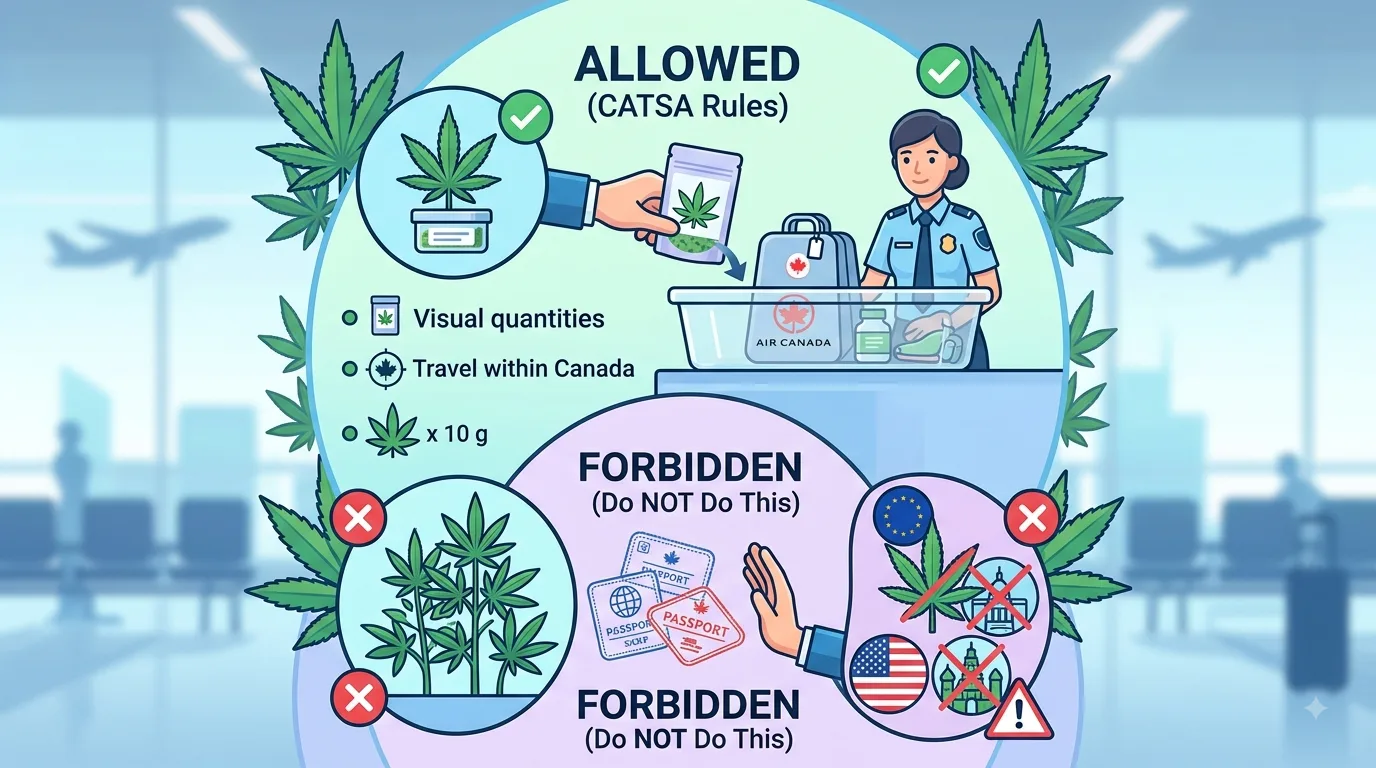
Here's the reality that most Canadian travellers don't know: flying domestically with cannabis in Canada is perfectly legal under federal law. Yes, you read that correctly. Since the Cannabis Act came into force in October 2018, adults can legally transport up to 30 grams of dried cannabis (or equivalent) on domestic flights within Canada. The Canadian Air Transport Security Authority (CATSA) has clear guidelines, yet confusion and misinformation still dominate airport conversations and online forums.
This comprehensive guide cuts through the noise. We'll break down exactly what CATSA allows, debunk the most persistent myths that could land you in unnecessary trouble, and outline the critical mistakes that could turn your legal cannabis into a confiscated product or worse. Whether you're flying from Ottawa to Vancouver or Halifax to Calgary, understanding these rules isn't just about convenience. It's about protecting your rights as a legal cannabis consumer in Canada.
The Legal Framework: What Canadian Federal Law Actually Says About Flying with Cannabis
The foundation for flying with cannabis starts with the Cannabis Act, Canada's federal legislation that legalized recreational cannabis nationwide. Under this law, adults 19 years or older (18 in Alberta and Quebec) can possess up to 30 grams of dried cannabis in public spaces. Airports fall under federal jurisdiction, which means provincial cannabis laws take a back seat to federal regulations when you're inside a Canadian airport terminal.
This is a critical distinction many travellers miss. While some provinces restrict where you can consume cannabis or how much you can purchase at once, the federal possession limit of 30 grams applies uniformly in all Canadian airports. Transport Canada and CATSA operate under this federal framework, not provincial rules.
Understanding the 30-Gram Limit and Equivalencies
The 30-gram limit applies to dried flower, but what about edibles, concentrates, vapes, or oils? Health Canada established equivalency guidelines that airport security uses:
- 1 gram of dried cannabis = 1 gram
- 5 grams of fresh cannabis = 1 gram dried equivalent
- 15 grams of edibles = 1 gram dried equivalent
- 70 grams of liquid product = 1 gram dried equivalent
- 0.25 grams of concentrates = 1 gram dried equivalent
This means you could theoretically fly with 450 grams of cannabis gummies (equivalent to 30 grams dried), or 7.5 grams of shatter or other concentrates. These equivalencies exist specifically to ensure travellers don't accidentally exceed legal limits when carrying mixed product types.
Where You Can Pack Cannabis: Carry-On vs Checked Baggage
CATSA explicitly permits cannabis in both carry-on and checked baggage for domestic flights. There's no official preference or restriction. However, practical considerations make carry-on the smarter choice for most travellers. Checked baggage goes through more handling, increases loss risk, and subjects your products to temperature fluctuations in cargo holds.
Keep your cannabis in its original packaging when possible. While not legally required, original packaging helps security officers quickly verify product information and THC content if questions arise. If you're bringing flower from a trusted Ottawa weed store, keep the container sealed until you reach your destination.
What CATSA Screening Officers Actually Look For (And What They Ignore)
Here's what surprises most first-time cannabis flyers: CATSA screening officers are not actively searching for cannabis on domestic flights. Their primary mandate focuses on aviation security threats like weapons, explosives, and prohibited items that could compromise flight safety. Cannabis doesn't fall into any of these categories on domestic routes.
CATSA's official statement makes this clear: "It is the responsibility of passengers to ensure they comply with the regulations regarding cannabis products. There are no restrictions on carrying cannabis products in either checked or carry-on bags, as long as it is within the legal limit."
The X-Ray Reality: What Shows Up and What Doesn't
Modern airport X-ray machines detect organic materials, metals, and density anomalies. Cannabis flower shows up as organic material, similar to food items, toiletries, or other plant matter. Screening officers see these items daily and won't flag cannabis specifically unless something else about your bag triggers secondary inspection.
Vape pens and batteries receive more scrutiny, but for battery safety reasons, not cannabis concerns. Lithium-ion batteries must travel in carry-on baggage, never checked bags. If you're flying with a vape, whether it's a THC vape cartridge or nicotine device, pack it in your carry-on and follow standard battery safety protocols.
When Officers Ask Questions: Your Rights and Obligations
If a CATSA officer asks about cannabis in your bag during screening, you're obligated to answer truthfully. Lying to a screening officer about bag contents is an offence under the Aeronautics Act. However, the conversation typically ends quickly once you confirm it's within legal limits.
Officers may ask you to open the container or package to verify contents. This is standard procedure for any item that appears unclear on X-ray. Cooperate politely, confirm the quantity is under 30 grams, and you'll proceed through security without issues. CATSA officers cannot seize legal cannabis that falls within federal possession limits.
The Myths That Won't Die: Debunking Common Cannabis Flying Misconceptions
Despite clear federal guidelines, myths about flying with cannabis persist in online forums, social media groups, and word-of-mouth advice. These misconceptions range from mildly inaccurate to potentially illegal. Let's dismantle the most common ones with facts.
Myth #1: "You Need a Medical Cannabis Prescription to Fly"
Absolutely false for domestic flights. Recreational cannabis consumers have identical rights to medical patients when flying within Canada. The 30-gram federal limit applies to everyone. Medical patients with prescriptions may possess more than 30 grams outside airports, but inside airport terminals and on aircraft, the 30-gram rule applies universally.
This myth likely stems from pre-legalization rules when only medical cannabis was legal. Those days are gone. Any adult meeting provincial age requirements can fly domestically with recreational cannabis products purchased from legal retailers.
Myth #2: "Airport Security Treats Cannabis Like TSA Does in the United States"
This dangerous myth causes unnecessary anxiety and sometimes leads to poor decisions. CATSA is not the TSA. Canada's federal cannabis legalization means completely different rules apply at Canadian airports compared to American ones.
In the United States, cannabis remains federally illegal even in states where recreational use is legal. TSA operates under federal law and can refer passengers to law enforcement if they discover cannabis. In Canada, CATSA operates under the Cannabis Act, which explicitly allows adult possession of up to 30 grams.
The confusion intensifies because many Canadians travel to U.S. airports. Remember this critical distinction: domestic Canadian flights follow Canadian law. Flights to or from the United States follow stricter rules we'll address later.
Myth #3: "You Can't Fly with Edibles Because They Look Like Regular Food"
Cannabis edibles are legal to fly with domestically, full stop. Whether you're carrying gummies, chocolates, baked goods, or beverages, they're permitted within the 30-gram dried equivalent limit (remember: 15 grams of edibles = 1 gram dried equivalent).
The "regular food" concern stems from parents worrying about child access, not legal restrictions. Store edibles in child-resistant packaging and keep them secured in your bag. Officers may ask you to identify edibles during screening, but possession itself is legal.
Myth #4: "Some Airports Are More Strict Than Others"
CATSA applies federal standards uniformly across all Canadian airports. Whether you're flying from Toronto Pearson, Vancouver International, or Ottawa Macdonald-Cartier, the rules remain identical. Individual officer attitudes might vary slightly, but official policy doesn't change by location.
This myth often spreads when someone has a negative experience at one airport and assumes it's location-specific policy. More likely, they encountered an officer unfamiliar with cannabis rules, had product over the legal limit, or faced issues unrelated to cannabis that they attributed to their cannabis possession.
Myth #5: "You Should Hide Cannabis Deep in Your Bag to Avoid Problems"
This myth is particularly problematic because it suggests deceptive behavior that could actually create problems. Burying cannabis under layers of clothing or hiding it in toiletry bags signals you're doing something wrong, which may trigger additional scrutiny.
Pack cannabis like any other legal item you're transporting. Keep it accessible if officers need to verify contents. Trying to conceal legal products raises suspicion about whether you're actually complying with quantity limits or possibly transporting other prohibited items.
What You Absolutely Should Not Do: Critical Mistakes That Turn Legal Cannabis Into Legal Problems
Understanding what's allowed only tells half the story. Knowing what to absolutely avoid prevents the situations that lead to confiscation, fines, or criminal charges. These aren't minor oversights. They're mistakes that transform your legal cannabis into a legitimate legal problem.
Never, Ever Fly Internationally with Cannabis (Including to the United States)
This is the single most important rule: never cross international borders with cannabis, even if travelling to countries or states where cannabis is legal. The Cannabis Act explicitly prohibits taking cannabis across Canadian borders in either direction. This applies to all international destinations, including:
- United States (all states, including those with legal recreational cannabis)
- Mexico
- Uruguay
- European countries with legal cannabis
- Litreally everywhere outside Canada
Canadian Border Services Agency (CBSA) and international customs agencies actively screen for cannabis. Getting caught attempting to export cannabis from Canada can result in arrest, criminal charges, and a permanent criminal record. International drug trafficking charges don't care that you were only bringing your personal stash to Colourado.
If you're flying from Ottawa to any U.S. city, leave your cannabis at home or with trusted friends. Consider using same-day weed delivery in Ottawa when you return instead of risking international transport.
Don't Exceed the 30-Gram Limit (Even by a Little)
The 30-gram possession limit isn't a suggestion or rough guideline. It's a hard legal limit enforced by federal law. Exceeding it, even by one gram, technically constitutes illegal possession. While minor overages might result in warnings rather than charges, why risk it?
Before heading to the airport, weigh your cannabis if you're bringing multiple products. Remember those equivalency calculations for edibles, concentrates, and oils. Three gummies might seem innocent, but if each contains 10mg THC and weighs 5 grams, you're already over 1 gram dried equivalent just from candy.
Many travellers make this mistake by thinking in "number of items" rather than weight. Don't count how many joints you're packing. Weigh them and calculate total cannabis content. A kitchen scale costs less than the legal fees from a possession charge.
Never Consume Cannabis in Airports or on Aircraft
Possessing cannabis in airports is legal. Consuming cannabis in airports or on aircraft is absolutely prohibited. Canadian airports are smoke-free environments, and cannabis consumption violates both airport regulations and the Aeronautics Act.
This includes vaping, which some travellers mistakenly believe is more permissible because it's less conspicuous. It's not. Vaping cannabis in airport terminals or airplane bathrooms can result in fines up to $5,000 and potential criminal charges for interfering with flight crew duties.
Airlines have zero tolerance for intoxicated passengers or onboard consumption. If flight crew suspects you're impaired or consumed cannabis during flight, they can request law enforcement meet the aircraft upon landing. Save consumption for after you land and leave the airport.
Don't Pack Cannabis in Carry-On If Flying with Connecting International Flights
Some domestic itineraries include connections where you might transfer through airports handling international flights. While domestic Canadian travel allows cannabis in carry-on, you could face complications if your domestic connection shares space with international terminals.
For example, if you're flying Ottawa to Vancouver with a connection through Toronto Pearson's international terminal, keep cannabis in checked baggage to avoid accidentally entering restricted international zones where different rules apply. Better yet, ship cannabis products to your destination using Canada Post if your itinerary involves complex routing.
Never Lie to CATSA Officers About Bag Contents
We mentioned this earlier, but it bears repeating as a critical "don't." If a screening officer asks what's in your bag, answer honestly. Lying about bag contents, even about legal items, violates federal aviation security laws.
If you're unsure whether your cannabis quantity is within limits, say so. Officers can weigh items or help you calculate equivalencies. They'd rather spend two minutes helping you verify legal possession than deal with the paperwork from someone who lied during screening.
Practical Tips for Stress-Free Cannabis Air Travel in Canada
Now that you know what's legal and what to avoid, let's cover practical strategies that make flying with cannabis smooth, professional, and entirely uneventful. These tips come from experienced travellers who fly regularly with cannabis and never encounter issues.
Keep Products in Original, Sealed Packaging
While not legally required, original packaging serves multiple purposes. It displays THC content, producer information, and government warnings that help verify legal products. Sealed containers also prevent odour from escaping, which keeps your bag smelling neutral during screening.
If you've already opened a package and used some product, keep what remains in the original container. The government warning labels and producer information still identify it as legal cannabis rather than unknown substances.
Pack a Small Digital Scale if Carrying Multiple Products
A compact digital scale (available for $15-20) removes all guesswork about whether you're within legal limits. Weigh your cannabis before leaving for the airport. Calculate equivalencies for mixed product types. Document your math if it makes you feel more confident.
This might seem excessive, but it takes five minutes and eliminates the primary reason cannabis gets confiscated at airports: accidental possession over legal limits. Think of the scale as insurance against honest mistakes.
Arrive Early and Stay Calm During Screening
Airport security moves slower when you're anxious about legal cannabis in your bag. Give yourself extra time. Rushing creates stress that makes legal situations feel illegal. If you're within the 30-gram limit and flying domestically, you have nothing to worry about.
Approach screening with the same calm confidence you'd have carrying any legal item. Cannabis is legal. You're a legal adult. Your possession is within legal limits. There's no reason for concern.
Consider Shipping Products to Your Destination via Canada Post
For extended trips or situations where you want to bring more than 30 grams total, Canada Post allows adults to ship cannabis to themselves or other adults within Canada. This legal alternative avoids possession limit concerns while ensuring your products reach your destination.
Many regular travellers use this method for vacation homes or extended work trips. Purchase from a trusted Indigenous-owned Ottawa cannabis delivery service, ship products before departure, and they arrive when you do. No airport screening, no weight calculations, no stress.
Know Your Rights But Don't Be Confrontational
Understanding cannabis laws empowers you to travel confidently, but aggressive assertion of rights creates unnecessary conflict. If an officer questions your cannabis possession, calmly explain that you're within the 30-gram federal limit for domestic air travel.
Offer to show product packaging or have items weighed if there's uncertainty. Cooperation resolves questions quickly. Confrontation escalates situations that should take 30 seconds to clarify. You're right about the law, but being right doesn't require being difficult.
Province-Specific Considerations When Flying Within Canada
While federal law governs airports and aircraft, you'll eventually leave the airport and enter provincial jurisdiction at your destination. Understanding provincial differences prevents problems after landing.
Public Consumption Rules Vary Significantly by Province
Quebec prohibits cannabis consumption in all public spaces. British Columbia allows consumption anywhere tobacco smoking is permitted. Ontario restricts consumption to private residences with limited exceptions. Alberta allows consumption in designated areas similar to tobacco.
Research your destination province's consumption laws before travelling. Just because you legally flew with cannabis doesn't mean you can consume it wherever you want after landing. Many first-time travellers run into trouble by lighting up in hotel parking lots or public parks in provinces with strict consumption laws.
Purchase Age Varies: 18 in Alberta and Quebec, 19 Everywhere Else
If you're 18 or 19, pay attention to age requirements. You can legally possess cannabis at 18 in Alberta and Quebec, but you must be 19 in all other provinces. Flying from Alberta to Ontario at age 18 with cannabis creates a legal grey area once you land.
Technically, federal possession limits apply during air travel regardless of provincial age. However, possessing cannabis in Ontario's airport terminal upon landing when you're under 19 could trigger provincial law complications. When in doubt, wait until you're 19 for interprovincial travel with cannabis.
Retail Purchase Restrictions Don't Apply to Personal Travel Quantities
Some provinces limit how much cannabis you can purchase in a single transaction at retail stores. Quebec limits purchases to 30 grams per transaction. These retail restrictions don't affect personal possession or air travel.
You can fly with up to 30 grams regardless of where you purchased it or how many separate transactions it took to acquire. Retail purchase limits and personal possession limits are separate legal concepts.
What Happens If Something Goes Wrong: Understanding Enforcement and Consequences
Despite your best efforts to comply with regulations, misunderstandings or genuine mistakes can occur. Knowing what to expect if you're stopped, questioned, or face enforcement action helps you respond appropriately and protect your rights.
Minor Overages and First-Time Issues
If CATSA officers or police determine you're slightly over the 30-gram limit, enforcement response depends on circumstances. A first-time traveller with 32 grams might receive a warning and have excess cannabis confiscated. Someone with 50 grams faces potential criminal charges.
Officers have discretion in enforcement. Polite cooperation, honest communication, and clear evidence you didn't know about exact weight can influence whether you receive a warning versus criminal charges. This doesn't make overages acceptable, but understanding enforcement discretion explains why outcomes vary.
International Travel Violations Carry Serious Consequences
Attempting to cross international borders with cannabis triggers immediate law enforcement involvement. CBSA officers will detain you, seize cannabis, and refer you to police for criminal charges. These aren't minor possession tickets.
International cannabis trafficking, even for personal amounts, creates permanent criminal records that affect employment, travel to other countries, and professional licensing. The U.S. Customs and Border Protection maintains records of cannabis-related incidents that can result in permanent entry bans to the United States.
If you accidentally pack cannabis in luggage for an international flight and realize before screening, you have options. Tell CATSA officers immediately, surrender the cannabis voluntarily, and explain the honest mistake. This approach avoids criminal charges in most cases. Trying to sneak through and getting caught eliminates any benefit of doubt.
Consumption Violations in Airports or Aircraft
Consuming cannabis in airports or on aircraft results in immediate intervention by airport security or flight crew. Fines start at $1,000 and can reach $5,000 for first offences. Repeat violations or consuming during flight can result in criminal charges for interfering with aircraft operations.
Airlines can also ban you from future flights. Being intoxicated on aircraft or consuming cannabis onboard violates airline terms of carriage and potentially federal aviation safety regulations. One bad decision in an airplane bathroom can result in criminal charges, permanent airline bans, and fines that cost more than your entire vacation.
Frequently Asked Questions About Flying with Cannabis in Canada
Yes, cannabis edibles are completely legal to fly with on domestic flights within Canada. Edibles count toward your 30-gram dried cannabis equivalent limit using the conversion rate of 15 grams of edibles equals 1 gram of dried cannabis. Keep edibles in original child-resistant packaging when possible and be prepared to identify them if screening officers ask. A standard pack of 10mg THC gummies weighing 150 grams total equals 10 grams dried equivalent, well within legal limits.
No, you don't need to declare cannabis when flying domestically in Canada. CATSA doesn't require passengers to declare legal cannabis products during screening. However, if a screening officer asks about items in your bag, you must answer truthfully. Cannabis is treated like any other legal item in your possession. Keep it within the 30-gram federal limit, pack it in carry-on or checked baggage, and proceed through security normally.
Yes, you can bring vape pens and THC cartridges on domestic Canadian flights, but they must travel in your carry-on baggage, not checked bags. This requirement exists because vape pens contain lithium-ion batteries that pose fire risks in cargo holds. Pack your vape pen with other electronics, ensure batteries are protected from short circuits, and keep THC cartridges within your 30-gram dried equivalent limit. Remove batteries from devices if possible and store them in protective cases.