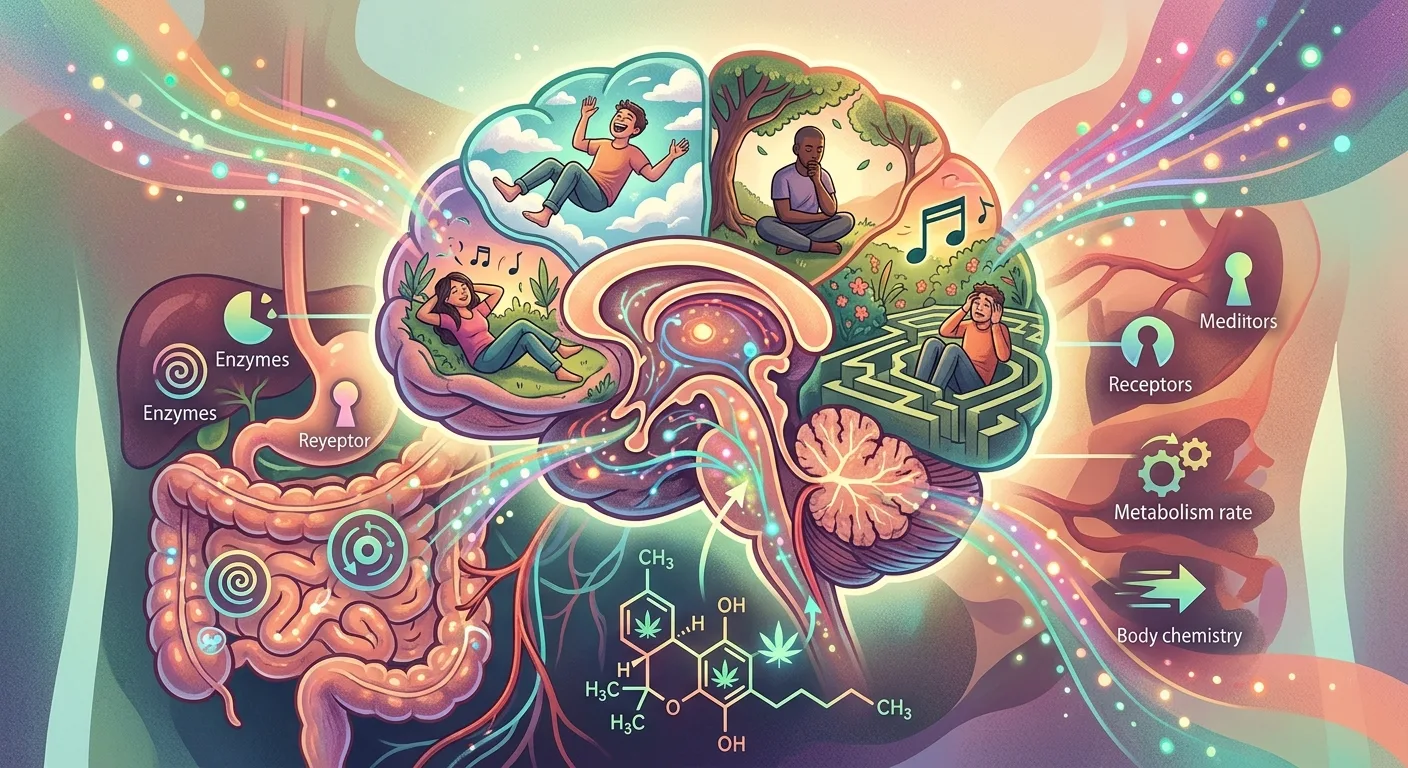
Four people can split the same bag of 10mg cannabis gummies on the same evening and have completely different experiences. One may feel comfortably relaxed within an hour, another may barely notice anything, while someone else may feel overwhelmed or still feel the effects the following morning.
Same product. Same dose. Same night.
That variation is one of the defining characteristics of cannabis edibles. Unlike inhaled cannabis, an edible has to pass through the digestive system and liver before its effects fully develop. Each stage introduces variables that can change the experience.
Understanding those variables won't make an edible experience perfectly predictable, but it can help you understand which factors you can control.
The Liver Step Changes the Molecule
This is one of the biggest differences between eating and inhaling cannabis.
When cannabis is inhaled, THC moves from the lungs into the bloodstream and reaches the brain relatively quickly. When THC is eaten, it travels through the digestive system and then to the liver.
The liver converts a substantial portion of THC into 11-hydroxy-THC, a different compound that crosses into the brain more readily and is generally associated with stronger and longer-lasting effects.
That means an edible isn't simply a slower version of smoking. Your body processes the THC differently, and the amount converted can vary between people.
Why Smoking Tolerance Doesn't Always Transfer
One of the most common edible mistakes is assuming that smoking tolerance directly determines edible tolerance.
Someone who smokes cannabis regularly may assume they need a similarly large edible dose. But the exposure profile is different because the body produces 11-hydroxy-THC during digestion.
For that reason, a history of smoking isn't necessarily a reliable guide to your starting edible dose.
Enzyme Variation Between People
The liver conversion process involves enzymes whose activity can vary considerably from person to person.
Research has identified genetic differences associated with different rates of THC metabolism. Some people may convert THC relatively quickly and extensively, while others may convert it more slowly or less completely.
That can help explain why one person finds a modest edible dose very noticeable while another says edibles barely affect them.
There isn't a simple consumer test that tells you exactly how your body will process an edible. Comparing your dose directly with someone else's therefore isn't particularly useful.
Stomach Contents and Fat
Food is one of the variables you can actually control.
On an empty stomach: onset can be faster and the peak may feel sharper.
After a meal, particularly one containing fat: onset can be slower, while total absorption may increase because THC is fat-soluble.
This means the same gummy can produce noticeably different results on different days even when the dose hasn't changed.
If you're trying to understand your own response to edibles, consistency matters. Keeping your food routine relatively similar makes it easier to understand what the dose itself is doing.
For a deeper look at how fat affects cannabis products, see our guide on why fat content changes your high.
Format Changes the Route
Not every cannabis edible follows exactly the same absorption pathway.
| Format | Typical Onset | Route | Notes |
|---|---|---|---|
| Gummies, baked goods | 30–120 min | Digestive, full liver pass | Standard edible profile |
| Chocolate | 30–120 min | Digestive, fat-assisted | Fat content can aid absorption |
| Capsules | 45–120 min | Digestive, full liver pass | Generally slower |
| Beverages, nano-emulsified | 15–45 min | Partly faster absorption | Often marketed for quicker onset |
| Tinctures held under tongue | 15–45 min | Partly sublingual | Some absorption can bypass the liver |
| Tinctures swallowed | 30–120 min | Digestive | Behaves more like a standard edible |
Sublingual tinctures are particularly interesting. When held under the tongue, some of the product can absorb through oral tissue directly into the bloodstream.
Swallow the same tincture, however, and it follows the digestive route instead.
So even the same product can produce a different experience depending on how you take it.
Other Variables Worth Knowing
Several additional factors can affect how an edible feels.
Body Composition
THC is fat-soluble and can distribute into fatty tissue, influencing how much is immediately available and how long traces can persist.
Recent Tolerance
Tolerance can change after a period without cannabis. If you've taken several weeks away, assuming your previous regular dose will feel identical may lead to an unexpectedly strong experience.
Product Accuracy
Product consistency matters too.
Outside regulated products, testing and manufacturing standards can vary. A product labelled as 10mg may not always contain exactly 10mg, and individual pieces from the same package may not necessarily contain identical amounts.
Package Total vs. Per-Piece Dose
Always distinguish between the total THC in a package and the amount in each piece.
For example, a 600mg package containing 20 pieces would contain 30mg per piece, assuming the THC is distributed evenly.
Our guide to reading THC labels on Canadian edibles explains how to read those numbers correctly.
A Practical Approach to Finding Your Baseline
Because individual responses vary so much, keeping your own records can be more useful than comparing your experience with someone else's.
If you're new to edibles, the source recommends starting with 2.5–5mg, regardless of your smoking history.
A practical approach is:
- Start with 2.5–5mg if you're inexperienced with edibles.
- Wait at least two hours before considering additional THC.
- Keep your food routine consistent while establishing a baseline.
- Increase in small increments rather than doubling your dose.
- Record the dose, product, food, onset time, duration and overall experience.
- Avoid combining cannabis with alcohol.
The point isn't to find a universal "correct" dose. It's to understand how your own body responds to a particular dose and product.
Uper Weed lists per-piece strengths across its edibles and gummies categories, making it easier to identify the amount you're actually taking. You can also explore weed delivery in Ottawa when choosing a lower-strength product for establishing a baseline.
If You Take Too Much
Taking more THC than intended can be uncomfortable. Common effects can include anxiety, a racing heart, nausea and disorientation, and the experience generally resolves with time.
If you've taken too much:
- Stay somewhere quiet and familiar.
- Drink water.
- Avoid taking more cannabis.
- Avoid alcohol and caffeine.
- Have someone you trust nearby if possible.
- Give the effects time to wear off.
Seek medical attention for serious symptoms such as chest pain, difficulty breathing, persistent vomiting or loss of consciousness. If a child or pet consumes cannabis, seek immediate professional guidance.
Frequently Asked Questions
Individual differences in THC metabolism can affect how strongly someone responds to an edible. Product consistency, dose accuracy, food intake and other factors can also contribute.
When THC is eaten, the liver converts a substantial portion into 11-hydroxy-THC, which has a different effect profile from inhaled THC. This is one reason an edible can feel stronger and last longer than expected.
Not directly. Smoking and edibles produce different exposure profiles, so someone who regularly smokes cannabis may still respond strongly to a relatively small edible dose.
Both can produce different results. An empty stomach may lead to faster onset, while a meal containing fat can slow onset and increase total absorption. Consistency is useful when you're trying to understand your own response.
Food intake, recent tolerance, product consistency and individual factors can all contribute. Changes in stomach contents can particularly affect onset and absorption.
They can. A tincture held under the tongue can have some sublingual absorption, while a swallowed tincture follows the digestive route and behaves more like a standard edible.
The Short Version
Edibles affect everyone differently because they take a longer route through the body, with the liver converting THC into 11-hydroxy-THC along the way. The amount and speed of that conversion can vary between people.
You can't control your enzymes, but you can control several important variables: dose, food, timing and consistency.
If you're learning how edibles affect you, start low, wait long enough before considering more, keep your food routine consistent and record what happened. A few notes about your own experiences can tell you considerably more than someone else's edible dose.
Browse Uper Weed's edibles and gummies and choose a product with a clearly listed per-piece strength.Explore Cannabis Edibles