 %
%
 %
%
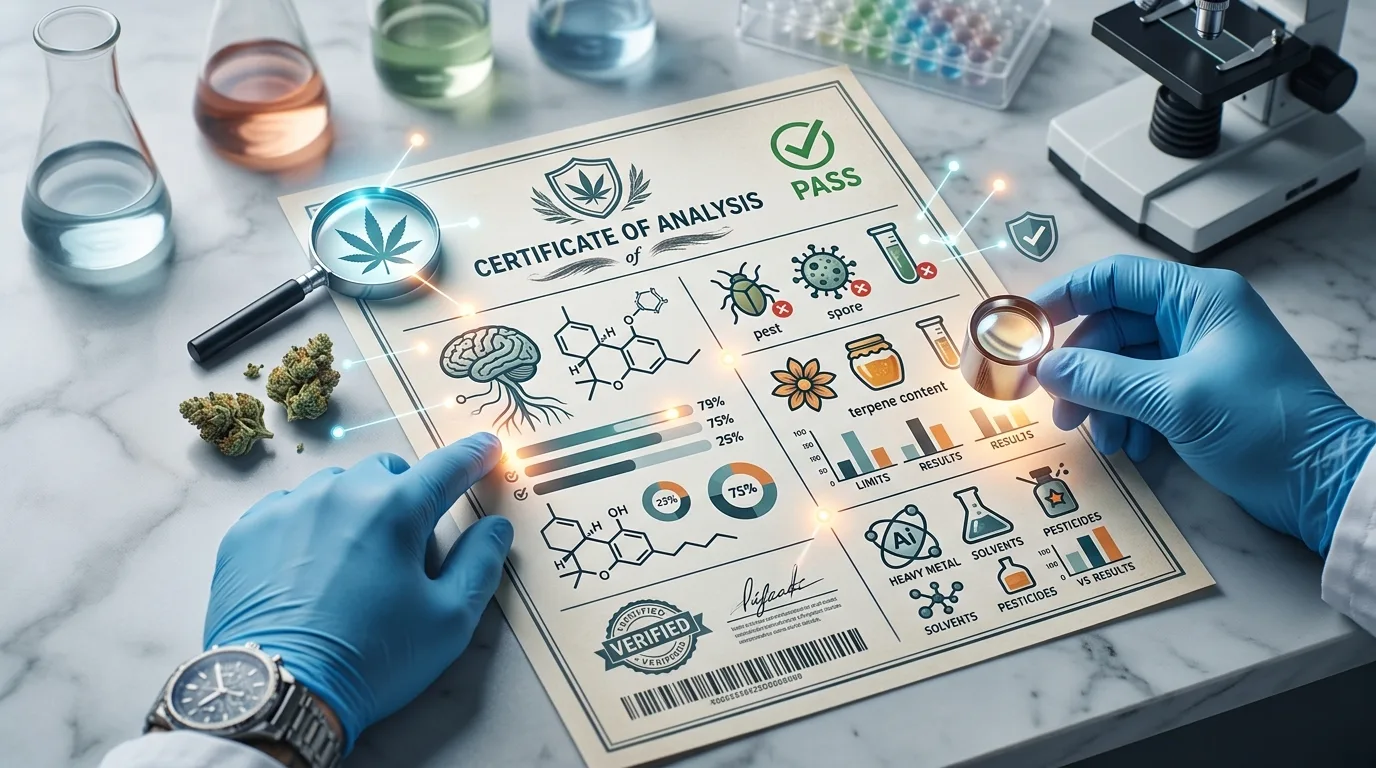
"Lab tested" appears on an enormous number of cannabis listings. A document you can actually open appears on far fewer, and a document that covers more than potency is rarer still.
That gap matters, because a Certificate of Analysis is the one piece of information about cannabis that isn't a judgement call. Everything else on a menu is a description someone wrote. A COA is a set of measurements taken by a third party on a specific batch, and it either exists or it doesn't.
The catch is that almost nobody reads past the first panel. People check the THC percentage, nod, and close the tab, which skips the sections that answer the questions that actually matter: was there mould, were there pesticides, was the solvent properly purged out of the concentrate.
Here's what each part of the document covers and what a problem looks like.
What a COA Is
A Certificate of Analysis is a report issued by an analytical laboratory for a specific sample, from a specific batch, on a specific date. It should name the lab, identify the sample, and present results against defined limits.
Three things worth being clear about up front:
It applies to a batch, not a product line. A COA for one harvest tells you nothing about the next one.
It reflects the sample submitted. If a producer sends their best material, the result is accurate for that material and unrepresentative of the rest.
Testing is mandated inside Canada's licensed retail system and not outside it. In the unregulated market, a COA is something a seller chooses to obtain. Some do, properly. Some obtain potency-only testing and describe it as "lab tested." Some don't test at all.
The Seven Sections
1. The Header
Easy to skip and the most important part for establishing whether the rest means anything.
Look for: the laboratory's name, its accreditation if listed, a sample identifier, a batch or lot number, the date the sample was received, and the date of testing.
The batch number is what connects the document to the product in your hand. A COA without one cannot be matched to anything, which makes it decorative.
2. Cannabinoid Potency
The panel everyone reads.
You'll see THCA and THC listed separately, because raw cannabis contains mostly THCA, which only becomes active THC when heated. Labs calculate a "total THC" figure using a standard formula that accounts for mass lost during that conversion. Our article on what THC percentage actually measures covers why that figure is a theoretical ceiling rather than what reaches you.
CBD and CBDA are reported the same way. Minor cannabinoids such as CBG, CBN and CBC may appear if the panel covers them.
ND means not detected. LOQ is the limit of quantification, the lowest level the method can measure reliably. A result below LOQ means present but too low to quantify, not absent.
Sanity check: flower above roughly 35% total THC is physically implausible. Anything over 100% on any product is a data entry error, usually a milligram value typed into a percentage field.
3. Terpenes
Often optional, and more useful than the potency panel for predicting what a flower will actually be like.
You'll get individual compounds with percentages and usually a total. Total terpene content is the more informative number: anything around 2% or above is generally considered strong for flower, and very low totals suggest either poor genetics, a rushed dry, or age.
Worth noting that terpene panels do not measure the volatile sulfur compounds responsible for the skunky, gassy character. Those need different equipment entirely, which is why a terpene report can miss the aroma you notice first. Our guide on why some weed smells like skunk covers that.
4. Pesticides
Reported as pass/fail against action limits, usually with the specific compounds listed.
This is one of the two panels where a failure actually matters to your health rather than your wallet. Pesticide residue isn't visible, isn't smellable, and isn't something any of the sensory checks in our cure quality guide will reveal.
A full pesticide panel covers dozens of compounds. A short panel covering a handful is better than nothing and worth noticing as a limitation.
5. Heavy Metals
Typically lead, arsenic, cadmium and mercury.
Cannabis is a known bioaccumulator, meaning it draws metals out of the growing medium and concentrates them in plant tissue. That makes soil quality a genuine variable, and it's a particular consideration for outdoor material from unknown sites.
6. Microbials and Mycotoxins
Yeast and mould counts, plus specific pathogens: E. coli, salmonella, and Aspergillus species.
This is the panel that matters most for flower. Mould on cannabis is not safe to inhale, and the species tested for are the ones with real consequences for people with compromised immune systems.
Mycotoxins, usually aflatoxins and ochratoxin, are toxic compounds produced by certain moulds. They can be present even when visible mould isn't.
Visual inspection catches obvious contamination. It doesn't catch everything, which is exactly why this panel exists.
7. Residual Solvents
Concentrates only, and not optional for them.
Solvent-based extraction uses hydrocarbons such as butane and propane, which are then purged under heat and vacuum. This panel measures what's left behind, typically covering butane, propane, ethanol, hexane, benzene and others.
If you're buying shatter, budder, wax, live resin or distillate, this is the panel that tells you whether the purge was done properly. Our comparison of live resin, live rosin and cured resin covers which products involve solvents; solventless products such as rosin and ice water hash don't need this panel, which is part of their appeal.
Also Sometimes Present
Water activity and moisture content on flower, which relates directly to mould risk and to how well it was cured. Our humidity pack guide covers the storage side of the same issue.
Foreign matter, meaning stems, seeds, hair, insects and debris.
Panel Summary
| Panel | What it answers | Who should care most |
|---|---|---|
| Header | Does this document apply to my product? | Everyone |
| Cannabinoids | How potent, roughly | Everyone, with scepticism |
| Terpenes | What will it smell and taste like | Flavour-focused buyers |
| Pesticides | Was it sprayed | Everyone |
| Heavy metals | What was in the soil | Outdoor and bulk buyers |
| Microbials | Is there mould or bacteria | Flower buyers especially |
| Residual solvents | Was the extraction purged | Concentrate buyers only |
Red Flags
No lab name. A result from an unnamed lab is a number in a table.
No batch number or date. Cannot be matched to the product, so it proves nothing about what you're holding.
Potency only, described as "full panel." If there's no contaminant testing, the safety questions simply weren't asked.
A document that doesn't match the product. Different strain name, different product type, different batch. More common than you'd expect.
An old date on current inventory. A COA from two years ago doesn't describe this year's harvest.
An image rather than a document. A screenshot of a result can't be verified against the lab.
Impossible numbers. Flower above 35%, anything above 100%, or cannabinoid totals that don't add up.
Pass/fail with no limits shown. A "pass" is only meaningful against a stated threshold.
How to Actually Verify One
-
Check the lab exists. Search the name. Reputable labs have a web presence and list their accreditations.
-
Match the batch number on the COA to the batch number on the product.
-
Check the date is recent relative to when the product was packaged.
-
Look for a QR code or verification link. Many labs provide one that pulls the original record from their own system, which defeats any tampering with the PDF.
-
Ask for the full panel if only potency is shown. How a seller responds to that question is informative on its own.
The Honest Context
Outside Canada's licensed retail system, there is no requirement to test, no standard methodology, and nobody auditing whether a stated number came from a lab at all. That's the situation, and no article changes it.
What it means practically: a seller who provides complete, current, batch-matched COAs is giving you something they weren't obliged to give, and that's worth weighing. A seller who provides nothing isn't necessarily selling bad product, but you're relying entirely on inspection and reputation instead.
The sensory checks still matter and still catch a lot. Our guides on how to tell if flower was cured properly and spotting adulterated cannabis cover what your own eyes and nose can establish. They just can't establish pesticide residue or mycotoxins, which is the gap a lab report fills.
We note testing and batch information where producers supply it across our flower, concentrates and hash listings, and weed delivery Ottawa covers how ordering works.
Frequently Asked Questions
A Certificate of Analysis: a report issued by an analytical laboratory on a specific sample from a specific batch. A complete one covers cannabinoid potency, terpenes, pesticides, heavy metals, microbials and mycotoxins, plus residual solvents for concentrates. It applies to that batch only, not to a product line generally.
Raw cannabis contains mostly THCA, which isn't intoxicating until heat converts it into THC. Labs report both separately and then calculate a
Not detected, meaning the compound wasn't found above the method's detection threshold. LOQ is the limit of quantification, the lowest level the method can measure reliably. A result listed as below LOQ means something was present but too low to quantify accurately, which is not the same as absent.
Microbials for flower, since mould isn't safe to inhale and visual inspection misses plenty of it. Residual solvents for concentrates, since that's the only way to confirm the extraction was properly purged. Pesticides matter for everything and can't be detected by any sensory check.
No. Testing is mandated and audited inside Canada's licensed retail system and not outside it, so a COA from an unregulated seller is something they chose to obtain. That makes complete, batch-matched, current documentation a meaningful signal rather than a baseline expectation.
Check that the lab exists and has a real web presence, match the batch number on the document to the product, confirm the date is recent, and use any QR code or verification link to pull the record from the lab's own system. A screenshot without those elements can't be verified.
The Short Version
A COA has seven sections and most people read one. The potency panel is the least informative of them.
The header tells you whether the document applies to your product at all. Microbials tell you whether there's mould. Residual solvents tell you whether a concentrate was purged. Pesticides and heavy metals tell you about things no amount of smelling and squeezing will ever reveal.
Check the batch number matches, check the date is current, and if only potency appears, the safety questions weren't asked. That's three checks and about a minute, and it's the only part of buying cannabis that isn't somebody's opinion.