 %
%
 %
%
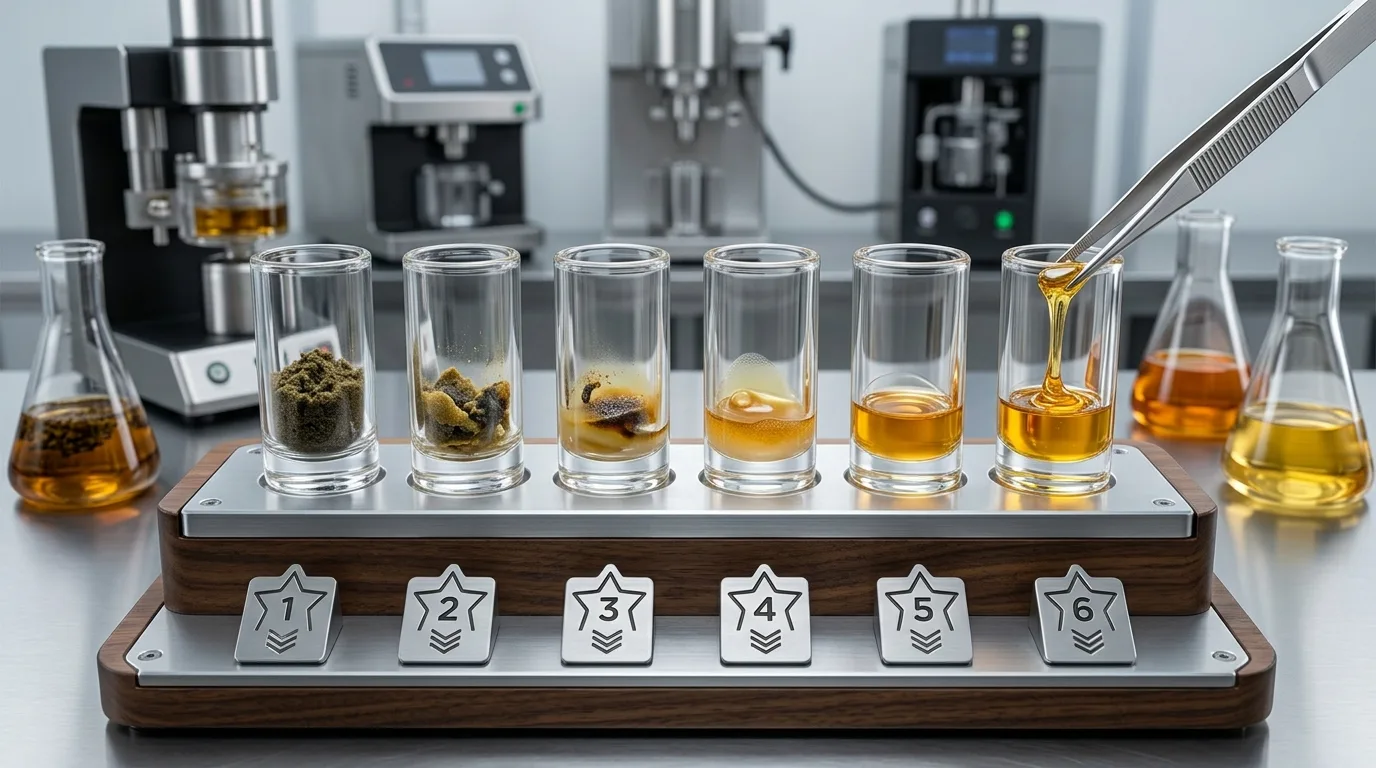
Hash menus carry a vocabulary that nobody explains at the point of sale. Full melt. Half melt. Six star. 90 micron. Cold cure. The prices track those terms closely, which suggests they mean something specific, and they do, but almost nothing written for consumers says what.
The most common assumption is that the star rating is a potency scale, so six star must be stronger than three star. It isn't. Two hashes at opposite ends of the scale can test within a few percentage points of each other.
What the rating measures is purity, expressed through a physical test: how completely the material melts when heated. That single property determines what you can usefully do with a given hash, which makes the scale far more practical than a potency figure would be.
What the Rating Measures
Hash is concentrated trichome heads. The bulbous heads are what you want; the stalks, plant fragments and contaminants that come along with them are what you don't.
Pure trichome heads melt. Heat ruptures them and the resin inside liquefies and bubbles. Plant material doesn't melt; it chars and leaves black residue.
So heating a small amount of hash and watching what it does is a direct physical test of purity. Hash that melts completely into clear bubbling oil with almost no residue is nearly pure resin. Hash that bubbles partly and leaves black char behind contains a meaningful proportion of plant matter.
The six-star scale is a shorthand for where a given batch sits on that spectrum. It originated in the ice water extraction world, where the separation process can be controlled precisely enough to produce a range of purities from the same starting material.
The Hash Star Rating Scale
| Rating | Melt behaviour | Residue | Typical use |
|---|---|---|---|
| 1 to 2 star | Barely melts, mostly chars | Heavy black residue | Pressing into traditional hash, cooking |
| 3 star | Partial melt, bubbles unevenly | Noticeable residue | Bowls, joints, pressing |
| 4 star | Half melt, bubbles well | Some residue | Bowls, topping, light dabbing |
| 5 star | Near full melt | Light residue | Dabbing, vaporizing |
| 6 star | Full melt, liquefies completely | Almost none | Dabbing, pressing into rosin |
The practical division is between four and five. Below that line, the material is better suited to being smoked alongside flower or pressed into traditional hash. Above it, you can dab or vaporize it directly without leaving a mess behind.
Why Lower Ratings Aren't Bad
This is where people misread the scale. A three-star hash is not a failed six-star. It's a different product with different uses, and it's often the better buy for someone smoking bowls and joints rather than dabbing.
Lower-star material also presses into excellent traditional hash. The plant content that prevents it melting cleanly doesn't prevent it being pressed, cured and smoked the way hash has been consumed for centuries.
Our M.M.S hash guide covers that tradition, and most traditional hash would not score highly on a melt scale while being thoroughly enjoyable.
Where Micron Numbers Come In
Ice water extraction works by agitating cannabis in ice water so trichome heads break off, then filtering the water through a stack of mesh bags with progressively smaller openings. The openings are measured in microns.
Each bag catches a different size fraction. Trichome heads fall within a particular size range, so some bags catch mostly heads while others catch mostly stalks, fragments and contaminants.
| Micron range | What it catches | Typical quality |
|---|---|---|
| 160µ and above | Large debris, plant matter, some large heads | Lower |
| 120 to 159µ | Large heads plus some contamination | Good |
| 73 to 119µ | The core of the head size range | Usually the best |
| 45 to 72µ | Smaller heads, immature heads | Good to very good |
| Below 45µ | Fine fragments, broken material | Lower |
The 73 to 120 micron range is generally where the highest-quality material lands, which is why you'll see hash marketed by those numbers. Producers often combine adjacent fractions, and a listing describing itself as "73 to 120" is telling you it kept the best bags and discarded the rest.
This is the same physical separation principle as dry sifting, just with water doing the work instead of screens and agitation. Our kief guide covers the simplest version of it.
Testing Melt Yourself
Two methods, neither requiring special equipment.
The dome or glass test. Place a small piece, no bigger than a grain of rice, on a clean heat-resistant surface, apply gentle heat from underneath, and watch. Full melt material liquefies and bubbles vigorously, going clear. Lower grades bubble weakly, char at the edges and leave black residue behind.
The bowl test. Put a small piece on top of flower in a bowl and observe how it behaves as it heats. Higher grades melt into the flower; lower grades sit there and burn.
Caveat worth stating: melt behaviour indicates resin purity, not safety or absence of contaminants. It tells you about plant matter, not about anything that might have been added. Treat it as a purity indicator rather than a quality certificate.
Star Rating Versus Colour
These are two different properties that people conflate.
Colour reflects purity, pressing, oxidation, origin and genetics. Melt rating reflects purity and the separation method almost exclusively.
They overlap, since both respond to purity, but they diverge in an important place: heavy pressing and working darkens hash considerably without reducing how well it melts. So a very dark hash can be full melt, and a pale hash that was poorly separated may not be.
How Each Hash Tier Is Best Used
1 to 3 star: Press it into traditional hash, smoke it in bowls and joints, or use it for infusion and edibles where residue is irrelevant. This is the value tier and it's genuinely good at these jobs.
4 star: Half melt. Versatile. Works on top of a bowl, in a joint, and will dab acceptably if you don't mind some residue to clean afterward.
5 to 6 star: Dabbing and vaporizing at low temperature, where the flavour justifies the price. Also the input for pressing into hash rosin, since full melt material presses cleanly.
If you're pressing into rosin, six star is the material that makes it worth doing. Our comparison of live resin, live rosin and cured resin covers where hash rosin sits against the solvent-based categories.
Temperature Matters More at Higher Grades
Six-star hash consumed at high temperature is wasted money. The reason to pay for full melt is the terpene content and flavour, and high heat destroys exactly that.
Keep it low, roughly 150 to 200°C at the surface, and work up only if you need more vapour.
Storage
Higher-grade material is less stable, because purer resin carries more volatile terpene content with less plant matter buffering it.
Keep full melt cold and sealed, ideally refrigerated, and take out only what you're using. Lower-star pressed hash is far more forgiving and stores well at stable room temperature in an airtight container.
Let cold hash warm in your hand before working with it, which matters particularly through an Ottawa winter. Our cold weather guide covers the broader picture.
Our hash section notes extraction method, micron range and melt grade where the producer provides them, so you can match a product to how you actually consume rather than guessing from a price. Same-day weed delivery Ottawa covers the full range.
Frequently Asked Questions
Hash pure enough that it liquefies completely when heated, bubbling into clear oil and leaving almost no residue. That behaviour indicates the material is nearly all trichome heads with minimal plant matter, since plant material chars rather than melting. Full melt corresponds to the top of the six-star scale.
Not necessarily. The star rating measures melt behaviour, which reflects purity rather than cannabinoid concentration. Two hashes several stars apart can test within a few percentage points of each other. What the rating tells you is what you can do with it, not how strong it is.
They describe the mesh size of the filter bags used during ice water extraction, which determines what size fraction was collected. Trichome heads fall within a particular size range, so the 73 to 120 micron fractions typically contain the highest proportion of intact heads and the least contamination.
No, it's a different product for different uses. Lower-star material presses into excellent traditional hash and works well in bowls, joints and edibles, where melt behaviour is irrelevant. For anyone not dabbing, it's frequently the better value. Most traditional hash would not score highly on a melt scale.
Place a piece the size of a grain of rice on a clean heat-resistant surface and apply gentle heat from underneath. Full melt liquefies and bubbles vigorously. Lower grades bubble weakly, char at the edges and leave black residue. Note that this indicates resin purity, not the absence of added contaminants.
No. Colour reflects purity, pressing, oxidation and origin, while melt reflects purity and separation method. Heavy working and heat pressing darken hash substantially without affecting how well it melts, so very dark hash can be full melt and pale hash isn't automatically high-melting.
The Short Version
Stars measure melt, melt measures purity, and purity is not the same as potency. A six-star hash will dab cleanly and taste excellent. A three-star hash will press into something you'll enjoy in a bowl all week for considerably less.
Match the tier to how you actually consume. If you're not dabbing, you're paying a large premium for a property you won't use. And if you are buying full melt, keep the temperature low, because high heat destroys the exact thing the price was for.
Explore our hash selection with extraction method, micron range and melt grade where available.Shop Hash in Ottawa