 %
%
 %
%
"Craft cannabis" might be one of the most overused phrases on Canadian weed menus.
Craft flower. Small-batch craft. Premium craft. Artisan-grown craft. Ultra-premium craft.
Put enough nice words beside a strain name and suddenly that eighth costs twenty bucks more.
But here's the problem: "craft" isn't a magic quality stamp.
In Canada, craft cannabis generally refers to flower produced in smaller batches with more hands-on attention given to genetics, cultivation, harvesting, trimming, drying, and curing. But the term itself doesn't guarantee you're getting exceptional weed.
Sometimes the flower genuinely reflects the extra work.
Sometimes "craft" is doing more work on the label than the grower did in the room.
So how do you tell the difference?
Let's look at what genuine craft cannabis should bring to the table, where mass-produced flower usually differs, and what to check before paying a premium.
First, What Does "Craft Cannabis" Actually Mean?
There's no single universal definition that turns a batch of weed into craft cannabis.
That's worth understanding immediately.
"Craft" isn't simply another word for strong.
It doesn't mean the flower must hit a particular THC percentage.
It doesn't automatically mean indoor-grown.
And it doesn't mean every small producer creates better cannabis than every large producer.
The basic idea is attention at a smaller scale.
Instead of optimizing primarily for massive production volume and consistency across huge crops, craft cultivation tends to put more attention into individual cultivars and batches.
That can include:
Carefully selected genetics
Smaller cultivation batches
Strain-specific growing conditions
Close monitoring throughout flowering
Harvest timing based on plant maturity
Careful trimming
Controlled drying
Slower, deliberate curing
The result should be flower where you can actually notice that attention.
Real craft cannabis isn't defined by one THC number or a fancy package. It's generally about smaller-batch cultivation with greater attention to genetics, plant care, harvest timing, trimming, drying, curing, and the quality of the finished flower.
The key phrase is should be.
Because anyone can type "craft" into a product description.
Small-Batch Doesn't Automatically Mean Better
This is where cannabis marketing gets sneaky.
Small-batch sounds premium.
And there are legitimate reasons smaller production can improve quality.
Managing fewer plants can allow growers to pay closer attention to individual cultivars. They can adjust environmental conditions, monitor plant health carefully, and make harvest decisions around what's happening in the room rather than simply what's happening on a production calendar.
But let's kill one myth immediately:
Small does not automatically equal good.
You can grow mediocre cannabis in a tiny room.
You can also produce excellent flower at a larger scale.
The real advantage of small-batch cultivation is that it can create more opportunities for control and attention.
Whether the grower actually uses those opportunities is another question.
That's the standard craft cannabis should be judged against.
Not the size of the facility.
The result.
Genetics Are Where Craft Really Starts
Great craft cannabis usually begins long before harvest.
It starts with genetics.
A serious grower isn't necessarily choosing cultivars based purely on which plant produces the biggest yield or the highest THC result.
They're often looking for something distinctive.
Maybe it's an unusually loud gas profile.
Maybe it's exceptional resin production.
Maybe one phenotype produces beautiful purple flower with a creamy dessert nose.
Maybe another has the structure, flavour, and overall expression the grower wants to preserve.
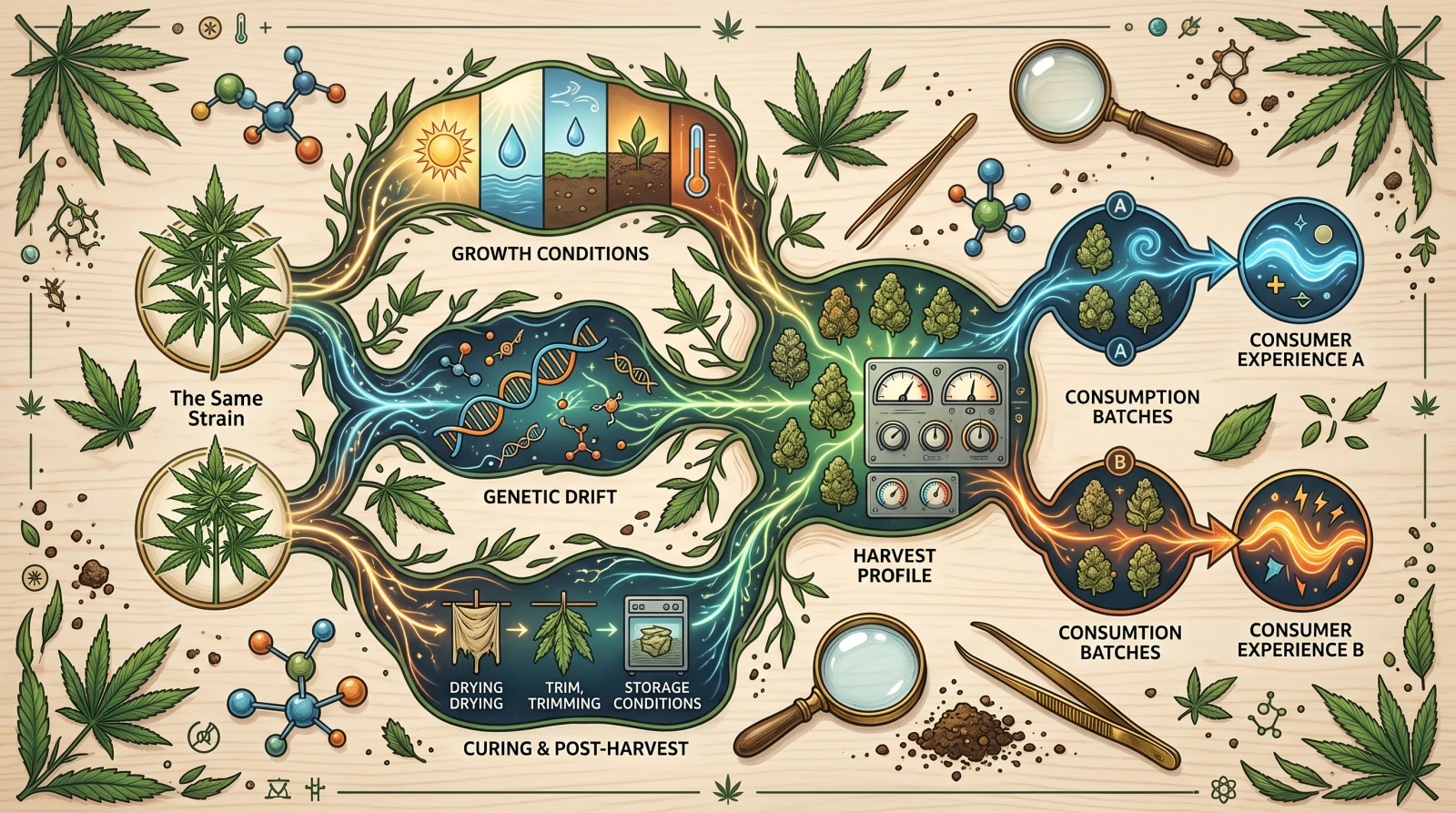
This selection process matters because plants grown from the same genetic line can still express different characteristics.
Those different expressions are commonly called phenotypes.
Think of siblings.
Same parents.
Clearly related.
Still not identical.
A craft grower may hunt through multiple plants to identify a particular phenotype worth keeping and then preserve it through cloning.
That's considerably more intentional than simply growing whatever produces the most weight.
Craft Flower Should Have a Personality
Open the bag.
Before you check the THC percentage again, smell it.
Good cannabis should tell you something.
Maybe it's sharp diesel.
Maybe it's lemon peel.
Maybe it's sweet cream and berries.
Maybe it's pine, pepper, and damp earth.
Whatever the profile is, quality craft flower should generally have some aromatic identity.
That's where terpenes come into the conversation.
Terpenes are aromatic compounds that contribute significantly to how cannabis smells and tastes. Genetics establish the potential profile, but cultivation and post-harvest handling help determine how much of that character survives until consumption.
This is one reason craft flower can stand apart.
The goal isn't simply to produce cannabis with cannabinoids in it.
It's to preserve the characteristics that make that particular cultivar interesting.
If your supposedly premium craft flower smells like almost nothing, that's not a great start.
Don't Judge Craft Cannabis by THC Alone
Here's an easy way to turn an interesting cannabis menu into a boring one:
Sort by THC.
Choose the highest number.
Repeat forever.
Potency matters, especially if that's what you're specifically shopping for.
But THC percentage isn't a craftsmanship score.
Imagine judging every bottle of wine entirely by alcohol percentage.
Congratulations.
You've ignored almost everything that makes one bottle different from another.
Cannabis quality involves more than potency.
A craft batch might stand out because of its terpene expression, trichome development, genetics, freshness, cure, flavour, or overall smoking experience.
A 24% THC strain with an incredible nose and beautiful cure may be far more enjoyable to someone than dry, flavourless flower testing significantly higher.
High THC and high-quality craft cannabis can absolutely exist together. But THC percentage alone doesn't tell you whether the flower was grown, harvested, dried, cured, and stored well.
The number matters.
It just doesn't deserve the entire conversation.
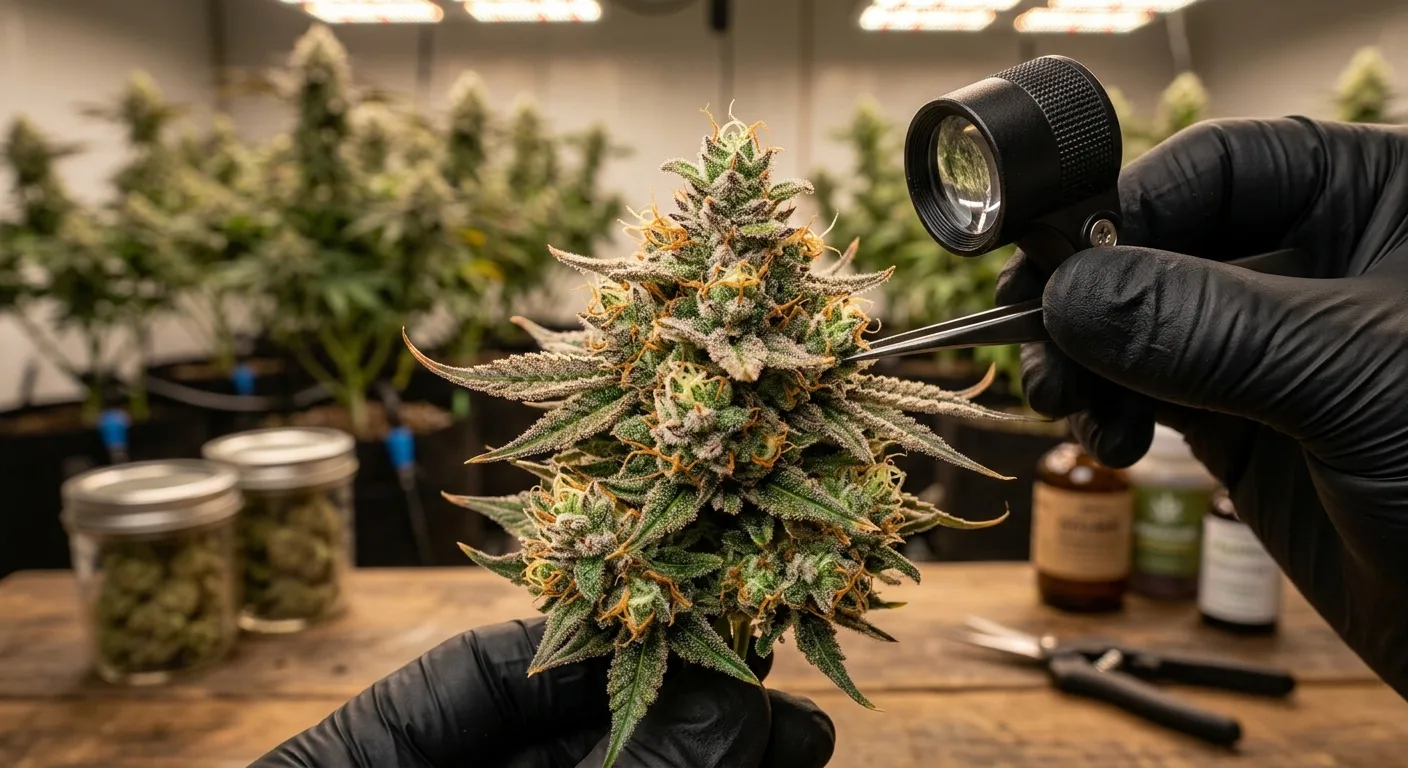
Look at the Buds
Craft cannabis usually gets extra attention in the appearance department.
You might notice:
Well-developed bud structure
Visible trichome coverage
Minimal unnecessary leaf
Careful trimming
Healthy colour
Limited physical damage
But be careful.
Beautiful weed isn't automatically great weed.
Cannabis photography has trained everyone to fall in love with frosty purple buds before asking whether they smell or taste like anything.
Some cultivars naturally produce more visually dramatic flower than others.
Likewise, an aggressive trim can make buds look incredibly clean while removing parts of the flower unnecessarily.
Use appearance as one clue.
Not the verdict.
Hand-Trimming Matters, But It's Not Magic
Hand-trimmed is another phrase you'll see attached to craft cannabis.
There's a legitimate reason for it.
Cannabis flowers and their trichomes are delicate.
Machine trimming makes processing large harvests much faster, but careful hand trimming gives a person more control over what gets removed and how the individual buds are handled.
The goal is to remove unnecessary leaf while preserving the flower's structure and resin.
That's valuable.
But don't get carried away.
Hand trimming doesn't transform mediocre cannabis into top shelf.
If the genetics were poor, the plant was badly grown, or the flower was dried into oblivion, somebody carefully trimming it with scissors isn't going to save the batch.
Craft quality comes from the entire process.
Not one bullet point on the package.
Harvest Timing Matters More Than Most Buyers Realize
Cannabis plants don't read production schedules.
A cultivar is ready when it's ready.
Growers typically monitor maturity and trichome development to decide when a crop should come down.
Harvest timing can influence the chemical profile and overall character of the finished flower.
And different cultivars don't necessarily mature at the same rate.
That's where smaller, cultivar-focused production can have an advantage.
Instead of forcing everything through exactly the same timeline, growers can make decisions based on what's actually happening with the plants.
Again, that doesn't mean every small producer does this perfectly.
It means genuine craft production should be giving these details serious attention.
The Cure Is Where the Truth Comes Out
You can grow gorgeous cannabis and still ruin the experience after harvest.
This is where drying and curing enter the picture.
Freshly harvested cannabis contains substantial moisture. It needs to be dried under controlled conditions and then cured properly before the finished flower reaches its potential.
Rush the process and problems start appearing.
Flower may become harsh.
The aroma can suffer.
Buds may end up too dry.
Flavour can become flat.
The smoking experience can feel completely disconnected from how beautiful the plant looked before harvest.
This is one of the easiest places to separate genuinely cared-for flower from cannabis that's simply carrying a premium label.
Pick up a bud.
Give it a gentle squeeze.
Quality flower shouldn't instantly turn into dust.
It also shouldn't feel suspiciously damp.
There should generally be a little resilience.
Then grind it.
Smell it again.
Smoke it.
Does the flavour actually survive?
That's where the word "craft" has to prove itself.
Freshness Still Matters
Even excellent craft cannabis doesn't stay perfect forever.
Cannabis is an agricultural product.
Once harvested, its quality can change with time and storage.
Heat isn't helping.
Direct light isn't helping.
Excessive oxygen exposure isn't helping.
And leaving flower in a badly sealed container certainly isn't helping.
Terpenes are particularly vulnerable because they're volatile compounds.
That incredible aroma the grower worked hard to preserve can gradually fade.
The flower can dry out.
Flavour can flatten.
So don't assume that cannabis must be amazing simply because it was amazing when it left the grower.
Storage and freshness remain part of the final experience.
Does White Ash Prove It's Craft?
Short answer:
No.
White ash has become one of those cannabis quality tests that gets repeated so often it starts sounding scientific.
People will look at a joint and immediately declare:
"White ash. That's clean."
Or:
"Black ash. Bad weed."
Reality isn't that simple.
Ash colour can be influenced by combustion conditions and multiple characteristics of the material being burned.
That doesn't mean the burn is irrelevant.
If your expensive flower refuses to stay lit, tastes terrible, and produces an unpleasant smoking experience, those observations matter.
But ash colour by itself isn't a complete quality test.
Judge the whole session.
Aroma.
Flavour.
Smoothness.
Moisture.
Burn.
Effects.
Freshness.
That's considerably more useful than treating your ashtray like a laboratory.
Craft Cannabis vs Mass-Produced Flower
This comparison is easy to oversimplify.
Mass production isn't automatically bad.
Scaling cannabis production can create consistency, availability, and lower costs.
Those are genuine advantages.
The challenge is that producing enormous quantities efficiently can require greater standardization.
Craft production generally has different priorities.
The focus can shift toward smaller runs, specific genetics, hands-on care, slower processing, and maximizing the characteristics of individual cultivars.
Think of the difference like this:
Mass production asks: How do we produce this reliably and efficiently at scale?
Craft production asks: How good can we make this particular batch?
The best producers can find some balance between both.
But when you're paying craft prices, that second question should be obvious in the finished flower.
Is Craft the Same as AAAA?
Not exactly.
Canadian cannabis consumers use grading terms like AA, AAA, AAAA, quads, craft, exotic, and top shelf constantly.
They're useful shorthand.
But they're not universal government quality grades.
AAAA generally implies high-end flower based on characteristics such as appearance, aroma, potency, trim, cure, and smoking quality.
Craft is slightly different.
Ideally, craft describes something about how the cannabis was produced, while AAAA describes the perceived quality of the finished product.
The two can overlap.
Excellent craft flower should probably look and smoke like premium flower.
But something can be marketed as AAAA without being produced in a small-batch craft environment.
And something can be small-batch without deserving an elite quality grade.
That's why labels should never replace judgment.
The "Premium Packaging" Trap
Let's talk about the easiest trick in cannabis marketing.
Make the package black.
Add gold lettering.
Use a minimalist logo.
Put "CRAFT" somewhere in capital letters.
Charge more.
We're joking.
Mostly.
Premium packaging can be nice, but it tells you absolutely nothing about what happened in the grow room.
Neither does an elaborate strain name.
Neither does a dramatic product description.
The flower still has to deliver.
Words like "craft," "premium," "exotic," and "small-batch" can help describe cannabis, but none of them replace actual quality. If the flower is dry, muted, badly cured, or unpleasant to smoke, premium branding doesn't rescue it.
This is where buyers need to become slightly more skeptical.
Don't ask whether the package looks premium.
Ask what you're paying extra for.
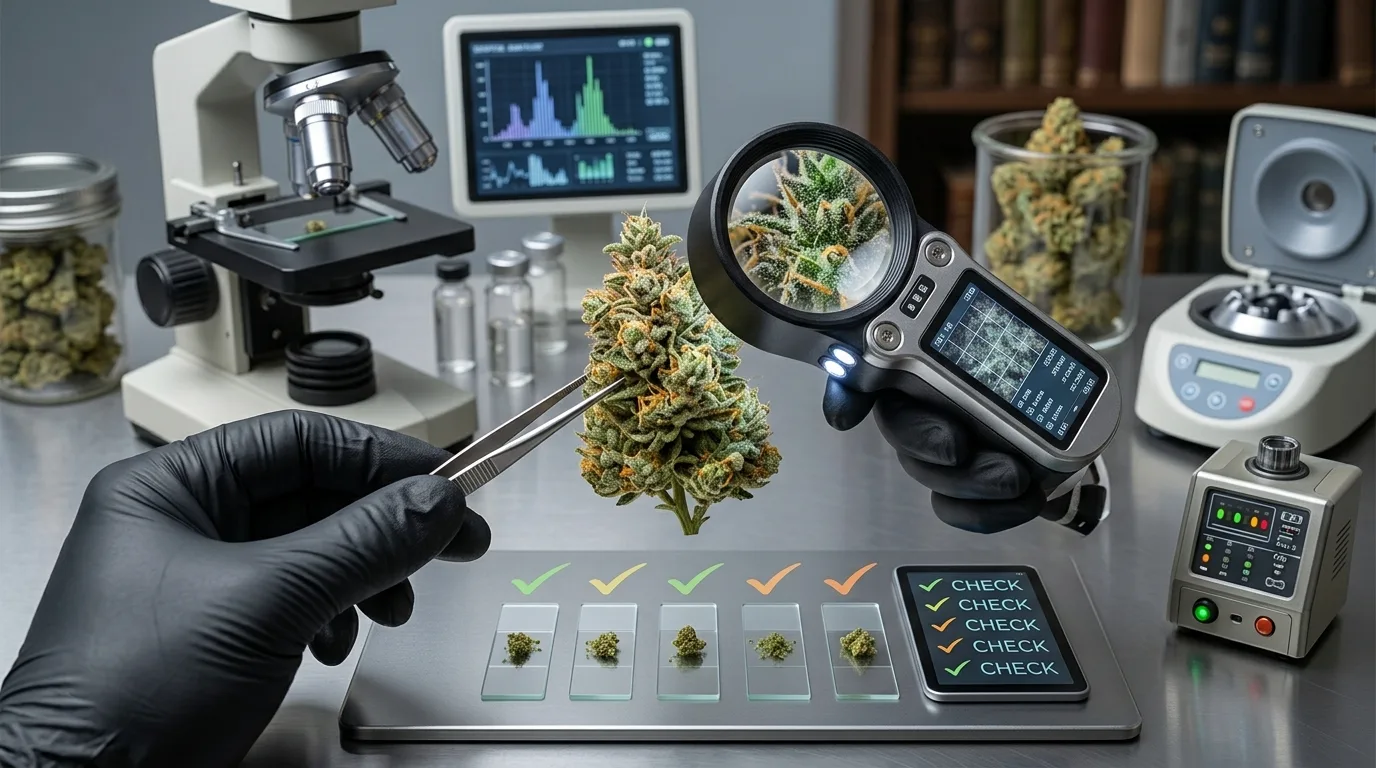
The Craft Cannabis Checklist
So you're looking at expensive flower labelled "craft."
What should you actually care about?
Genetics
Is there something distinctive about the cultivar or phenotype?
Craft doesn't have to mean rare genetics, but there should be more thought involved than slapping a fashionable strain name onto average flower.
Aroma
Does the flower have a clear aromatic identity?
A premium batch should generally smell like something worth remembering.
Trichomes
Look for healthy resin coverage appropriate to the cultivar.
More frost doesn't automatically equal better, but badly handled premium flower isn't a great sign.
Trim
Has the flower been carefully finished without excessive leaf or obvious damage?
Moisture
Does the bud have a little give, or does it disintegrate when touched?
Cure
Does it grind properly?
Does it burn reasonably?
Is the smoke unnecessarily harsh?
Flavour
Does the taste match the promise from the aroma?
More importantly, does that flavour last beyond the first hit?
Freshness
Even excellent cannabis loses quality when stored poorly for too long.
Overall Experience
This is the final test.
Would you buy it again at the same price?
That's more useful than any number of A's attached to the product name.
When Craft Cannabis Is Actually Worth the Money
Not everyone needs craft flower every time they buy cannabis.
And that's completely fine.
If your main priorities are affordability, consistency, and reliable effects, paying extra for rare genetics, hand finishing, or particularly expressive terpenes may not make sense for every session.
Craft becomes more interesting when the flower itself is part of the experience.
You care about what happens when the container opens.
You notice the difference between citrus and gas.
You care whether the flower has been overdried.
You notice whether the flavour disappears halfway through the joint.
You actually want to experience what makes one cultivar different from another.
For that consumer, genuinely good craft cannabis can justify a premium.
But the important word remains genuinely.
Frequently Asked Questions
Craft cannabis generally describes flower produced in smaller batches with greater attention to genetics, cultivation, harvest timing, trimming, drying, curing, and finished quality. The term itself isn't a guarantee of quality, so consumers should still evaluate the actual flower.
Craft cannabis is strongly associated with smaller-batch production, but small scale alone doesn't guarantee craft quality. What matters is how much attention is given to the plants and post-harvest process and whether that work is reflected in the finished flower.
Not necessarily. Craft flower can be highly potent, but THC percentage isn't what defines craftsmanship. Aroma, terpene expression, genetics, cure, freshness, structure, flavour, and overall experience can be equally important.
AAAA generally refers to a perceived top-shelf quality tier, while craft ideally says something about the production approach, such as smaller batches and greater hands-on attention. The categories can overlap, but neither label guarantees quality on its own.
Evaluate the whole flower rather than relying on the label. Look at aroma, bud structure, trichomes, trim, moisture, freshness, cure, flavour, burn, and the overall smoking experience. Genuine premium flower should give you noticeable reasons for its premium price.
It can be if you value distinctive genetics, strong terpene expression, careful curing, freshness, flavour, and overall flower quality. If your main priorities are simply affordability and reliable effects, premium craft flower may not be necessary for every purchase.
The Bottom Line on Craft Cannabis
"Craft" should tell you something about the care that went into the cannabis.
Not the graphic designer who made the package.
Not how many adjectives appear in the product description.
And definitely not how many A's somebody managed to put beside the strain name.
Real craft starts with genetics and continues through cultivation, harvest, trimming, drying, curing, storage, and final presentation.
The result should give you evidence.
A distinctive nose.
Well-handled flower.
Proper moisture.
An intentional cure.
Flavour with some personality.
And an overall experience that makes the premium price understandable.
Small-batch production can help growers achieve that level of attention.
It doesn't guarantee it.
So the next time you see "craft cannabis" on a Canadian menu, don't immediately assume you've found the best flower available.
Ask a much better question:
What about this weed actually makes it craft?
If the flower can answer that question once you open the bag, you've probably found the real thing.