 %
%
 %
%
Buying an ounce always sounds like a great idea when you're placing the order.
More flower. Better value per gram. Fewer orders.
Then the bag arrives.
You open it three times on the first night, leave it sitting beside your grinder, move half of it into a random sandwich bag, and two weeks later the buds at the bottom are dry enough to crumble if you look at them too aggressively.
So much for buying in bulk.
The problem usually isn't the ounce.
It's how you handle it afterward.
If you're buying bulk weed for yourself or splitting an order between a few adults, a little portioning and storage can make the difference between enjoying the last gram and wondering why the final quarter smells nothing like the flower you opened on day one.
Here's how to split an ounce properly, store each portion, rotate through your stash, and keep the whole thing as fresh as reasonably possible.
First: How Much Is an Ounce of Weed?
Let's get the basic math out of the way.
One ounce of cannabis is approximately:
28 grams
That means you can divide it into:
2 half-ounces: 14 g each
4 quarters: 7 g each
8 eighths: 3.5 g each
Or any combination that makes sense for how quickly you'll use it.
1 ounce = approximately 28 grams. That's 2 half-ounces, 4 quarters, or 8 eighths. If you're portioning flower, weigh each amount rather than trying to divide the bag by eye.
Yes, experienced smokers get pretty good at estimating weight.
No, your eyeballs are not a calibrated digital scale.
Especially with cannabis.
Why 7 Grams Can Look Completely Different From Another 7 Grams
This is worth understanding before you start dividing flower.
Cannabis density varies.
One strain may produce tight, compact buds. Another might be lighter and fluffier.
That means two piles containing exactly 7 grams can look dramatically different in size.
Even buds from the same batch aren't perfectly uniform.
So don't try to create four visually identical piles and assume you've made four quarters.
Use a scale.
A simple digital scale measuring to at least 0.1 gram gives you a much better idea of where your flower actually went.
That solves the portioning problem.
Now we need to stop those portions from turning into dry little time capsules.
Don't Store the Whole Ounce in One Working Jar
Technically, you can.
Practically, there's a better way.
Imagine you keep all 28 grams in one large jar.
Every time you want to smoke, you open it.
Take out a bud.
Close it.
Two hours later, open it again.
Maybe smell it for absolutely no practical reason.
Close it.
Repeat that process for several weeks.
Every opening exchanges some of the environment inside the container with the air in your room.
If you're dealing with dry indoor air, particularly during a Toronto winter, repeatedly opening the same container isn't helping your flower stay consistent.
Instead, split your bulk purchase.
The Working Jar Strategy
This is probably the simplest storage system for an ounce.
Divide the flower into smaller portions.
Then designate one as your working jar.
That's the flower you're currently consuming.
The other portions stay sealed until you need them.
For example:
Jar 1: 7 g — currently using
Jar 2: 7 g — sealed
Jar 3: 7 g — sealed
Jar 4: 7 g — sealed
Finish Jar 1.
Then open Jar 2.
You're exposing only a quarter of your ounce to repeated opening rather than all 28 grams.
Simple.
And much smarter than treating your entire stash like one endlessly opened snack container.
What's the Best Way to Divide an Ounce?
For most people, quarters are a practical starting point.
Four portions of approximately 7 grams each are large enough that you aren't managing eight tiny containers but small enough to reduce how much flower you're repeatedly exposing to air.
If you consume cannabis more slowly, eighths may make more sense.
If you move through flower relatively quickly, two 14-gram portions may be enough.
The best division depends on one question:
How quickly do you finish an open portion?
If 7 grams takes you months, split smaller.
If 7 grams disappears quickly, there's little benefit in turning your cupboard into a cannabis jar warehouse.
The slower you consume your ounce, the smaller your storage portions should generally be. Keep one portion in regular rotation and leave the rest sealed until you actually need them.
The goal isn't to create the most elaborate storage system possible.
It's to stop opening flower unnecessarily.
Use Airtight Containers
Once your ounce is divided, each portion needs a proper home.
Airtight glass jars are difficult to beat for straightforward cannabis storage.
They don't absorb aroma easily, they're reusable, and a proper seal helps maintain a more stable environment inside.
Choose jars appropriate to the amount you're storing.
You don't need a giant one-litre jar for an eighth.
At the same time, don't crush buds into a container that's clearly too small.
Leave enough room for the flower to sit naturally without packing it down.
What About Plastic Bags?
Plastic bags are convenient.
They're just not our first choice for longer-term storage.
Thin bags can allow more air exchange than a properly sealed container, offer limited physical protection, and make it much easier to crush your flower.
For a short trip?
Fine.
For protecting the portions of an ounce you're planning to keep for weeks?
Use something better.
Keep Your Portions Somewhere Cool and Dark
Your weed doesn't need a suntan.
Light and heat aren't helping preserve cannabis quality.
Once you've portioned your ounce, store the sealed containers somewhere:
Cool
Dark
Dry
Stable
A cupboard or drawer usually makes much more sense than a windowsill.
Avoid placing your stash beside heaters, radiators, appliances that generate heat, or anywhere receiving direct sunlight.
And don't assume "cold" automatically means "better."
You're trying to create stable storage conditions.
Not preserve a woolly mammoth.
Should You Put Weed in the Fridge?
Usually, there's no need.
A refrigerator introduces its own problems.
Temperature and humidity can fluctuate as the door opens and closes, and condensation becomes a concern when cold containers are repeatedly moved into warmer air.
Cannabis also doesn't need to be refrigerated for ordinary household storage.
A cool, dark location with a properly sealed container is much simpler.
What About the Freezer?
Also unnecessary for most people storing an ounce.
Very cold trichomes can become brittle and break away from the flower more easily during handling.
Unless you have a specific processing reason for freezing cannabis, your everyday ounce doesn't need to live beside the frozen peas.
Humidity Packs: Useful or Overkill?
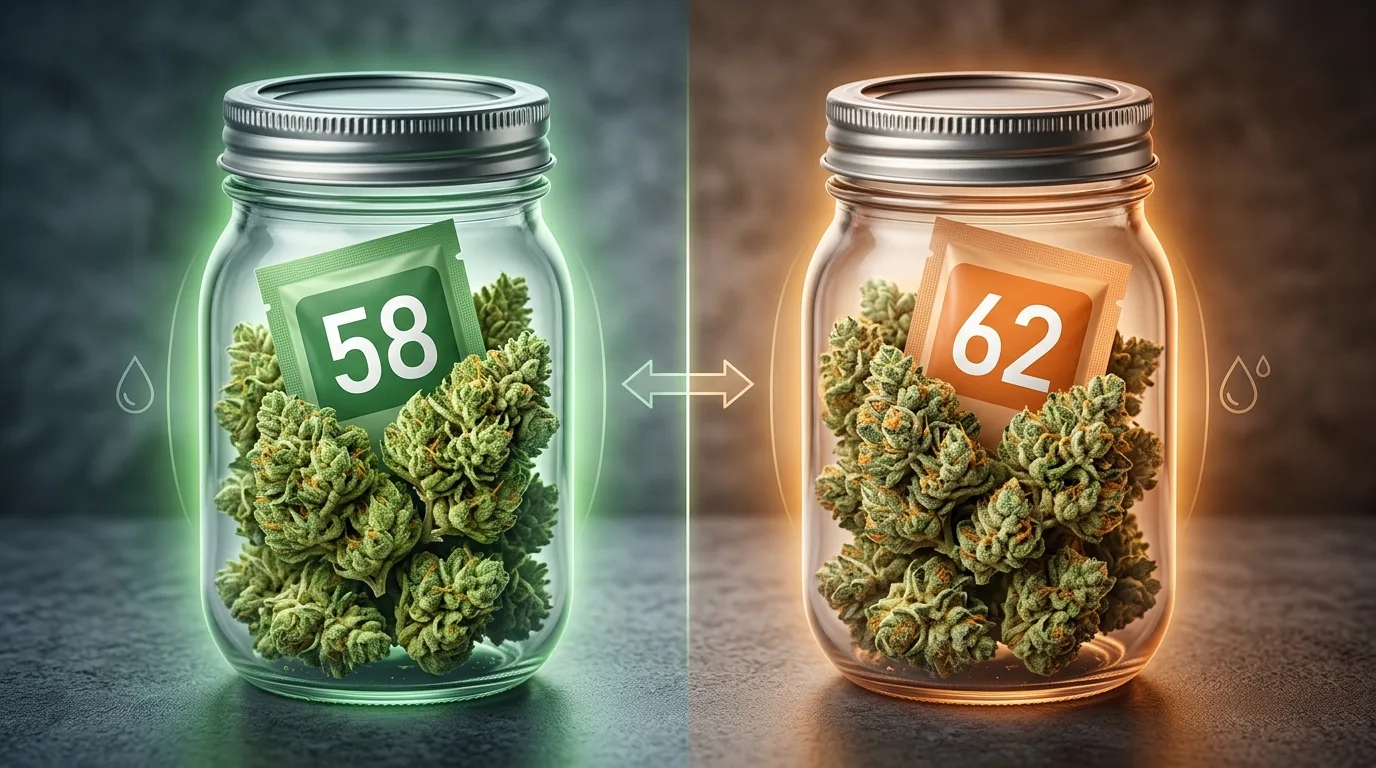
For larger quantities you're storing over time, a two-way humidity pack can be useful.
These packs are designed to help maintain a target relative humidity inside a sealed container rather than simply adding moisture without control.
The important part is using an appropriately sized pack for the amount of flower you're storing.
Don't throw a giant humidity pack into a tiny jar because more must be better.
Cannabis storage isn't a competition.
Humidity control is particularly useful if your home gets extremely dry during winter or if you know portions of the ounce will remain stored for a while.
But remember:
A humidity pack helps manage moisture.
It doesn't stop time.
It won't recreate terpenes that have already disappeared or transform old flower into a fresh harvest.
Don't Use Orange Peels for Long-Term Storage
The orange peel trick refuses to die.
Yes, citrus peel contains moisture.
Yes, dry cannabis can absorb some of that moisture.
No, that doesn't make a piece of fruit peel an ideal long-term humidity-management system.
Fresh organic material introduces uncontrolled moisture and can create conditions where mould becomes a concern if it's forgotten inside the container.
It can also change the aroma of your flower.
If you've bought an ounce because you love its terpene profile, making the final quarter smell vaguely like breakfast juice isn't necessarily an improvement.
Use proper storage equipment.
Eat the orange.
Everybody wins.
Label Every Portion
This sounds unnecessary until you have several containers.
Then suddenly you're holding two nearly identical jars thinking:
"Was this the one I opened last Tuesday?"
Use a small label.
Write:
Strain
Date received
Date portioned
Weight
If you're storing multiple strains, labelling becomes even more useful.
You can also number the portions:
1 of 4
2 of 4
3 of 4
4 of 4
Now your rotation requires approximately zero thought.
Which is exactly how storage systems should work.
First In, First Out
Restaurants use inventory rotation for a reason.
You can steal the concept.
If you already have older flower at home and buy another ounce, don't automatically start demolishing the newest bag while the older stash continues aging in the back of your cupboard.
Use a simple first in, first out approach.
Older properly stored flower gets used first.
Newer flower waits.
Of course, we're talking about flower that's still in good condition.
If anything appears mouldy, smells unusually musty, or shows other signs of contamination, "first in, first out" does not mean "smoke it anyway."
It means don't consume questionable cannabis.
Splitting an Ounce Between Two People
If two adults are dividing an ounce evenly, the math is wonderfully uncomplicated.
28 grams divided by 2:
14 grams each.
Weigh one portion.
Then weigh the other.
If you're working with an ounce sold as 28 grams, each share should be approximately 14 grams.
Don't do this:
"You take the big buds and I'll take what's left."
Unless both people specifically agree to it.
Large buds aren't necessarily stronger, but different parts of the bag can contain different proportions of larger flower, smaller buds, and loose material.
If the goal is a fair split, mix the batch gently enough to distribute the flower and then divide by weight.
Splitting an Ounce Four Ways
Four people makes things even easier.
Each share:
Approximately 7 grams.
Again, weigh the portions.
If everyone wants the split to be as even as reasonably possible, distribute different bud sizes rather than giving one person two massive tops while someone else gets the bottom of the bag.
The total weight might technically be equal either way.
The experience of opening those two bags definitely isn't.
Splitting an Ounce Into Eighths
An ounce contains eight standard 3.5-gram eighths.
This is useful if you're:
A slower consumer
Trying to control how much flower is open at once
Separating portions for storage
Rotating between several strains
Eight containers may be excessive for someone who finishes an ounce quickly.
But if that ounce is going to be around for a long time, smaller sealed portions can make sense.
Just don't create unnecessary handling.
Every time you're touching, transferring, and repackaging flower, there's an opportunity to knock trichomes off or lose little pieces.
Divide it once.
Store it properly.
Leave it alone.
What About Mixing Multiple Strains in One Jar?
Don't.
Unless you intentionally want them mixed.
Cannabis strains have different aroma profiles and may arrive at slightly different moisture levels.
Store them separately if you want to preserve their individual character.
Putting a loud gas strain beside a delicate citrus strain in the same container isn't exactly a controlled tasting experiment.
A few weeks later, everything may smell like the loudest flower in the room.
Separate strains.
Separate jars.
Future-you will appreciate knowing what's actually in the grinder.
Keep Your Grinder Out of the Storage Jar
Your main storage container isn't a workstation.
Don't repeatedly grind flower directly over it.
Don't leave the lid open throughout an entire session.
Don't throw half-ground cannabis back into the main jar unless you genuinely need to.
Take out what you're planning to use.
Close the container.
Then grind it.
The less time your stored flower spends sitting exposed to room air, the better.
This matters even more for the sealed portions you're saving for later.
Those should be boring.
Dark cupboard.
Closed jar.
No attention.
Perfect.
What If One Portion Starts Getting Dry?
First, figure out why.
Is the container actually airtight?
Are you opening it constantly?
Is your home extremely dry?
Did the flower arrive dry in the first place?
If the cannabis is simply overly dry but otherwise appears normal, controlled humidity can restore some moisture and improve its texture.
What it cannot restore is lost freshness.
Terpenes are volatile.
Once some of those aromatic compounds have disappeared, adding water back into the flower doesn't recreate them.
That's why good storage from day one beats trying to rescue the last quarter later.
Don't Grind the Whole Ounce at Once
Please don't do this.
We understand the logic.
Grind everything once.
Save time later.
Except grinding dramatically increases the surface area of the cannabis exposed to air.
Whole buds provide more physical protection to the material inside.
Once you've turned 28 grams into a giant pile of ground flower, you've made storage harder and accelerated exposure.
Grind what you need for the session.
Keep the rest as intact flower.
Your grinder isn't a storage container either.
What About Pre-Rolling the Entire Ounce?
Similar problem.
Pre-rolling a few joints for convenience is one thing.
Turning your entire ounce into dozens of joints on day one means all that flower has been ground and redistributed into paper.
Convenient?
Absolutely.
Ideal for preserving flower over a longer period?
Not really.
If you're consuming the ounce quickly, that may not matter much.
If it's supposed to last weeks or longer, keep most of it as whole flower and prepare smaller amounts as needed.
Watch the Bottom of the Bag
Bulk orders often contain a mixture of bud sizes.
As you work through an ounce, small pieces and loose trichome-rich material can accumulate at the bottom.
Don't automatically throw that away.
And don't accidentally leave two grams of small flower scattered across five bags because you portioned everything carelessly.
When dividing the ounce, use a clean surface.
Transfer everything deliberately.
Check the original packaging before deciding you're finished.
A surprising amount of "missing weed" is just sitting in corners, stuck around seals, or scattered beside the scale.
Hence the title:
Don't waste a single gram.
The Simple Four-Jar Ounce System
If all of this sounds like too much effort, here's the version we'd actually recommend for most people.
Start with your ounce.
Weigh it.
Divide it into four approximately 7-gram portions.
Put each portion in its own appropriately sized airtight container.
Label them:
1
2
3
4
Store all four somewhere cool and dark.
Open Jar 1.
Use only Jar 1 until it's finished.
Then move to Jar 2.
Repeat.
Use appropriately sized humidity control if your storage conditions and timeline call for it.
That's it.
You don't need a cigar humidor, climate-controlled vault, or spreadsheet tracking the emotional development of each bud.
Good storage should be simple enough that you actually do it.
For a 28 g ounce, four sealed 7 g portions offer a practical balance between freshness and convenience. Keep one jar in active rotation and leave the other three sealed until their turn.
Frequently Asked Questions
An ounce of cannabis is approximately 28 grams. It can be divided into two 14-gram half-ounces, four 7-gram quarters, or eight 3.5-gram eighths.
Rather than repeatedly opening one large container, consider dividing the ounce into smaller portions stored in airtight containers. Keep one portion in active use while leaving the others sealed somewhere cool, dark, and away from direct sunlight and unnecessary heat.
An ounce sold as 28 grams divides into four approximately 7-gram portions. Use a digital scale rather than judging portions visually because different cannabis buds can have very different densities.
You can, but dividing an ounce into smaller sealed portions can reduce how often the entire supply is exposed to room air. This can be especially useful if you consume the ounce slowly.
Refrigeration generally isn't necessary for ordinary flower storage and can introduce temperature and humidity fluctuations. A properly sealed container kept in a cool, dark, stable location is simpler for typical household storage.
It's generally better to store different strains separately if you want to preserve their individual aromas and keep track of what you're consuming. Strong aromatic profiles can also influence how a mixed container smells.
No. Grinding greatly increases the surface area exposed to air. For longer-term quality, keep most cannabis as whole flower and grind smaller amounts when you're ready to consume them.
The Bottom Line on Buying and Storing Bulk Weed
Buying bulk weed can offer better value.
But only if the final grams are still worth smoking.
An ounce is approximately 28 grams.
You can leave all 28 grams in one container and open it every day for weeks.
Or you can spend five minutes when the order arrives and make your life considerably easier.
Weigh the flower.
Divide it into sensible portions.
Store each portion in an airtight container.
Keep those containers cool and dark.
Use one portion at a time.
Don't grind everything in advance.
Don't throw orange peels into every jar.
And don't keep opening the sealed portions just because you want to smell them again.
We know they smell good.
Leave them alone.
Bulk buying works best when you treat the ounce like inventory rather than one enormous bag you're permanently working out of.
Do that, and the last quarter has a much better chance of smelling and smoking like the flower you were excited about on day one.