Walk into any Ottawa coffee shop, coworking space, or weekend farmer's market, and chances are someone in the room is microdosing psilocybin mushrooms. Not tripping, not "seeing colours," just moving through their day with a subtle shift in perspective that might help them focus on a spreadsheet, connect better in a meeting, or notice the way sunlight hits the Rideau Canal with fresh appreciation. Microdosing mushrooms has quietly entered the mainstream in Ottawa and across Canada, and understanding what it actually is , beyond the hype and the headlines , matters if you're considering it.
This guide breaks down the science, the practice, and the realities of microdosing psilocybin in Ottawa. We'll cover what microdosing means in concrete milligram terms, who's doing it and why, how to approach dosing safely, and what the current research actually says. No medical claims, no miracle promises , just clear, educational information for adults who want to make informed decisions.
What Is Microdosing? Defining the Practice in Milligrams
Microdosing psilocybin mushrooms means consuming a sub-perceptual dose , an amount small enough that you don't experience classic psychedelic effects like visual distortions, altered sense of time, or profound emotional shifts. The goal isn't to "trip" but to introduce a barely noticeable change in cognition, mood, or perception that some users describe as removing a layer of mental fog.
In practical terms, a microdose of dried psilocybin mushrooms typically falls between 50mg and 300mg of dried mushroom material. For context, a standard recreational or therapeutic "trip" dose ranges from 1,000mg to 3,500mg (1 to 3.5 grams). A microdose sits at roughly one-tenth to one-twentieth of that amount.
The Sub-Perceptual Threshold
The key concept here is "sub-perceptual." A properly calibrated microdose should be imperceptible in the moment. You shouldn't feel "high," see trails, or struggle to hold a conversation. If you're noticing overt psychedelic effects, you've crossed into a low dose rather than a microdose. The most common feedback from experienced microdosers is that they feel "like themselves, but slightly better" , more present, less anxious, marginally more creative.
Because psilocybin content varies between mushroom strains and growing conditions, milligram precision matters. Two 100mg capsules from different batches might produce different effects. That's why many Ottawa users prefer standardized psilocybin edibles or capsules with known concentrations over raw dried mushrooms when starting out.
Common Dosing Ranges in Ottawa
Among Ottawa's microdosing community , which includes everyone from Carleton University students to government workers to artists in Hintonburg , three dosing ranges appear most frequently:
- 50-100mg: The "threshold" range. Many beginners start here to assess tolerance. Effects are extremely subtle, sometimes unnoticeable on day one.
- 100-200mg: The "sweet spot" for many users. Enough to potentially notice improved focus or mood without any perceptual changes.
- 200-300mg: The upper limit of microdosing. Some users report this feels slightly "too much" , a faint body buzz or mild distraction. Others find it ideal for creative work.
There's no universal "correct" dose. Bodyweight, neurochemistry, tolerance, and even what you ate that morning all influence how a given milligram amount lands. The practice requires personal calibration, which is why most protocols recommend starting low and adjusting gradually over weeks, not days.
Who Microdoses Psilocybin and Why?
The stereotype of the Silicon Valley programmer microdosing to "optimize productivity" exists for a reason, but Ottawa's microdosing population is far more diverse. Based on community discussions, online forums, and anecdotal reports from across the capital region, the reasons people explore microdosing fall into several broad categories.
Focus and Productivity
Many users , particularly those in knowledge work, creative fields, or academic settings , report that microdosing helps them enter and maintain flow states. The subjective experience is often described as reduced mental chatter and increased task engagement. A policy analyst in Centretown might find it easier to parse dense reports; a musician in the Glebe might feel more connected to their instrument during practice.
It's important to note that these are subjective self-reports, not clinical outcomes. Controlled studies on microdosing's cognitive effects remain limited, and the placebo effect plays a significant role. But the consistency of these reports across independent user groups suggests something worth investigating, even if we can't yet quantify it scientifically.
Mood and Emotional Regulation
Another common motivation is mood support. Users describe feeling less reactive to stressors, more emotionally resilient, or simply "lighter" on microdosing days. Some Ottawa residents with long Ottawa winters and seasonal affective patterns explore microdosing as a supplementary practice alongside light therapy or exercise.
This is where clear boundaries matter: microdosing is not a treatment for clinical depression, anxiety disorders, or any diagnosed mental health condition. Those conditions require professional care. Microdosing is a personal experiment some people undertake for general well-being, not a medical intervention.
Creative Exploration
Artists, writers, and musicians in Ottawa's creative communities sometimes microdose to shift their perceptual baseline. The idea isn't to unlock hidden genius but to approach familiar materials , a blank canvas, a melody, a paragraph , from a slightly different cognitive angle. The effect is subtle: noticing new connections, feeling less self-critical, or finding it easier to start.
Again, these are qualitative experiences. There's no rigorous evidence that psilocybin microdosing makes you "more creative" by any measurable standard. But for individuals whose creative practice involves breaking habitual patterns, even a small perceptual shift can feel valuable.
Curiosity and Self-Exploration
Some Ottawa residents simply want to explore their own consciousness safely. Microdosing offers a low-risk entry point into psilocybin's effects without committing to a full psychedelic experience. It's a way to dip a toe in, observe, and decide whether deeper exploration interests you. For more context on psilocybin fundamentals, our Psilocybin Mushrooms 101 Ottawa guide covers the basics of effects, legality, and responsible use.
How to Approach Microdosing: Protocols and Practices
If you're in Ottawa and considering microdosing, the question isn't just "how much?" but "how often?" and "what should I pay attention to?" Over the past decade, several informal protocols have emerged from both research settings and community practice.
The Fadiman Protocol
Named after psychedelic researcher Dr. James Fadiman, this is the most widely cited microdosing schedule. It follows a simple pattern:
- Day 1: Microdose (e.g., 100mg dried psilocybin mushrooms)
- Day 2: No dose (observe residual effects)
- Day 3: No dose (baseline day)
- Day 4: Microdose
- Repeat for 4-8 weeks, then take a 2-4 week break
The two-day gap serves two purposes. First, it prevents tolerance buildup , psilocybin tolerance develops rapidly with daily use. Second, it creates space to notice whether any effects persist on non-dosing days. Many users report feeling the "afterglow" on Day 2, which some consider part of the microdosing benefit.
The Stamets Stack
Mycologist Paul Stamets popularized a protocol that combines psilocybin microdoses with lion's mane mushroom and niacin (vitamin B3). His hypothesis , not yet validated by peer-reviewed research , is that lion's mane promotes neurogenesis and niacin aids psilocybin distribution across the brain via vasodilation.
A typical Stamets stack might include 100mg psilocybin, 500-1000mg lion's mane extract, and 100-200mg niacin, taken four days on and three days off. The niacin produces a harmless but uncomfortable "flush" (skin tingling and redness) that some users dislike. This protocol remains experimental and should only be attempted after researching each component independently.
Intuitive or As-Needed Dosing
Some experienced users abandon fixed schedules in favour of intuitive dosing , taking a microdose only when they feel it would serve them. This might mean dosing before a creative project, a challenging meeting, or a nature walk in Gatineau Park. This approach requires more self-awareness and experience to avoid slipping into daily use and tolerance.
Keeping a Journal
Regardless of protocol, nearly every experienced microdoser recommends keeping a simple log. Note the dose, the day, your energy level, mood, sleep quality, and any notable experiences. Over weeks, patterns emerge. You might discover that 150mg works better for you than 200mg, or that dosing on an empty stomach produces clearer effects, or that your ideal schedule is five days on, two days off.
Journaling also helps you distinguish actual effects from placebo, expectation, or simply having a good day. If you can't tell the difference between dosing days and baseline days after a month, that's useful information , it might mean your dose is too low, the batch is weak, or microdosing isn't for you.
What the Research Actually Says About Microdosing
Here's where we separate enthusiasm from evidence. While anecdotal reports of microdosing benefits are widespread, the scientific litreature remains surprisingly thin. Most research on psilocybin focuses on high-dose therapeutic contexts , treating depression, end-of-life anxiety, addiction , not microdosing.
The Placebo Problem
A 2021 study published in Nature found that when participants thought they were microdosing psilocybin but were actually taking a placebo, they reported benefits nearly identical to those taking real psilocybin. This doesn't mean microdosing "doesn't work" , it means expectation and ritual matter enormously. The act of setting an intention, creating a schedule, and paying attention to your internal state may produce benefits independent of the substance.
This is methodologically tricky. Standard placebo-controlled trials rely on participants not knowing whether they're in the treatment or control group. With psilocybin, even at microdose levels, many users report they can tell when they've taken the active substance versus a placebo. This "breaking blind" makes clean data hard to obtain.
Emerging Evidence
Despite these challenges, some patterns are appearing in the research. Small studies suggest microdosing may improve psychological flexibility , the ability to adapt thinking and behavior to changing contexts. A 2019 study found microdosers scored higher on measures of creativity and open-mindedness compared to controls, though whether this is cause or correlation remains unclear.
Other research hints at acute improvements in mood and reductions in rumination on dosing days. But sample sizes remain small, follow-up periods short, and control conditions imperfect. The honest scientific stance right now is: "Microdosing shows enough promise to warrant rigorous study, but we can't yet make evidence-based claims about specific benefits."
Safety Considerations
Psilocybin is physiologically safe at both microdose and macrodose levels , it's non-addictive, impossible to fatally overdose on, and produces no organ toxicity. However, microdosing isn't risk-free. Concerns include potential cardiac effects from chronic serotonin receptor activation (still theoretical and unstudied), psychological dependence on the ritual, and the possibility of exacerbating latent mental health issues.
People with personal or family histories of psychosis should avoid psilocybin entirely, including microdoses. The same goes for those on certain medications, particularly SSRIs or MAOIs, which can interact unpredictably with psilocybin. This is personal experimentation, not medical treatment , if you have health conditions or take medications, consult a healthcare provider familiar with psychedelics before starting.
Sourcing and Legality in Ottawa
Let's address the obvious question: where do Ottawa residents actually get psilocybin mushrooms for microdosing? The legal landscape in Canada is complex and rapidly evolving.
Current Legal Status
As of 2024, psilocybin remains a Schedule III controlled substance under Canada's Controlled Drugs and Substances Act. Possession, production, and distribution are technically illegal. However, Health Canada has granted exemptions for therapeutic use in specific contexts, and enforcement priorities have shifted significantly. Personal possession of small amounts rarely results in criminal charges in Ottawa, though this varies by jurisdiction and circumstances.
Several dispensaries and delivery services operate openly in Ottawa and Gatineau, existing in a regulatory grey zone similar to cannabis pre-legalization. Some focus specifically on microdose products , capsules, chocolates, gummies , with standardized dosing. Others offer dried mushrooms that users measure themselves.
Quality and Consistency
The lack of regulation means quality varies wildly. Some sources lab-test for psilocybin and psilocin content; others don't. This matters enormously for microdosing, where precision is the point. A capsule labelled "100mg" might contain 50mg or 200mg depending on the source's measurement practices.
If you're sourcing mushrooms for microdosing in Ottawa, prioritize suppliers who provide batch testing, clear labelling, and consistent user feedback. Our first-timer's guide to psilocybin dosing explores the differences between product types and what to look for when choosing edibles versus dried material.
DIY Capsule Preparation
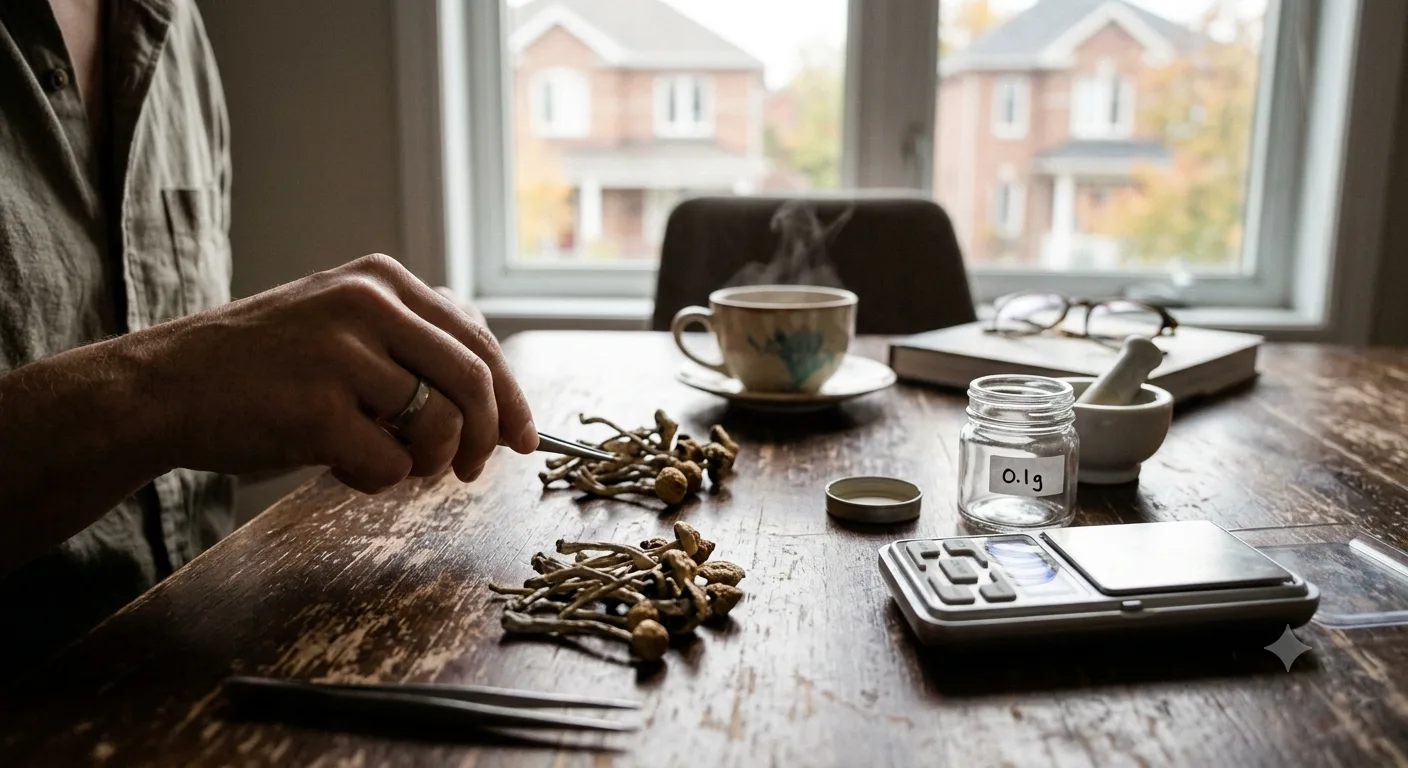
Some Ottawa microdosers prefer making their own capsules from dried mushrooms. This requires a milligram scale (accurate to 0.01g), empty gelatin or vegetarian capsules, and dried, well-ground mushroom powder. The process is straightforward: weigh precise amounts, fill capsules, store in a cool, dark place. This gives you full control over dosing but requires care and consistency.
The advantage is cost and customization. The disadvantage is potential measurement error and the need to trust your source for the raw material. If you're measuring 100mg doses and your scale is off by 50mg, you're not microdosing consistently.
Common Experiences and What to Expect
If you're starting a microdosing practice in Ottawa, it helps to know what might happen , and what almost certainly won't. Microdosing is subtle, and managing expectations prevents disappointment or overcorrection.
The First Few Doses
Many first-time microdosers report feeling nothing on their initial dose. This is normal and doesn't mean the dose was too low. Psilocybin's effects can be imperceptible when you're actively looking for them. Some users notice a slight shift in the quality of light, a marginal increase in sociability, or slightly enhanced music appreciation. Others genuinely feel no difference.
By the third or fourth dose, patterns usually become clearer. You might notice that on dosing days, the commute down Elgin Street feels less tedious, or that you're more patient with a difficult colleague, or that you're slightly more motivated to exercise. These micro-improvements add up over weeks but rarely announce themselves on day one.
Physical Sensations
At true microdose levels, physical effects should be minimal. Some users report a faint sense of "energy" or "lightness," occasional yawning, or mild digestive activity. These are typically short-lived. If you're experiencing significant body sensations, visual changes, or difficulty focusing, your dose is likely too high. Drop by 50mg and reassess.
A small percentage of users experience mild nausea, particularly if dosing on an empty stomach. Taking your microdose with a light meal or smoothie usually resolves this.
Cognitive and Emotional Shifts
The most commonly reported effects are cognitive and emotional rather than perceptual. Users describe reduced mental rigidity, fewer automatic negative thoughts, enhanced pattern recognition, and a general sense of well-being. These are gradual and cumulative. You won't feel a sudden mood lift like you might with caffeine or a pharmaceutical. It's more like noise reduction , things that normally bother you might not, or only slightly.
Some users also report increased emotional sensitivity on dosing days, feeling more connected to music, art, or nature. This can be pleasant or occasionally overwhelming depending on context. If you're microdosing before a stressful workday, heightened emotional awareness might not serve you. Timing and setting matter even at sub-perceptual doses.
When Microdosing Doesn't Work
Not everyone experiences benefits from microdosing, and that's worth stating clearly. Some people genuinely can't tell the difference between dosing and non-dosing days even after weeks. Others find the practice creates mild anxiety or restlessness. A minority report increased rumination rather than decreased , the opposite of the intended effect.
If after 4-6 weeks of consistent, journaled microdosing you're not noticing any benefits, it's okay to stop. Psilocybin isn't a universal tool, and your neurochemistry might not respond the way others' does. There's no shame in concluding it's not for you.
Harm Reduction and Best Practices
Even at low doses, harm reduction principles apply. Microdosing is generally safe, but "generally" isn't "always." Here are practices that reduce risk and maximize the likelihood of a positive experience.
Start Low, Go Slow
Begin with the lowest dose in your target range , 50-100mg for most people , and hold there for at least three cycles before increasing. Resist the urge to "feel more" by jumping to 250mg on day two. Psilocybin's effects compound subtly over time, and what feels like "nothing" on day one might reveal itself as "just right" by week two.
Avoid Daily Use
Microdosing every day defeats the purpose. Tolerance builds rapidly, requiring higher doses for the same effect. More importantly, the two-day gap allows you to observe whether the practice is genuinely helpful or whether you're simply chasing a feeling. If you find yourself wanting to dose every day, that's a signal to pause and reassess.
Don't Operate Heavy Machinery
Even at microdose levels, psilocybin can subtly affect reaction time and judgment. Avoid driving, operating heavy equipment, or making critical decisions until you know exactly how a given dose affects you. Most Ottawa microdosers reserve their dose days for work-from-home situations or weekends until they're confident in their response.
Integrate with Healthy Practices
Microdosing works best as part of a broader well-being practice , good sleep, regular movement, social connection, time in nature. It's not a substitute for addressing underlying issues like burnout, loneliness, or chronic stress. Think of it as one ingredient in a larger recipe, not a magic solution.
Know When to Stop
If you notice increased anxiety, disrupted sleep, emotional volatility, or any other negative pattern emerging, stop immediately. Take at least a month off before considering whether to try again at a lower dose. Your baseline mental health matters more than any potential microdosing benefit.
Microdosing Edibles vs. Dried Mushrooms
Ottawa's psilocybin market offers both traditional dried mushrooms and a growing array of edibles , chocolates, gummies, capsules. Each format has advantages for microdosing.
Dried Mushrooms
Pros: Direct source material, minimal processing, often cheaper per dose. If you're measuring and capsulating yourself, you control the entire process.
Cons: Potency varies batch to batch, measuring requires precision equipment, taste and texture can be unpleasant even in small amounts, more effort required.
Psilocybin Chocolates
Pros: Precise dosing (when from reputable sources), pleasant taste, discreet, shelf-stable.
Cons: Typically more expensive per milligram, added ingredients (sugar, fats) might not align with dietary preferences, potential for melting in summer heat.
For a deeper comparison of edible formats, check out our article on mushroom chocolates vs mushroom gummies, which breaks down bioavailability, onset times, and storage considerations.
Capsules
Pros: Maximum precision, no taste, easy to dose consistently, portable, discreet.
Cons: Usually the most expensive option, reliance on supplier accuracy, less flexibility to adjust dose mid-experiment unless you're making your own.
For microdosing specifically, capsules tend to be the preferred format among experienced users because they eliminate guesswork and ritual complexity. You take the capsule, note the time, and go about your day. Simplicity supports consistency, and consistency is what makes microdosing work.
Building a Personal Practice in Ottawa
If you've read this far and microdosing still interests you, here's a simple framework for starting thoughtfully in Ottawa.
Week One: Research and Preparation
Before your first dose, spend time clarifying your intentions. What are you hoping to explore? Better focus? Mood support? Creative expansion? Write it down. Then choose your protocol, set up a journal template, and source your material from a trusted supplier.
Weeks Two Through Five: Consistency
Follow your chosen protocol religiously. Dose on schedule, skip days on schedule, journal daily regardless of whether you dosed. Note sleep quality, energy, mood, social interactions, creative output , whatever matters to you. Avoid changing multiple variables at once (e.g., don't start a new exercise routine the same week you start microdosing). You want clean data on what the