 %
%
 %
%
You buy two containers of bubble hash.
One is labelled 3-star.
The other says 6-star full melt and costs considerably more.
They both look like hash. They both came from cannabis trichomes. And if you're relatively new to concentrates, the obvious question is:
What exactly are those extra three stars buying you?
The answer comes down to purity.
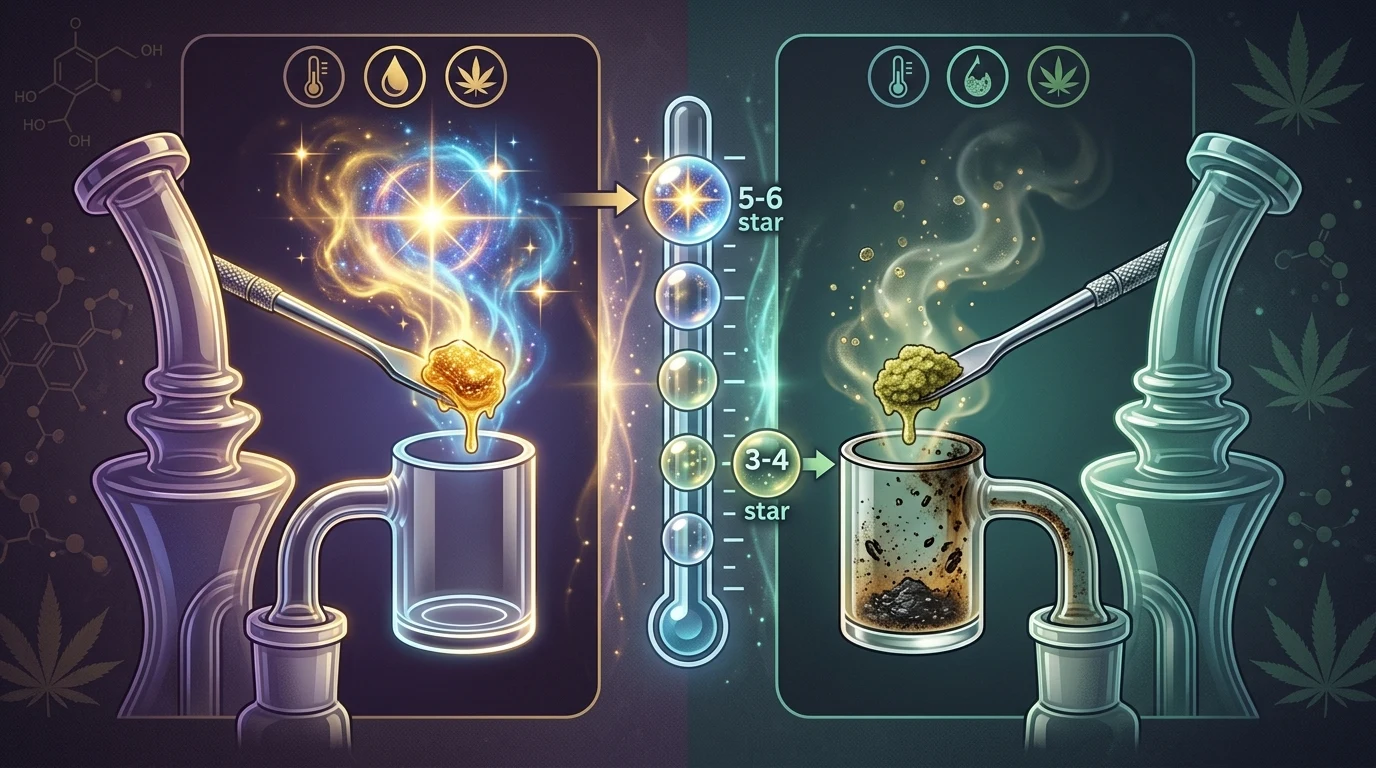
The traditional 1–6 star bubble hash rating system describes how cleanly hash melts when heated and, by extension, how much desirable resin is present compared with plant material and other contaminants.
At the top end sits full melt hash — highly refined bubble hash capable of melting almost completely with very little residue.
Lower down, you'll find products commonly described as half melt or cooking-grade hash.
But here's the important part:
Not everybody needs 6-star hash.
Let's decode the rating system, look at what full melt actually means, and figure out when paying the premium makes sense.
Full melt generally refers to exceptionally clean bubble hash that melts almost completely when heated, leaving very little residue. Half melt contains more plant material and other non-melting material, so it bubbles and partially melts rather than liquefying as completely. The 1–6 star system is a traditional quality shorthand, not a standardized government grading system.
First, What Is Bubble Hash?
Bubble hash is a solventless cannabis concentrate made by separating trichomes from cannabis flower or plant material.
Trichomes are the tiny resin glands covering cannabis flowers.
They're where much of the plant's cannabinoids and aromatic compounds are concentrated.
Instead of using chemical solvents to extract those compounds, bubble hash production typically relies on cold water, ice, agitation, and increasingly fine filter bags.
The cold makes trichome heads brittle enough to separate from the plant material.
The mixture is then filtered through screens with different micron sizes.
What remains is collected, dried, and processed into hash.
Simple idea.
Very difficult to perfect.
Because the goal isn't merely to collect something from the plant.
The goal is to collect as many clean, mature resin heads as possible while bringing along as little unwanted plant material as possible.
And that's where melt quality enters the conversation.
What Does "Full Melt" Actually Mean?
Full melt is basically a description of what happens when high-quality hash meets heat.
Excellent bubble hash contains a very high concentration of resin glands with relatively little plant contamination.
When heated, those resin-rich trichomes melt.
The cleaner the hash, the more complete that melt tends to be.
That's why premium full melt can appear to liquefy and bubble dramatically while leaving relatively little solid residue behind.
Lower-quality hash contains more non-melting material.
Heat it and you'll still see bubbling and melting, but more residue remains afterward.
That distinction matters.
The rating is primarily telling you about resin purity and melt quality.
It isn't a universal measurement of how high you're going to get.
The 1–6 Star Bubble Hash Scale
Here's where things become slightly messy.
The six-star system is widely used in hash culture, but it isn't a standardized laboratory grading system.
One producer's 5-star can potentially look more like another producer's 4-star.
Still, the scale provides a useful general framework.
1-Star Hash
At the bottom of the scale, you're dealing with material containing substantial plant matter and relatively low resin purity.
It won't melt cleanly.
It may barely melt at all.
This grade is generally better suited to uses where pristine melt quality isn't the objective.
Calling it "bad" isn't always useful.
It's simply far removed from what concentrate enthusiasts mean when they talk about full melt.
2-Star Hash
Two-star material represents a step up but still contains considerable non-resin material.
You may see some bubbling when heat is applied, but don't expect anything resembling the clean melt of premium hash.
There's still plenty left behind.
This is another grade where the value tends to come from practicality rather than a connoisseur-level concentrate experience.
3-Star Hash
This is where the term half melt commonly enters the conversation.
Three-star hash can bubble and melt noticeably when heated, but only partially.
Hence:
Half melt.
There's enough resin present to produce obvious melt behaviour, but also enough plant material and contamination to prevent a clean liquefaction.
Depending on quality and price, this can still be perfectly enjoyable hash.
And for many casual consumers, that's an important point we'll come back to.
4-Star Hash
Four-star bubble hash moves closer to the premium end.
You should generally expect cleaner material, stronger melt behaviour, and less residue than lower grades.
This is where the line between "half melt" and "full melt" starts becoming less rigid.
Remember, we're dealing with an informal scale rather than six legally defined categories.
Some people may describe particularly good 4-star material as approaching full melt, while others reserve that term for the very top grades.
The actual behaviour under heat matters more than arguing about vocabulary.
5-Star Hash
Now we're firmly in premium territory.
Five-star bubble hash should contain a high concentration of quality resin and demonstrate excellent melting characteristics.
Very little unwanted plant material should be getting in the way.
For many consumers, 5-star represents an interesting sweet spot.
You can get much of what makes full melt special — flavour, cleanliness, resin quality, strong melt — without necessarily paying whatever premium accompanies the absolute best material from a particular batch.
6-Star Full Melt Hash
This is the top of the traditional scale.
Six-star full melt.
The goal here is exceptional resin purity.
When heated, the material should melt extremely cleanly with minimal residue.
At this level, you're not paying only for cannabinoids.
You're paying for selection.
You're paying for clean resin heads.
You're paying for careful processing.
You're paying for flavour and terpene preservation.
And you're paying for the fact that producing a small amount of exceptional full melt can require starting with considerably more cannabis material.
1–2 stars = low melt. 3 stars = commonly associated with half melt. 4 stars = cleaner, stronger melt. 5 stars = premium melt quality. 6 stars = top-tier full melt with exceptionally little residue.
That's the map.
Just don't mistake it for an official certification system.
Why Does Full Melt Cost So Much?
Look at what producers are actually trying to collect.
Not leaves.
Not stems.
Not random plant particles.
Trichome heads.
And not just any trichomes.
Premium hash production aims to isolate mature resin glands while minimizing contamination and preserving their quality throughout washing, collection, drying, and storage.
That creates a yield problem.
The cleaner and more selective you become, the less material qualifies for the top grade.
Imagine sorting a giant bowl of mixed coins because you're interested only in perfect-condition quarters from one specific year.
You'll end up with a much smaller pile.
Full melt works on a similar principle.
Only certain fractions of a wash may reach the quality expected for the highest grade.
So when you're buying premium full melt, part of the price reflects how little of the starting material actually becomes that final product.
Micron Size Matters — But Don't Turn It Into Another THC Percentage
Bubble bags are measured in microns.
Different screen sizes capture trichome heads and material of different sizes.
You'll commonly see hash identified by micron ranges or specific micron fractions.
Here's the trap:
Consumers sometimes learn that one particular micron fraction produced incredible hash and immediately decide:
That micron = best.
Not necessarily.
Different cannabis cultivars can produce trichomes of different sizes.
Plant maturity matters.
Growing conditions matter.
The starting material matters.
Processing matters.
One cultivar's most desirable resin fraction may not be identical to another's.
Micron size tells you useful information about what passed through one screen and was caught by another.
It doesn't automatically tell you the final quality.
The melt test still has something to say.
Why Does Full Melt Bubble?
Those bubbles are part of where bubble hash gets its name.
When resin-rich hash is heated, the material softens and melts while volatile compounds and trapped gases contribute to bubbling.
Cleaner resin tends to produce more obvious melting behaviour.
But don't reduce the entire quality assessment to:
More bubbles = better.
Heat level matters.
Moisture matters.
Contamination matters.
The material itself matters.
What you're really interested in is the overall behaviour:
Does it melt?
How completely?
And what's left behind?
Half Melt Isn't "Bad Hash"
This is probably the biggest misunderstanding created by the rating system.
People hear:
6-star full melt
and then assume:
3-star half melt = garbage.
That's like saying every bottle of wine below the top shelf is undrinkable.
Half melt can still provide plenty of flavour, potency, and traditional hash character.
It simply contains more non-melting material than full melt.
For a casual user, that may be completely acceptable.
Especially when the price difference is significant.
And that's where buying decisions become much easier.
Is Full Melt More Potent Than Half Melt?
Often, cleaner resin can mean a more concentrated cannabinoid product.
But don't interpret the star rating as a THC scale.
Six stars doesn't mean six times stronger than one star.
And a 5-star product isn't automatically a fixed percentage more potent than 4-star.
The scale is about melt quality and purity.
Actual cannabinoid potency needs actual cannabinoid testing.
This is the same mistake people make with flower when they try to turn one measurement into a complete quality score.
Cannabis rarely cooperates with shortcuts.
What Does Good Full Melt Look Like?
Appearance varies.
Freshness, cultivar, processing, storage, and temperature can all change how hash looks and behaves.
So there isn't one colour that proves you've found 6-star material.
Still, quality full melt should generally appear clean and relatively uniform rather than obviously packed with green plant particles.
Colour can range from lighter blond and golden tones to darker shades depending on the starting material and processing.
Don't assume:
Blond = automatically premium.
Or:
Dark = automatically bad.
Colour is one observation.
Melt behaviour tells you more.
Aroma tells you more.
Cleanliness tells you more.
The complete product matters.
The Aroma Should Still Be There
Premium full melt isn't exciting because it disappears nicely on a hot surface.
The sensory side is a huge part of the appeal.
Quality resin can preserve a concentrated expression of the cultivar's aromatic profile.
Open the container and you may get gas, citrus, fruit, earth, cream, spice, or whatever combination the starting material expressed.
For concentrate enthusiasts, this is often where the premium starts making sense.
They're not simply chasing stronger effects.
They're chasing a cleaner and more expressive version of the plant's resin.
If the hash is expensive, labelled full melt, and smells almost completely dead?
That's worth questioning.
Freshness and Storage Matter Even More at the Top End
Imagine paying a premium for carefully separated resin and then leaving it somewhere warm for weeks.
Not ideal.
High-quality hash can be sensitive to temperature, oxygen, light, and repeated handling.
Its texture can change.
Aromatic compounds can be lost.
The material can oxidize.
The exact storage approach depends on the product and how quickly it's being consumed, but the principle is simple:
The more you're paying for preservation of resin quality and aromatic character, the less sense it makes to store it carelessly.
Premium hash deserves premium handling.
Otherwise, you paid extra for qualities you're allowing to disappear.
Is 6-Star Full Melt Worth It?
Now the useful question.
It depends on what you care about.
If you're a concentrate enthusiast who notices flavour, melt quality, residue, texture, and cultivar expression?
Yes.
Excellent full melt can offer an experience that lower grades don't reproduce exactly.
You're paying for refinement.
But what if you're an occasional hash user?
You consume it casually.
You're not inspecting residue.
You're not comparing micron fractions.
And you mostly want enjoyable hash without turning the session into a judging competition.
Then premium 6-star material may be unnecessary.
A good mid-grade or half-melt product may deliver what you're actually looking for at a considerably better value.
Full melt makes the most sense for consumers who value resin purity, terpene expression, clean melting behaviour, and the concentrate experience itself. Casual users may get better value from good lower-grade hash if those differences aren't particularly important to them.
Buying the highest grade simply because it exists is not automatically the smartest purchase.
When Full Melt Is Probably Worth the Premium
You may appreciate full melt if:
You care heavily about flavour.
You're choosing concentrates partly for terpene expression rather than effects alone.
You already enjoy concentrates.
You'll actually notice the difference between cleaner and dirtier melt.
You care about residue.
Clean melt behaviour is part of the experience you're paying for.
You're interested in the cultivar itself.
You want to experience a particularly good batch through its resin rather than simply consume hash.
You're comfortable paying for diminishing returns.
This one matters.
The difference between average hash and good hash can be huge.
The difference between very good hash and exceptional hash may be smaller while costing considerably more.
That's normal with premium products.
When Half Melt Is Probably Enough
Half melt makes plenty of sense when:
You're new to hash.
There's little reason to start at the most expensive end before you know what qualities you value.
You're budget-conscious.
Good half melt can offer a much friendlier cost-to-enjoyment ratio.
You aren't chasing perfect melt behaviour.
If a little extra residue doesn't bother you, why pay heavily to eliminate it?
You're consuming casually.
Premium full melt is easier to justify when appreciating the concentrate itself is part of the session.
If you're not doing that, you're paying for refinements you may barely notice.
There's no prize for buying the most expensive container.
Buy for your preferences.
How to Read a Bubble Hash Listing
When you're comparing hash, don't stop at the star rating.
Look for more information.
Grade
Is it described as full melt, half melt, or another quality level?
Micron Information
Does the producer identify the micron range or fraction?
Useful information, especially for experienced buyers.
Starting Material
Was it produced from quality flower or fresh-frozen material?
The starting material sets the ceiling for the final product.
You can't separate exceptional resin from plants that never produced exceptional resin.
Aroma and Cultivar
What genetics were used?
What flavour profile should you expect?
Processing and Storage
How was the hash dried and handled?
Premium resin can still suffer from poor post-processing.
Actual Testing
If cannabinoid percentages matter to you, look for testing rather than trying to estimate potency from stars.
The bubble rating answers one question.
Don't make it answer six.
Full Melt vs. Half Melt at a Glance
| Feature | Half Melt | Full Melt |
|---|---|---|
| Typical star range | Around 3-star | Usually 5–6 star |
| Melt behaviour | Partial melt | Near-complete melt |
| Plant material | More | Very little |
| Residue | Noticeable | Minimal |
| Resin purity | Moderate | High to exceptional |
| Price | Lower | Premium |
| Best for | Casual/value-focused users | Concentrate enthusiasts |
| Does it guarantee higher THC? | No | No |
| Is it automatically better value? | Depends | Depends |
The final two rows matter most.
More expensive doesn't automatically mean better value for you.
Don't Get Too Obsessed With the Stars
There's an irony here.
The star system exists to make hash quality easier to understand.
Then people turn it into another number to chase.
Six must be better than five.
Five must be better than four.
Therefore, always buy six.
That's not how personal value works.
A 6-star product can be objectively cleaner-melting while a 4-star product may still be the purchase you enjoy more for the money.
Price matters.
Flavour preference matters.
Freshness matters.
The cultivar matters.
Your experience level matters.
And because the rating system isn't universally standardized, the producer's consistency matters too.
Frequently Asked Questions
Full melt refers to highly refined hash that melts almost completely when heated and leaves very little solid residue. It generally contains a high concentration of resin glands with minimal plant material or other non-melting contamination.
Half melt generally refers to bubble hash that noticeably bubbles and melts when heated but leaves more residue than full melt. It's commonly associated with the middle of the traditional bubble hash grading scale and can still provide an enjoyable hash experience.
Six-star is traditionally used for the highest grade of full melt bubble hash, indicating exceptional resin purity and very clean melting behaviour. However, the 1–6 star system isn't a standardized government grading system, so quality can vary between producers.
Full melt may be highly concentrated because of its resin purity, but the star rating itself doesn't directly measure THC potency. Actual cannabinoid testing is needed to compare strength accurately.
Producing exceptional full melt requires high-quality starting material and careful separation of clean resin glands from plant matter. Only a portion of the collected material may meet top full-melt standards, which limits yield and contributes to the higher price.
Not necessarily. Beginners and casual hash users may find good half-melt or lower-priced bubble hash offers better value. Six-star full melt makes more sense when you specifically appreciate clean melt behaviour, resin purity, flavour, and terpene expression.
Not automatically. Colour can be influenced by genetics, maturity, processing, oxidation, and storage. Melt behaviour, cleanliness, aroma, freshness, and overall quality are more useful than judging hash from colour alone.
The Bottom Line on Full Melt vs. Half Melt Hash
The 1–6 star bubble hash scale becomes much less confusing once you understand what it's actually trying to describe.
It's primarily about melt quality and resin purity.
At the lower end, more plant material remains and the hash melts less completely.
Around the middle, you get what people commonly call half melt — noticeable bubbling and melting, but plenty of residue remains.
At the top, 5- and particularly 6-star full melt represents exceptionally clean resin that can melt almost completely.
That quality commands a premium because producing it requires excellent starting material, careful processing, and aggressive selection of the best resin fractions.
But don't make the mistake of assuming everyone needs it.
If you're deeply into concentrates, flavour, terpene expression, and clean melt behaviour, full melt can absolutely justify the extra money.
If you're an occasional hash user who simply wants a good experience?
A quality half melt may make far more sense.
Six stars tell you something about the hash.
They don't tell you how much you need to spend.