 %
%
 %
%
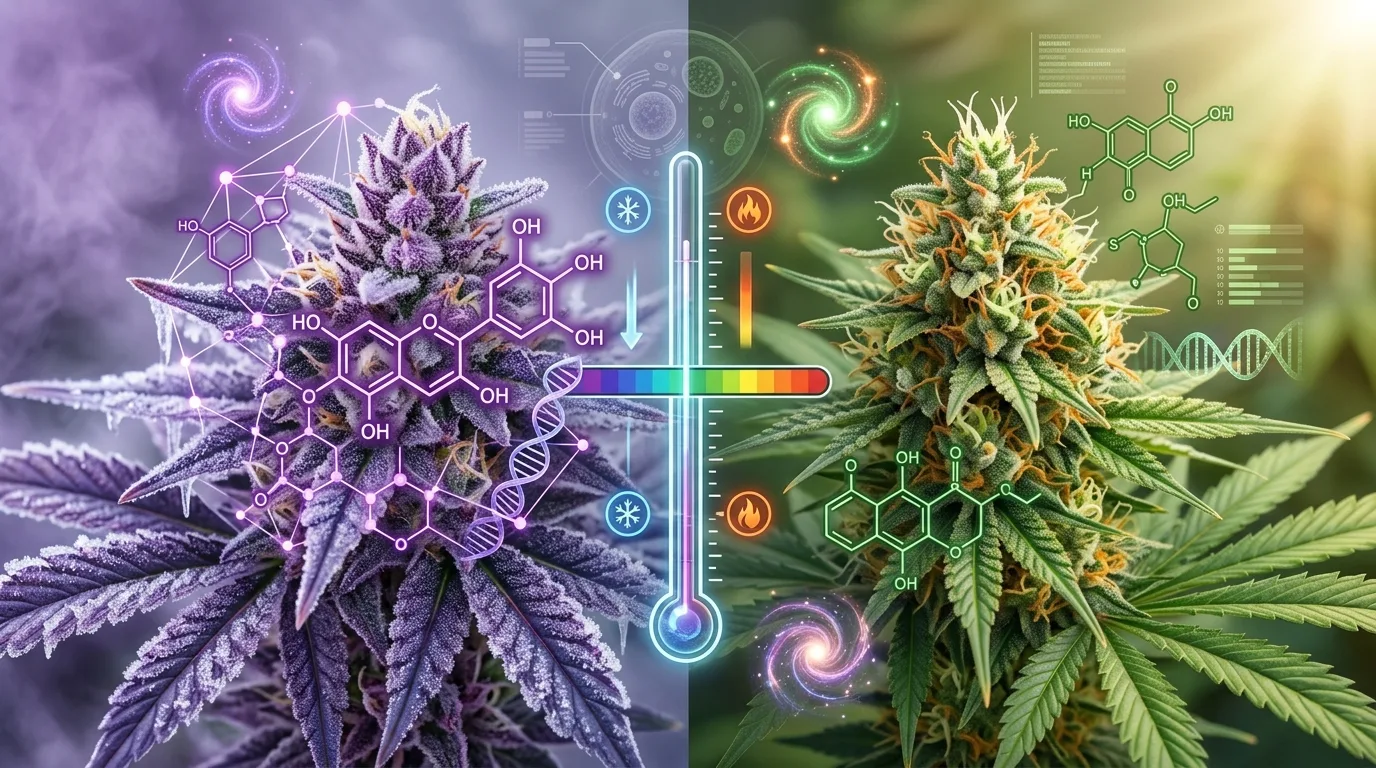
Purple buds sell.
They photograph beautifully, stand out on a menu full of green, and carry an aura of being something special. A noticeable number of buyers will pay more for them and assume they're getting something stronger.
They're getting a pigment.
The same family of pigment that makes blueberries blue, red cabbage red and autumn leaves change colour is present in cannabis for similar reasons: genetics, environment and plant chemistry that have essentially nothing to do with cannabinoid content.
That doesn't make purple flower bad, and some genuinely excellent cultivars happen to express it. But the belief that colour signals potency is one of the most durable pieces of misinformation in cannabis retail, and it can cost people money.
What's Actually Producing the Colour?
The pigments responsible are anthocyanins, a family of water-soluble compounds found throughout the plant kingdom. They're what gives blueberries, blackberries, red cabbage, eggplant skin and purple sweet potatoes their colour.
Anthocyanins are pH-sensitive, which is why the same compound family can produce a range of colours. In more acidic conditions, they tend toward red and pink; in more neutral to alkaline conditions, they can shift toward purple and blue.
Crucially, anthocyanins are not cannabinoids and not terpenes. They're a separate class of compound entirely, with no established relationship to the compounds responsible for cannabis's effects.
Chlorophyll Is the Other Half
Purple pigments can be present in a plant long before you can see them, masked by chlorophyll.
Green is a dominant colour.
As a plant approaches the end of flowering, chlorophyll production slows and existing chlorophyll breaks down. Whatever anthocyanin content was already present becomes more visible as the green fades.
This is essentially the same mechanism behind the colour changes seen in autumn leaves.
So in many cases, purple appearing late in flower isn't necessarily the plant producing a sudden burst of new pigment. It's the plant losing the green that was covering it.
What Triggers Purple Colour?
Genetics, First and Foremost
A plant can only turn purple if it carries the genetics to produce anthocyanins in meaningful quantities.
No amount of environmental manipulation will make a cultivar reliably purple if it doesn't have the genetic capacity for it.
This is why certain lineages are reliably purple while most remain predominantly green. Breeders have selected for this trait partly because it can be visually appealing and commercially attractive.
It's also why the same strain name can arrive purple from one grower and green from another.
Different phenotypes of the same cross can express anthocyanins differently. Our guide on why the same strain is different everywhere covers this in more detail.
Temperature
Temperature is one of the most commonly cited environmental influences on purple expression.
Cooler nighttime temperatures in late flowering can accelerate chlorophyll breakdown and, in cultivars with the genetics for it, make purple pigmentation more visible.
This is one reason outdoor flower harvested late in a Canadian autumn can sometimes show more colour. Cool September and October nights can contribute to the effect.
Some growers deliberately reduce nighttime temperatures during the final stages of flowering to encourage colour.
There is a trade-off, however. Cold stress isn't necessarily beneficial to the plant, and prioritising colour over overall plant health can potentially come at the expense of yield or resin development.
pH and Nutrients
Growing-medium pH can influence how anthocyanins express their colour, while certain nutrient conditions can also affect pigment production.
These are generally smaller factors than genetics and temperature.
Aggressively manipulating pH or nutrients simply to chase purple colour can create other problems for the plant.
What Doesn't Cause Natural Purple Colour
Ice-water flushing, freezing the plant, or putting cut branches in the freezer can produce colour changes through tissue damage and chlorophyll destruction rather than genuine anthocyanin expression.
These methods can damage the flower rather than creating desirable natural pigmentation.
Food colouring or dye is another issue.
Artificially coloured cannabis is adulterated. Our guide on how to spot adulterated cannabis covers the checks to look for.
Signs can include unnaturally uniform colour, colour appearing on stems and interior tissue in ways that don't match natural distribution, and pigment transferring onto wet fingers.
Purple Does Not Mean Potent
This is the central point.
Purple colour does not mean higher THC.
Anthocyanins are pigments, not cannabinoids, and there is no established mechanism showing that having more anthocyanin automatically means producing more THC.
A deep purple bud can test at 15% while a green one tests at 28%, or the reverse.
Colour simply isn't a reliable way to estimate cannabinoid potency.
Our article on what THC percentage actually measures explains why potency figures themselves can be weaker signals than people assume.
Colour is weaker still.
Does Purple Cannabis Taste Different?
Anthocyanins are largely tasteless at the concentrations present in cannabis.
The flavour of a purple cultivar comes primarily from its terpene and other volatile compound profile, just as it does with green flower. Those characteristics are influenced by genetics, cultivation, harvesting, curing, and storage.
Many purple lineages do happen to carry distinctive grape, berry, or wine-like flavour profiles.
But that's a correlation produced by breeding, not evidence that the purple pigment itself creates those flavours.
Breeders selecting for purple appearance may also select for particular flavour characteristics because both traits can be commercially appealing.
What Actually Predicts Cannabis Quality?
| Signal | Tells You | Reliability |
|---|---|---|
| Aroma on opening | Cure quality, freshness, terpene content | High |
| Trichome condition | Handling, maturity, resin condition | High |
| Squeeze and stem snap | Moisture and cure | High |
| Ash colour | Possible information about burn and product characteristics | Moderate |
| Grade letter | Overall product assessment | Moderate |
| THC percentage | One cannabinoid measurement from a sample | Low |
| Colour | Genetics and environmental influences | Essentially none |
Colour sits near the bottom of the list.
Our guide on how to tell if flower was cured properly covers several of the more useful checks, many of which can be done in under a minute.
So Should You Buy Purple Flower?
Buy it if you like how it looks, or if it happens to be a cultivar whose profile suits you.
Both are perfectly valid reasons.
Just don't pay a premium for the colour itself.
If two otherwise comparable options are priced differently and the main difference is colour, you're effectively paying for visual appeal.
Run the same checks you'd use on any other flower.
A purple bud that smells faint, crumbles when squeezed, or has poorly preserved trichomes can still be poor flower that happens to look attractive.
Our flower and AAAA listings can help you compare products based on factors beyond colour, while same-day weed delivery in Ottawa makes ordering convenient.
Frequently Asked Questions
Purple cannabis typically gets its colour from anthocyanins, a family of water-soluble pigments also found in blueberries, red cabbage and autumn leaves. A plant needs the genetics to produce these pigments, and the colour can become more visible late in flowering as chlorophyll breaks down and stops masking the existing pigment.
No. Anthocyanins are pigments, not cannabinoids, and there is no established mechanism linking purple colour directly to higher THC production. Purple flower can be potent or less potent, just like green flower. Colour alone is not a reliable indicator of cannabinoid content.
Cooler nighttime temperatures in late flowering can accelerate chlorophyll breakdown and reveal anthocyanins in cultivars that have the genetics for purple expression. Cold alone will not reliably make a plant purple if the genetics are not present. Deliberately stressing a plant to force colour can also create other cultivation trade-offs.
Anthocyanins themselves are largely tasteless at the concentrations found in cannabis. Some purple cultivars have grape, berry or wine-like flavour profiles, but this is generally related to their genetics and terpene composition rather than the purple pigment itself.
Artificially colouring cannabis can occur and would be considered adulteration. Potential warning signs include unusually uniform colour, colour appearing on stems or interior tissue in unnatural patterns, and pigment transferring onto damp fingers. Breaking a bud open can help you assess whether the colour distribution looks natural.
Not for the colour alone. Buy purple flower if you like its appearance or if the specific cultivar suits your preferences, but colour is one of the least informative quality signals on a cannabis listing. Aroma, trichome condition, moisture, cure and overall freshness provide more useful information about the flower.
The Short Version
Purple cannabis gets its colour primarily from anthocyanins, the same family of pigments found in blueberries and autumn leaves.
The colour becomes more visible when chlorophyll fades late in flowering, and genetics determine whether a plant can express significant amounts of anthocyanins in the first place.
Cooler temperatures can encourage the expression of purple colour in genetically capable plants, but purple does not mean more potent.
It doesn't reliably tell you anything about THC content, flavour, or cure quality.
When buying flower, look beyond the colour.
Smell the jar, inspect the trichomes, check the texture, and consider the cure.
Those signals can tell you considerably more about the flower than whether it's purple or green.