 %
%
 %
%
They look like something that shouldn't be on a menu.
Dense, lumpy, almost grey-green, and so thickly coated in crystal that the bud underneath is barely visible. The price is often three or four times standard flower per gram, and the listing usually says something about extreme potency without explaining what's actually in it.
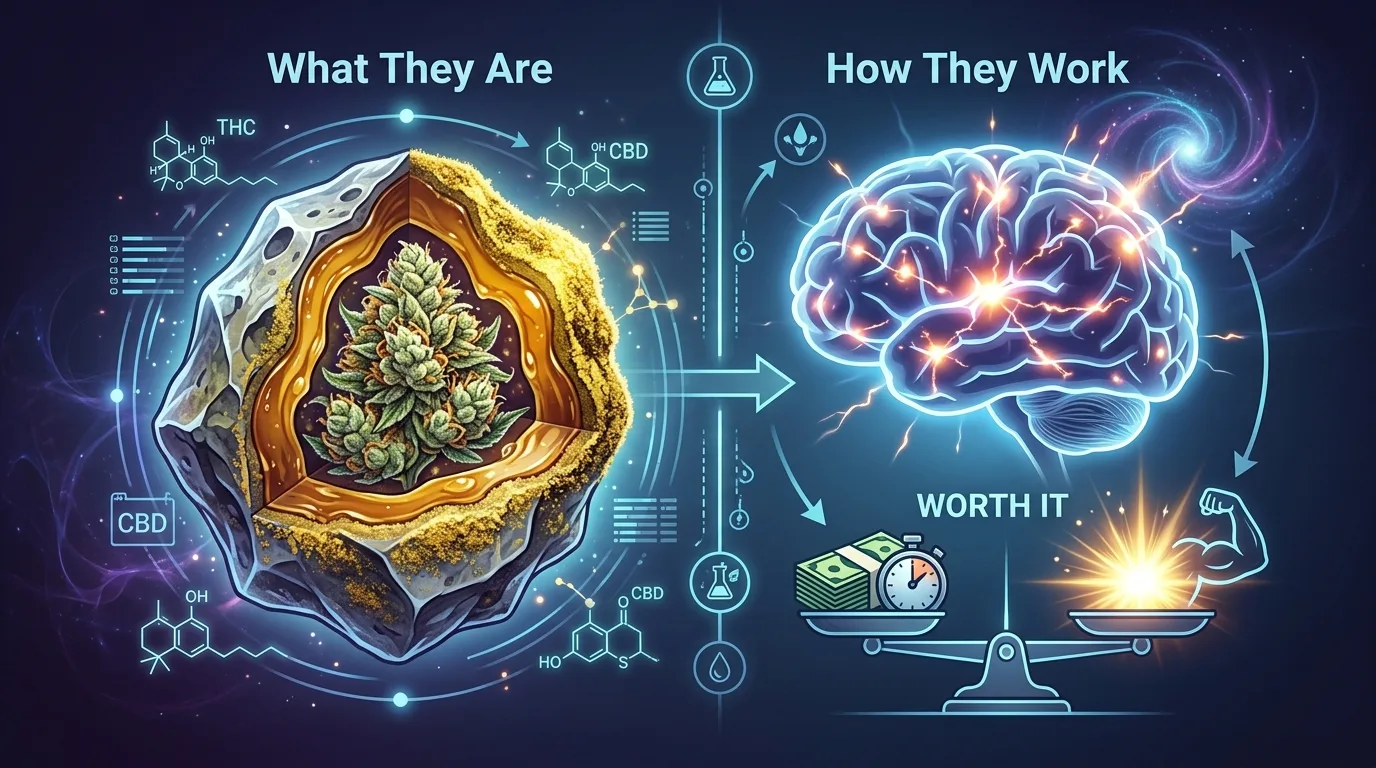
Moon rocks aren't a strain and they aren't a concentrate. They're an assembly: a bud, coated in a cannabis extract, then rolled in kief.
Three products stacked on top of each other, which is both why they're potent and why they behave so differently when you treat them like regular flower.
They're also one of the few products where the question "Would I be better off buying the components separately?" has a genuinely interesting answer. It depends on something most people don't think about until after they've bought one.
What's Actually in One?
The Three Layers
The core: a bud. Usually a dense, firm cultivar, since loose, airy flower can fall apart during the coating process.
The coating: a cannabis extract. Traditionally hash oil or distillate, warmed until it flows and then applied to the bud. The choice of extract matters enormously and is one of the biggest quality variables.
The outer layer: kief. The coated bud is rolled in sifted trichomes, which stick to the extract and form the characteristic crystalline shell. Our kief guide covers what that material actually is.
Caviar, and Why the Names Are Inconsistent
Terminology in this category is genuinely unstandardised, and sellers use the words differently.
Caviar sometimes means a bud dipped in extract without the kief layer, making it the two-layer version of a moon rock. In other contexts, it can refer to flower cured in hash oil, while some sellers use the term for specific concentrate textures that are unrelated to flower.
Infused flower is the broadest and most straightforward term: flower with concentrate added by some method.
Moon rocks is the most consistent term of the three and generally refers to the full three-layer version.
Because none of these terms are completely standardised, read the listing description rather than trusting the product name alone. If a listing doesn't say what extract was used, that's worth asking about.
Potency: What's Reasonable to Expect?
Listings in this category frequently claim figures in the 50% to 60% THC range, and those numbers should be treated with some scepticism.
The arithmetic isn't necessarily implausible. If a 20% flower is coated with a 70% to 80% extract and dusted with kief, the weighted result can be substantially higher than the flower alone.
But the actual figure depends entirely on the ratio of the three components. That ratio can vary by maker, batch, and even individual piece.
More importantly, these products are not necessarily tested as finished assembled products. A stated percentage may be an estimate based on the component inputs rather than a laboratory result from the finished moon rock itself.
What's reasonably reliable is that a moon rock can be substantially stronger than the flower it was built on.
What's less reliable is any specific THC percentage unless it comes from appropriate testing of the finished product.
Our article on what THC percentage actually measures explains why these figures can carry less information than they appear to, and the problem can be even greater with assembled products.
Why They Burn Badly
This is the practical issue nobody warns people about, and it causes much of the disappointment.
Oil Doesn't Burn Like Flower
The extract coating melts before it burns, which means it can run, drip, and pool rather than maintaining an even cherry.
A moon rock placed directly into a bowl can melt into a sticky mass at the bottom.
They Won't Stay Lit
The high oil content can smother the burn.
Expect to relight repeatedly throughout a bowl. That's a characteristic of the product rather than necessarily a defect.
They're Very Dense
Airflow through a coated bud is restricted, which compounds the problem of keeping it lit.
They Can Run Hot and Harsh
The extra heat needed to keep them burning can produce harsher smoke than regular flower, while the extract contributes its own characteristics.
They Can Waste Easily
Material that melts and drips down the side of a bowl is material you paid a premium for but didn't inhale.
How to Actually Use One
Never put one in a grinder.
This is the first and most important rule. The extract coating can gum up the teeth, coat the screen, and make the grinder difficult to use without a thorough cleaning.
Our cleaning guide covers the process, but avoiding the mess in the first place is easier.
Break it with scissors or your fingers.
Scissors are cleaner. Cut rather than crush, and break the moon rock into small pieces.
Use glass, not paper.
A pipe or bong can handle the melting extract better than a joint and provides a contained surface for material that liquefies. Rolling moon rocks into a joint is possible but can be messy and prone to running.
Put flower underneath.
A base layer of regular flower in the bowl gives the melting extract something to soak into instead of pooling directly on glass. This can significantly improve the experience.
Use a low flame and corner it.
Burn a small section at a time rather than applying the flame to the entire bowl. Hemp wick can also be used if preferred.
Expect to relight.
That's normal with this type of product.
Wash your hands afterwards.
The coating can transfer readily.
Should You Buy Moon Rocks or Buy the Parts?
Here's the comparison that matters.
| Factor | Buying Moon Rocks | Buying Components Separately |
|---|---|---|
| Cost per gram | High | Lower for equivalent material |
| Convenience | Ready to use | Requires assembly or layering |
| Control over ratio | None | Complete |
| Control over extract quality | None, often undisclosed | Full |
| Burn behaviour | Poorer | Better, since you control the amount |
| Consistency | Varies piece to piece | Depends on what you select |
The Case for Buying Them
The honest case for buying moon rocks is convenience, novelty, and the experience of something genuinely different.
They're a treat purchase, and there's nothing inherently wrong with that.
The Case Against
You can achieve a similar result by topping a bowl of good flower with a small amount of hash or kief.
That gives you:
-
Lower overall cost
-
Better control over the amount of concentrate
-
Better burn behaviour
-
More control over the quality of each component
-
A clearer idea of exactly what you're consuming
Our full melt hash guide covers which hash grades can work well for topping a bowl.
The Quality Pitfall
The single biggest concern with this category is that moon rocks can hide mediocre flower.
The bud underneath is almost completely concealed. A core of poorly cured, airy, lower-quality flower can look similar to better flower once it's coated in extract and kief.
You can't perform many of the usual checks because the coating makes it difficult to:
-
Smell the underlying flower
-
See its trichome structure
-
Assess its density
-
Evaluate the cure
-
Inspect the flower properly
Our guide on how to tell if flower was cured properly covers checks that simply aren't as useful when the flower is covered in extract and kief.
Combine that with a cheaper distillate coating, which may provide less terpene character than a flavour-rich extract, and you can end up paying several times the price of standard flower while having limited visibility into the quality of the underlying components.
What should you look for?
A seller that clearly states:
-
What the core flower is
-
What extract was used
-
What type of kief was used, when relevant
-
How the product was assembled
If those details are disclosed, you have more information with which to judge the product.
If none of them are disclosed, you're buying a sealed box.
Dosing
Treat moon rocks as considerably stronger than ordinary flower and start with less than you might normally use.
A small piece can be a reasonable starting point for someone with established cannabis tolerance. Use it, wait, and assess the effects before considering more.
The same principle of self-regulation that applies to flower is especially important here because the potency of an assembled product can be difficult to estimate precisely.
If you're new to cannabis or returning after a long break, moon rocks are generally not the most predictable product to start with.
Our hash, concentrates, and flower sections cover the individual components if you'd rather choose them separately, and weed delivery in Ottawa covers them in one order.
Frequently Asked Questions
Moon rocks are cannabis buds coated in a cannabis extract, usually hash oil or distillate, and then rolled in kief. The three components are assembled into one product, which can make the finished piece substantially more potent than the flower it was built on. Moon rocks are an assembled product rather than a strain or a concentrate in their own right.
Terminology isn't standardised in this category. Caviar often means a bud dipped in extract without the kief layer, making it a two-layer version, although some sellers use the term for other products. Moon rocks generally refers to the full three-layer combination of flower, extract and kief. Read the product description rather than relying only on the name.
It's best not to. The extract coating can gum up the teeth and coat the screen, making the grinder difficult to use until it is thoroughly cleaned. Break moon rocks apart with scissors or by hand instead, cutting rather than crushing them into smaller pieces.
The high extract content can interfere with combustion, while the dense coated bud can restrict airflow. These characteristics are normal for moon rocks. Using a base layer of regular flower underneath can give the melting extract somewhere to soak into rather than pooling, while a low flame and smaller sections can make the product easier to manage.
Treat stated figures with some scepticism unless they are supported by testing of the finished product. The combined potency can be high because the product contains flower, extract and kief, but the ratio of those components varies by maker, batch and individual piece. A stated percentage may be estimated from the component inputs rather than measured directly from the assembled product.
As a novelty or occasional treat, they can be worth trying. As a regular purchase, they may offer less value because you can create a similar combination by topping good flower with hash or kief while having more control over quality, quantity and cost. The bigger concern is that the coating can hide the quality of the flower underneath.
The Short Version
A moon rock is flower + extract + kief.
It's genuinely stronger than standard flower, genuinely more difficult to smoke, and difficult to inspect because many of the quality signals you'd normally use are hidden beneath the coating.
If you buy one:
-
Use scissors rather than a grinder.
-
Use glass rather than paper.
-
Put regular flower underneath.
-
Use a low flame and work in small sections.
-
Expect to relight.
-
Start with a small amount.
And before buying, consider whether topping a bowl of flower you can actually inspect with a little hash or kief gets you most of the way there.
It can cost less, give you better control, and let you know exactly what you're smoking.